

Key Takeaways
- Compliance planning decides how fast a medical device software reaches FDA or EU MDR clearance, and that planning belongs at the start of development.
- A seven-layer architecture, covering everything from edge devices to model governance, forms the foundation every clinical-grade AI system needs.
- Validation, security, and traceability built into each sprint remove the rework that stalls submissions built without this discipline.
- A partner with direct FDA and EU MDR submission experience reduces architecture risk and shortens the path from prototype to a production-ready device.
Why Is AI Medical Device Software Now a Strategic Engineering Priority?
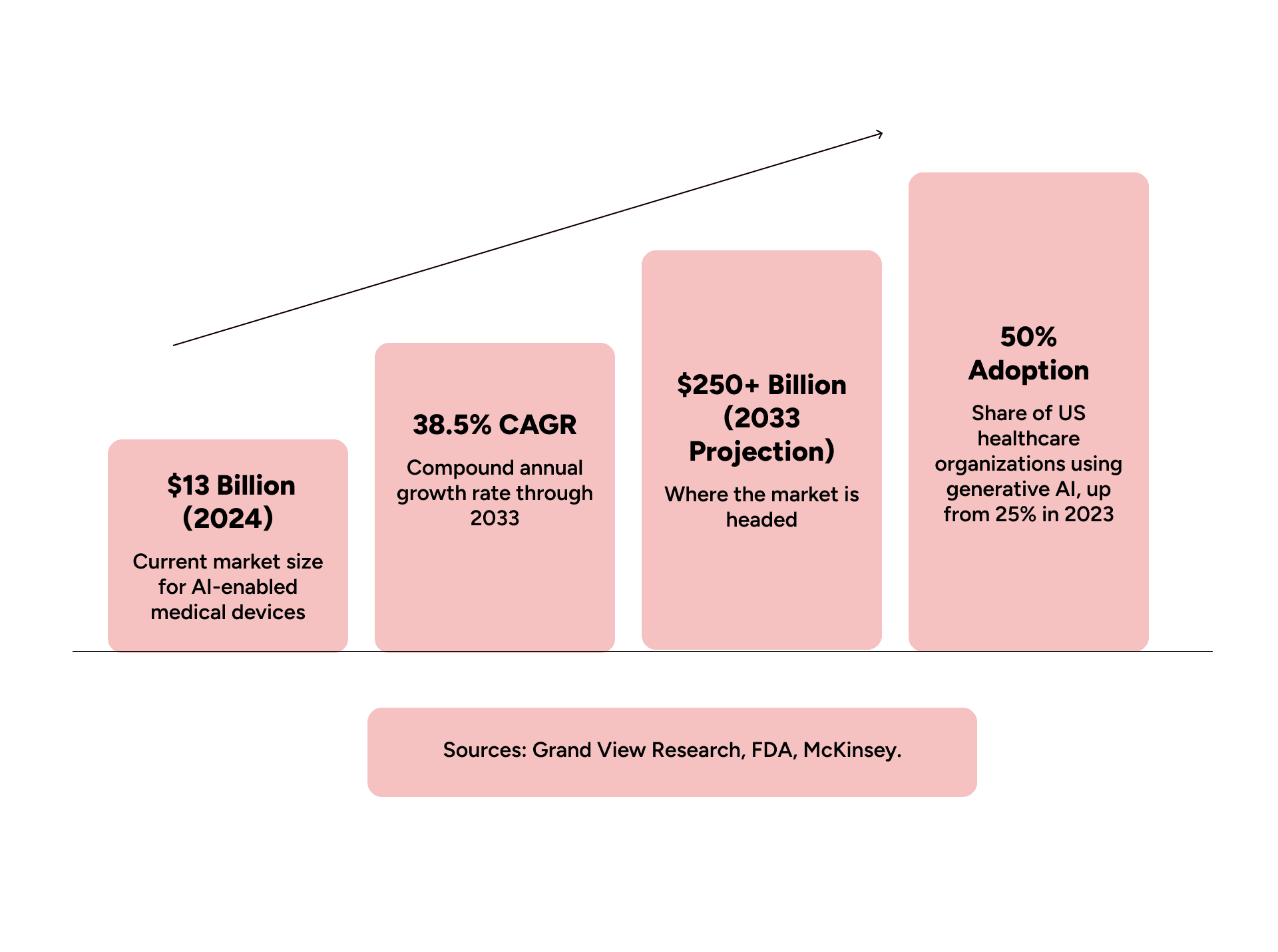
The AI-enabled medical device market grew past $13 billion in 2024 and moves toward a projection above $250 billion by 2033, a compound annual growth rate of 38.5%, according to Grand View Research. The FDA has cleared a growing roster of AI/ML-enabled medical devices through the 510(k) and De Novo pathways, with radiology accounting for the largest share of authorizations. A recent McKinsey survey found that half of US healthcare organizations have implemented generative AI, a jump from 25% in late 2023.
AI-enabled diagnostics assist radiologists and pathologists during patient review. Remote monitoring tools track vitals outside hospital walls. Connected devices push readings into cloud platforms built for real-time analysis. Model governance and regulatory scrutiny remain at the center of every one of these builds, since every unverified edge case in medical device software carries the weight of a potential compliance finding.
Standard software development tolerates iteration and retrospective documentation. Medical device software development offers no such flexibility. A design decision left unrecorded becomes an audit gap. A validation step skipped in an early sprint resurfaces at submission, as a full redesign.
Software as a Medical Device (SaMD) grew because compliant products delivered results clinicians and payers could trust. Digital therapeutics, connected monitoring platforms, and AI-driven clinical tools built a distinct category of regulated software, one that operates outside the physical boundaries of traditional hardware devices.
This guide speaks to VP Engineering, platform leaders, and digital product leaders working inside healthcare and MedTech organizations, the people responsible for architecture decisions, vendor selection, and delivery timelines tied to regulatory clearance. It covers the full scope of AI medical device software development: compliance planning, architecture, the development process, AI lifecycle governance, data governance, and partner selection.
Every healthcare client conversation we have this year opens with the same question: how fast can we reach clearance without cutting corners. Five years ago, few clients asked it at all. The organizations winning this cycle learned the cost of a compliance gap at submission. That lesson shapes every engagement we take on.
 Kunal KumarChief Revenue Officer
RFPs used to open with a feature list. Now they open with a compliance timeline, and that shift tells you where budget authority has moved inside these organizations. A year ago, engineering led the vendor conversation and compliance signed off near the end. Today, compliance and quality get involved from the first call, and a vendor without a real answer on IEC 62304 experience gets filtered out before the technical discussion even starts. The deals moving fastest through procurement right now are the ones where a client's compliance lead has already reviewed our submission history before their CTO does.
What Are the Core Challenges in Medical Device Software Development?
Building software for connected medical devices creates real opportunities for care delivery, and it introduces complexity. Teams that address this complexity in early planning stages keep their programs compliant, safe, and on schedule.
Why Does Regulatory Documentation Sit at the Center of the Challenge?
Standards such as the EU Medical Device Regulation, ISO 13485, IEC 62304, and ISO 14971 require traceability and risk management across every software component, from embedded firmware to cloud systems. A gap in that record can delay certification or block market entry.
How Does Change Control Complicate Medical Device Software Development?
A single code change inside a regulated system calls for a documented risk assessment, regression testing, and in many cases a regulatory notification. Deployment cadences built for consumer software collide with validation cycles built for clinical safety, and that collision drives up both timeline and cost when teams discover it mid-project.
Why Does Interoperability Introduce a Direct Safety Risk?
A clinical algorithm that processes incomplete or malformed electronic health record data puts a patient at risk with every faulty output it generates. Data quality governance belongs to the clinical safety function.
Why Do Hardware and Software Timelines Create Certification Delays?
Hardware and software teams work on separate timelines, yet regulatory classification applies to the complete system. A device stalls at certification when one half of the build waits on the other, and costs climb with every week of delay.
What Challenge Does AI Add to Medical Device Software?
AI adds a final layer to this stack, since a model deployed inside a medical device needs monitoring built into its initial architecture, and regulators expect continuous performance tracking once that model reaches the market.
What Types of AI Power Medical Device Software Engineering?
Choosing the right model type during initial planning prevents costly architectural rewrites later in development:
- Diagnostic and imaging models interpret radiology, dermatology, and ophthalmology data through pattern recognition.
- Risk prediction models flag adverse events before they occur, calibrated to avoid alert fatigue.
- Clinical decision support models combine structured data and rule-based logic to guide treatment recommendations
- Wearable and remote monitoring models process continuous sensor data to detect physiological shifts.
- Surgical assistance models interpret motion and instrument trajectories inside controlled feedback loops built under strict testing standards.
Matching each model type to its data and validation needs keeps performance stable in clinical settings.
How Does AI Model Development Differ From Standard SaMD Development?
Building AI models for a medical device demands more than standard software development does. Training data quality determines clinical safety, which means datasets need documented provenance, consistent labeling standards, and validation sets kept separate from training data to produce an honest measure of performance. Model performance thresholds get defined before deployment and hold through the validation process.
Bias checks run against demographic and clinical subgroups, since an AI model performing consistently in aggregate can still fail specific patient populations. Explainability features, such as confidence scores or interpretability reports, give clinicians a concrete basis for a given output. Human-in-the-loop review keeps a clinician inside the decision path for high-risk results.
Locked models remain fixed after clearance and change through a new submission. Adaptive models continue learning after deployment, a difference that introduces drift monitoring, defined retraining triggers, and version-controlled updates tied to a predetermined change control plan.
Building each of these controls calls for coordination across engineering, clinical, security, quality, and regulatory teams from the first sprint. No single team holds the complete picture of how a model behaves once it reaches a real patient population.
What Does the AI Medical Device Development Process Look Like From Discovery to Production?
Discovery is where most medical device builds either earn their timeline or lose it. Teams that skip the clinician interviews at the start end up redoing requirements work three sprints in, once a workflow assumption turns out wrong. The builds that stay on schedule are the ones where discovery took the extra two weeks it needed before architecture decisions got locked.
 Manav GoelPrincipal Technical Consultant.
Building AI medical device software follows a lifecycle where each stage produces the evidence the next stage needs. Nothing here runs in isolation.
Phase | What Happens | Evidence Created |
|---|---|---|
Discovery | Intended use, risk classification, clinician workflow | Intended use statement, initial risk file |
Architecture | Data flow, integrations, security controls | Architecture diagram, data flow map |
Prototype | Core ingestion or inference proof | Prototype test results |
V&V | Performance, safety, interoperability testing | Test reports, traceability matrix |
Launch | Release controls and monitoring | Deployment records, monitoring plan |
How Does Discovery Shape the Rest of the Build?
Discovery defines the clinical problem AI will solve, the device's risk classification, and the data available to train against it. Engineering teams interview clinicians to surface workflow gaps, decide which functions need machine learning and which stay rule based, and set measurable accuracy, latency, and safety targets before writing a line of code. Compliance planning starts in this same phase, since risk classification determines the regulatory pathway the entire build follows.
Where Does Architecture and Workflow Design Fit?
Architecture and data flow design map how information moves between device, cloud, and clinical application layers. Clinical workflow design runs alongside it, shaping interfaces clinicians can trust during high pressure moments, tested through prototypes before a single feature reaches production code.
How Does the Team Move From Prototype to Production?
Data pipeline setup and model training come next, built on datasets vetted for clinical variation and structured for reproducibility. Teams build a limited prototype first, one that proves core functions such as data ingestion or basic inference, before scaling toward full feature scope. Verification and validation testing follow, checking model performance against conditions drawn from real clinical use, not controlled lab settings alone. Security and interoperability testing round out this stage, simulating signal dropouts, load spikes, and malformed data ahead of deployment.
What Happens After Deployment?
Deployment includes release controls built for a regulated environment, paired with monitoring dashboards tracking real-world performance from launch day. Post-market monitoring connects to model retraining, since patient populations shift and clinical practices change over time.
Where Does Agile Fit Inside a Regulated Process?
Agile methods suit discovery, prototype iteration, and UX design, where fast cycles surface problems early. Verification, validation, and formal submission stages need fixed gates, built around documented evidence tied to a locked scope. Teams that build documentation continuously, capturing evidence at each sprint, avoid the late-stage rework that stalls a submission.
What Security, Privacy, and Interoperability Requirements Shape Cloud Infrastructure for AI Medical Device Software?
Security and privacy controls belong inside the architecture from the first design review, built alongside every other system decision from initial concept through deployment.
Authentication and role-based access control determine who reaches patient data and what actions each role can perform. Encryption protects data in transit and at rest, while audit logs create a record investigators can trace back to a specific action, user, and timestamp. Vulnerability management and a Software Bill of Materials give reviewers visibility into every component running inside the system, a requirement built into FDA premarket submission guidance.
Device-to-cloud communication needs secure APIs, identity and access management, and network segmentation limiting how far a breach in one component can spread. Cloud monitoring and incident response protocols close the loop, giving teams a documented path from detection to resolution.
Interoperability determines whether clinical data reaches the point of care complete and usable. Connections to EHR and EMR systems through HL7 and FHIR standards, alongside imaging systems, labs, and healthcare data platforms, all depend on this same infrastructure holding up under real clinical volume.
Weak infrastructure decisions surface as compliance gaps, unplanned downtime, or lost clinical trust, and each of these carries a cost that grows as the platform scales toward more patients and more connected systems.

What Mistakes Delay AI Medical Device Software Launches, and What Practices Prevent Them?
Most delays trace back to a small set of recurring mistakes, each with a practice that closes the gap before it costs a program its timeline.
Skipping risk classification before architecture begins
Teams that lock architecture before confirming IEC 62304 classification tend to rebuild their documentation infrastructure mid-project once the real risk class becomes clear. Classifying risk first keeps that rebuild off the roadmap.
Building requirements traceability after the fact
A traceability matrix assembled after development creates gaps between what was designed, built, and tested, and a gap here is grounds for FDA submission rejection. Building the matrix from day one, with every requirement tied to a design spec and a test case, removes that exposure.
Treating security as a pre-launch task
Threat modeling, SBOM generation, and penetration testing scheduled as cleanup work before submission tend to surface gaps too late to fix without delay. Scheduling this work as sprint-level engineering, alongside every other build task, keeps security findings from becoming submission blockers.
Rushing data migration and integration
Compressed timelines around HL7, FHIR, and legacy system integration produce incomplete or inconsistent patient data, a risk to both safety and compliance. Planning data integration as a full engineering task, with the same scrutiny given to core features, protects data quality from the start.
Underestimating change management
A system clinicians never trained on faces resistance regardless of its technical performance. Workflow alignment and structured onboarding built into the development timeline determine whether adoption happens at all.
Treating the system as a one-time delivery
Regulations, security expectations, and clinical needs shift after launch, and a system built without a lifecycle plan becomes costly to maintain within a few years. Planning for retraining, monitoring, and periodic compliance review from the outset keeps maintenance costs predictable.
Should You Build In-House, Augment Your Team, or Partner for AI Medical Device Software Development?
The right structure depends on which capabilities exist inside the organization today and which ones need to scale fast.
Building in-house works when the team carries deep healthcare software experience, AI/ML engineering strength, and a track record moving through FDA or EU MDR submissions. Augmenting an existing team with specialized talent fits a gap in one or two capability areas, such as security engineering or QA automation, without disrupting a program in motion. Partnering with a specialized engineering firm fits teams building AI medical device software for the first time, or teams facing a compressed timeline against a fixed submission date.
A capable software development partner brings coverage across AI/ML engineering, healthcare software engineering, cloud and DevOps, security engineering, UX for clinical workflows, interoperability, QA automation, compliance-aware documentation, and production support, a combination that sits inside very few internal teams at the depth a regulated build requires.
What Should a Partner Evaluation Checklist Include?
- A submission history spanning multiple FDA and EU MDR clearances
- Engineers who treat IEC 62304, ISO 13485, and ISO 14971 as design inputs shaping architecture from the first sprint
- A track record building HL7 and FHIR integrations into production systems
- Security engineering scheduled inside the development sprint, evaluated alongside every other feature
- Production support extending past launch into post-market monitoring
The right development partner reduces architecture risk before it compounds into rework, moves delivery velocity forward without cutting validation steps, and leaves the organization with a production-ready system built on audit-friendly engineering discipline.
Why Choose GeekyAnts for AI Medical Device Software Development?
The clients who come to us after a failed submission all describe the same gap: an engineering partner who could write code but had never sat across from an FDA reviewer. That distinction shows up in the first project call, in the questions we ask before a single wireframe gets built.
Kunal KumarChief Revenue OfficerEvery RFP we win this year has one thing in common: a client who called two other vendors first and got a features pitch instead of a straight answer about their FDA timeline. We've started leading every first call with a question most vendors skip, "what does your submission history actually look like," because that's the question a client's compliance team asks us in the second call anyway. Getting there first changes the entire tone of the engagement.
GeekyAnts brings healthcare-specific engineering depth to AI medical device software, backed by 20+ dedicated healthcare engineers, more than 6 years focused on medical device work, and 550+ engagements delivered since 2006 across regulated industries.
Production-grade engineering sits at the center of this work. AI-powered product engineering spans diagnostics, decision support, and predictive analytics, built inside architecture designed for HIPAA, GDPR, FDA, and FHIR compliance from the first sprint. Scalable tech architecture, DevOps and CI/CD pipelines, cloud monitoring, and compliance-aware documentation carry a build from prototype through production. UX design shapes every clinical interface alongside this engineering work, built for clinicians operating under time pressure and patients managing a condition day to day. Dedicated account management and a dedicated team engagement model round out the offering, giving teams control over which expertise joins their build, whether that's engineering, security, or compliance-focused talent, without the overhead of hiring and onboarding new employees.
Case Study: How Did GeekyAnts Build IoT Healthcare Solutions for Amputees and Footballers?
A medical device and consumer health product development partner brought GeekyAnts two connected builds under one engagement: a hydration monitoring app tracking real-time data for footballers, and enhancements to an existing clinical app supporting amputee care. Both interfaced directly with IoT devices, capturing and analyzing data in real time to support performance tracking and clinical monitoring.
The hydration app required custom data visualization work, graphs, gauges, and filters, built from the ground up in Flutter, since standard tools offered too few customization options for the client's needs. The clinical app called for a different discipline: understanding a large existing codebase well enough to add features and fix bugs without disrupting functionality already in production.
What Kinds of Projects Fit This Work?
AI-enabled diagnostic platforms, remote patient monitoring systems, connected device dashboards, and healthcare wearables each draw on this same combination of engineering, compliance, and clinical design experience.
What SaMD and AI Medical Device Compliance Requirements Should Engineering Leaders Plan for Before Development Starts?
Compliance planning shapes architecture decisions before a team starts submission paperwork. Treating compliance as a documentation task added at the end of a build causes most failed FDA and EU MDR submissions.
What Regulatory Pathway Applies to Your Medical Device Software?
FDA risk classification determines the pathway a device follows. Low-risk software qualifies for 510(k) clearance or an exemption. Higher-risk software requires the De Novo or Premarket Approval route, each carrying its own clinical validation burden. Selling into the EU adds CE marking under the Medical Device Regulation, along with post-market clinical follow-up obligations stricter than the directive it replaced. Both regions require a validation-ready architecture and a working quality system in place before submission begins.
What Quality and Lifecycle Standards Govern the Build?
ISO 13485 governs the quality management system surrounding development, covering document control, supplier qualification, and post-market surveillance. This surveillance work needs a plan built before launch, one that covers real-world performance monitoring, incident review, vulnerability management, and documented update procedures. IEC 62304 defines lifecycle requirements across architecture, coding, verification, and maintenance. ISO 14971 governs risk management and calls for a traceability matrix linking every requirement to test evidence.
What Data Privacy and Cybersecurity Requirements Apply?
HIPAA governs patient data handling in the US. GDPR extends similar obligations to devices processing EU patient data. FDA cybersecurity guidance calls for threat modeling, a Software Bill of Materials, and a documented vulnerability management plan submitted with every application.
What AI-Specific Compliance Considerations Apply?
AI components carry their own planning layer: model change control, a predetermined change control plan for models expected to update after clearance, documented bias and drift checks, dataset provenance records, and monitoring once the device reaches real-world use.
What Does This Mean for Engineering Leaders?
Traceability, validation design, and audit-ready documentation belong inside the architecture from the first sprint. This work functions as engineering input that shapes design decisions throughout the build.
What Does Late Compliance Planning Cost?
Compliance gaps found late in development force rework, delay submission timelines, and can require a full architecture redesign. Recalls tied to compliance failures carry costs beyond the redesign itself, in corrective action, field notification, and validation work repeated from scratch.
What Architecture Layers Make AI Medical Device Software Production-Ready?
Seven layers govern a functioning AI medical device architecture. Each layer performs a distinct job, and each layer connects to the ones around it through defined data contracts. A gap in any single layer becomes a gap in the entire system.
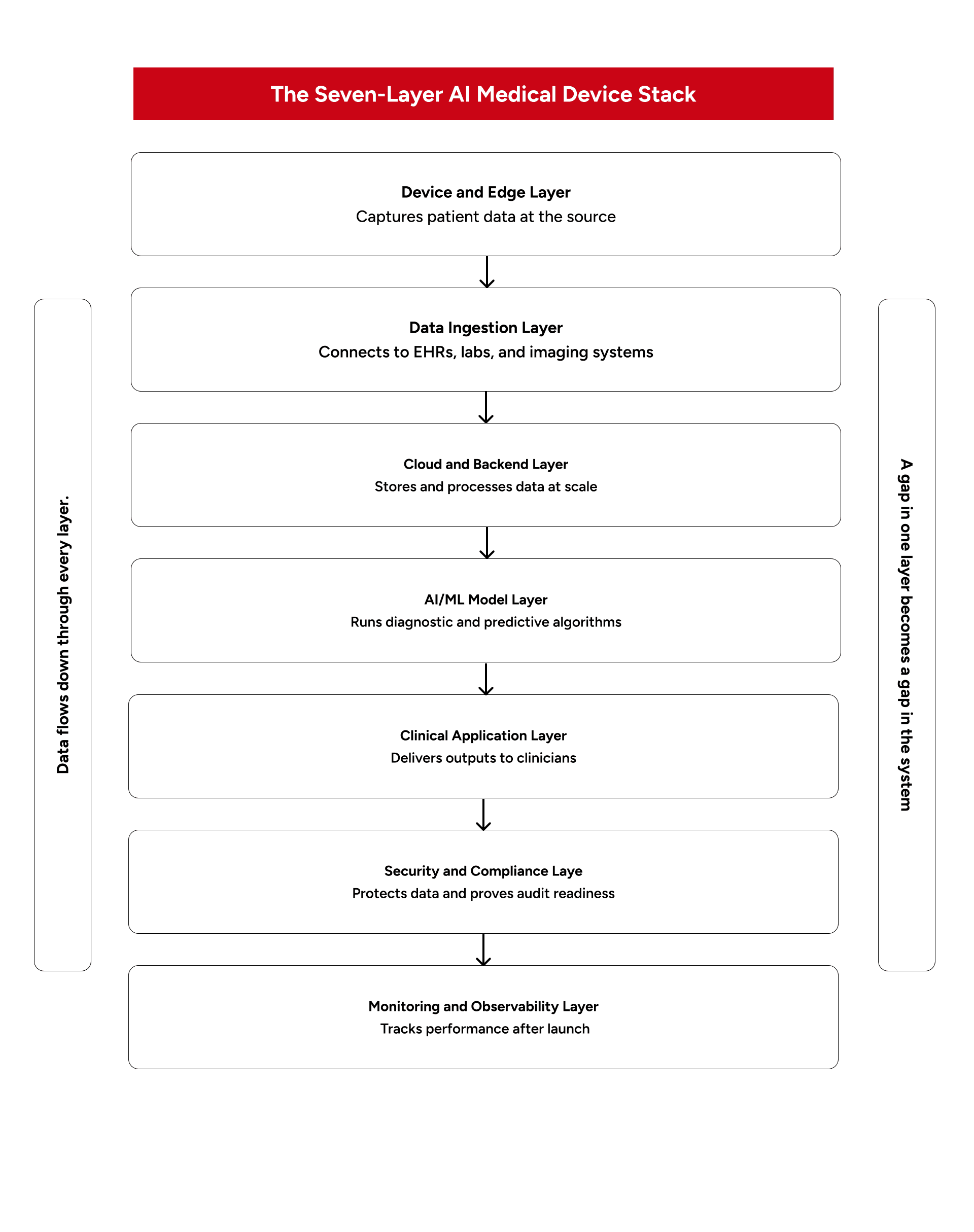
1. How Does the Device and Edge Layer Support Reliability?
Sensors, wearables, and connected hardware capture patient data at the source. This layer carries the tightest latency and reliability requirements in the stack, since a delayed or dropped reading at the edge propagates into every downstream layer as missing or corrupted data.
2. How Does the Data Ingestion Layer Handle Interoperability?
This layer connects the platform to electronic health records, connected devices, labs, and imaging systems through FHIR APIs and HL7 standards. Every data source introduces its own integration risk, and data provenance, format consistency, and latency tolerances each require explicit specification. Regulators treat an undocumented data flow as an open question during review.
3. What Does the Cloud and Backend Layer Need to Prove?
This layer processes and stores patient data at scale, handling authentication, database transactions, and API traffic between every other layer in the stack. Uptime commitments, encrypted storage, and stable performance during peak clinical hours define whether this layer holds under real hospital load.
4. What Does the AI/ML Model Layer Require for Regulatory Readiness?
Diagnostic algorithms, predictive models, and clinical scoring engines run here. The FDA treats AI/ML-enabled software as a distinct regulatory pathway, one that requires training data documentation, performance benchmarks, and defined output confidence thresholds. Models built to update after clearance need a predetermined change control plan on file, and algorithm performance needs a clear audit trail supporting every submission.
5. What Does the Clinical Application Layer Need to Support?
This layer manages interface and workflow logic for clinical inputs and decision outputs across device types and care settings. Usability validation under ISO 62366 treats every interaction that shapes a clinical decision as a documented risk item, tied to objective evidence gathered before submission.
6. What Security and Compliance Controls Belong in This Layer?
FDA cybersecurity guidance requires threat modeling, a Software Bill of Materials, and a documented vulnerability management process ahead of submission. Encryption, access controls, and audit logging all get evaluated during review, and reviewers hold this layer to the same evidentiary standard as the clinical claims themselves.
7. What Does the Monitoring and Observability Layer Track?
This layer tracks model performance, data quality, and system health once the device reaches real-world use. Continuous monitoring catches drift and degradation before they affect patient outcomes, feeding directly into the post-market surveillance obligations covered in the compliance section above.
Every architecture review we run for a medical device build finds the same weak point: the layer teams assumed would connect to everything else without friction. Interoperability does not behave the way a diagram promises. The systems holding up under real hospital load are the ones where a team pressure-tested every connection between layers before locking the architecture.
 Saurabh SahuChief Technology Officer (CTO)
What Should Engineering Leaders Take Away From This Guide?
AI medical device software rewards teams that treat compliance, architecture, and clinical safety as engineering decisions made from the first sprint, not tasks handled after a build is done. The organizations moving fastest toward FDA and EU MDR clearance are the ones building traceability, security, and model governance into their architecture from day one, with a team equipped to carry that discipline through to production.
Sources and Citations
- https://www.fda.gov/medical-devices/software-medical-device-samd/artificial-intelligence-enabled-medical-devices
- https://www.mckinsey.com/industries/healthcare/our-insights/generative-ai-in-healthcare-current-trends-and-future-outlook
- https://www.grandviewresearch.com/industry-analysis/ai-enabled-medical-devices-market-report
- https://www.fda.gov/regulatory-information/search-fda-guidance-documents/cybersecurity-medical-devices-quality-management-system-considerations-and-content-premarket