

Key Takeaways
- A working agreement should assign delivery ownership, approval authority, escalation responsibilities, and coverage across time zones.
- Sustainable overlap should provide shared working hours for decisions, requirement clarification, and acceptance reviews.
- Total delivery cost should account for partner fees, internal management time, onboarding, rework, and additional coverage.
- A pilot scorecard should provide evidence on delivery commitments, decision delays, rework, management effort, and budget performance before an offshore engineering partnership expands.
How Can US Companies Protect Delivery Commitments Across Time Zones?
A funded US company may face a committed product launch while engineering roles remain open and approval requests consume the CTO’s time. An offshore engineering partner can add delivery capacity, but the engagement also introduces decisions around ownership, handoffs, working hours, and escalation. For companies with limited vendor management resources, these decisions affect leadership capacity, release commitments, and budget control.
Distributed collaboration has become a common part of business operations. Workplace research found that 30% of meetings spanned multiple time zones, compared with 22% in 2021. This finding reflects workplace collaboration rather than offshore engineering performance. Companies evaluating outsourcing need to consider delivery outcomes alongside engineering capacity. The operating model determines how much coordination remains with internal leaders and how much responsibility the partner assumes.
For founders and engineering leaders, cross-time-zone delivery requires defined product priorities, approval authority, handoff responsibilities, escalation paths, and shared working hours. Continuous progress across locations requires agreed ownership and coverage.
This guide is for US founders, CTOs, and engineering leaders with limited management bandwidth. It covers how to select an engagement model, establish a working agreement, plan sustainable time-zone overlap, and validate delivery performance through a pilot before expanding the engagement.
Which Offshore Engagement Model Matches Your Management Capacity?
The right offshore development engagement model depends on how much delivery management the company can absorb. Product priorities, commercial decisions, and final approval of completed work remain with the buyer, while engineering and delivery responsibilities vary by model.
Engagement model | Client responsibilities | Partner responsibilities | Scope flexibility | Suitable business situation |
Staff augmentation | Sets priorities, assigns work, reviews delivery, and approves completed work | Provides engineers who join the client’s delivery structure | High | Established teams with engineering leaders available to manage added capacity |
Managed engineering pod | Owns product priorities, commercial decisions, key approvals, and final acceptance | Manages agreed engineering execution, technical direction, and delivery responsibilities | Moderate to high, based on the agreement | Companies that need added capacity with partner-led technical and delivery ownership |
Project-based engagement | Defines the business outcome, approves scope changes, and accepts deliverables | Executes an agreed scope against defined requirements and acceptance criteria | Moderate | Initiatives with a defined scope, budget, and deliverables |
Consider a funded startup with close to 50 employees and limited engineering leadership capacity. A managed engineering pod can reduce the delivery work placed on internal leaders by assigning agreed technical and delivery responsibilities to the partner. Staff augmentation places greater management responsibility with the startup.
For a mid-market company extending an established product team, staff augmentation can fit when internal engineering leaders have capacity for planning, work allocation, reviews, and delivery decisions. A project-based model can fit an initiative with defined requirements and acceptance criteria.
Before choosing a model, the company should confirm five conditions: a clear business outcome, a decision-maker with capacity for the engagement, an initial scope, an approved budget, and a documented decision process. These conditions show how much management responsibility the company can retain.
Nearshore or domestic delivery can fit products that require continuous live discovery and extensive shared working hours. Delivery location should reflect the collaboration window the work requires.
The first question I ask is who will manage the engineers once the engagement starts. A client with leadership capacity for planning, reviews, dependency resolution, and engineering decisions may have the structure for staff augmentation. A client with limited management capacity may need defined technical and delivery ownership from the partner. The engagement model should reflect the management responsibility the client can carry.
 Shreya MagoSenior Consultant - Technical Sales
Engagement-model selection starts with the client’s management capacity and scope clarity. Discovery should establish ownership of engineering decisions, dependency resolution, delivery reviews, and product approvals. Scope definition affects the management requirement. An approved backlog with acceptance criteria creates different management demands from a product requiring continued discovery. A frequent buying mistake is adding engineering capacity without assigning responsibility for managing that capacity.
What Should an Offshore Working Agreement Define Before Delivery Begins?
An offshore working agreement turns delivery expectations into commitments that the client and offshore engineering partner can review before kickoff. It should connect the business outcome and initial scope with delivery ownership, decision authority, communication expectations, handoffs, escalation, and acceptance. These commitments establish how work moves across time zones and which decisions remain with each side.
The table below provides a reusable framework for partner discussions.
Agreement item | Client commitment | Partner commitment | Evidence | Review point |
Business outcome and scope | Confirm priorities, initial scope, and acceptance conditions | Plan delivery against the approved scope | Approved scope and acceptance conditions | Before kickoff |
Delivery ownership | Name client decision owners | Name technical, delivery, and escalation owners | Responsibility record | At kickoff and after ownership changes |
Decision authority | Assign product, scope, and commercial approval authority | Route each decision to its designated owner | Decision authority record | At kickoff and after authority changes |
Working hours and communication | Confirm decision-maker availability during shared working hours | Confirm team hours, handoffs, and escalation coverage | Shared working schedule | Before kickoff and after schedule changes |
Acceptance process | Review submitted work against acceptance conditions | Submit completed work with acceptance evidence | Acceptance record | Before the first delivery review |
Scope changes | Approve changes that affect scope or budget | Record the delivery impact of each proposed change | Change record | With each proposed change |
What Information Should Each Cross-Time-Zone Handoff Include?
Each handoff should state the completed work, next action, business context, unresolved decision, accountable owner, and deadline with a named time zone. This record gives the receiving team the information required to continue approved work during its working hours.
Communication rules should reflect the type of issue. Routine updates can move through written records. Delivery blockers need live discussion when progress depends on a client or partner decision. Scope changes need live discussion when they affect budget, delivery commitments, or acceptance conditions. Customer-impacting incidents should follow the named escalation contacts and response expectations defined for the engagement. The working agreement should connect these expectations to engineering working hours and escalation coverage.
Hypothetical Example: A US Approver Is Outside the Shared Working Window
A US product owner holds approval authority for a proposed scope change. The request reaches the offshore team outside the shared working window. The handoff records the pending decision, business context, accountable owner, and response deadline in the named time zone.
The team continues tasks covered by the approved scope. The proposed change remains pending until the designated product owner provides approval. If the waiting decision puts a delivery commitment at risk, the team follows the escalation path and response expectations recorded in the working agreement. This keeps scope authority with the designated approver while approved work continues.
Approval authority deserves agreement at kickoff. A team may complete its assigned engineering work and reach a point that requires approval for a scope change, acceptance decision, or dependency. The working agreement should name the decision owner, response expectation, and escalation path. That structure gives the delivery team a defined route for decisions that affect scope, budget, or a release commitment.
Shreya MagoSenior Consultant - Technical SalesCross-time-zone engagements expose ambiguity in decision ownership because a missed approval window can carry a pending decision into another working period. A working agreement should document approval authority, handoff responsibilities, response expectations, shared working hours, and escalation coverage. These commitments give both teams a reference for routing decisions and continuing approved work. The result is less delivery time spent identifying who owns a decision during an active engagement.
How Much Time-Zone Overlap Should a US Company Plan With an Offshore Engineering Partner?
The required overlap with an offshore engineering partner depends on decision frequency, product clarity, cross-team dependencies, and the authority assigned to the partner. Products with frequent approvals or requirement changes need more shared working time. Defined scopes and delegated decisions can support a smaller overlap window.
The schedules below use a two-hour overlap as an illustrative planning scenario, rather than a recommended standard. Actual schedules should reflect the engagement and the working hours both teams can sustain.
What Could US–India Working Hours Look Like?
US location | US time period | US working schedule | India working schedule | Planned shared working window |
New York | Daylight time | 9:00 AM to 11:00 AM ET / 6:30 PM to 8:30 PM IST* | ||
New York | Standard time | 9:00 AM to 5:00 PM ET | 7:30 PM to 4:30 AM IST | 9:00 AM to 11:00 AM ET / 7:30 PM to 9:30 PM IST* |
Los Angeles | Daylight time | 9:00 AM to 5:00 PM PT | 9:30 PM to 6:30 AM IST | 9:00 AM to 11:00 AM PT / 9:30 PM to 11:30 PM IST* |
Los Angeles | Standard time | 9:00 AM to 5:00 PM PT | 10:30 PM to 7:30 AM IST | 9:00 AM to 11:00 AM PT / 10:30 PM to 12:30 AM IST* |
*The India schedules are illustrative shifted schedules created for this planning example. They do not represent standard GeekyAnts working hours or engagement commitments.
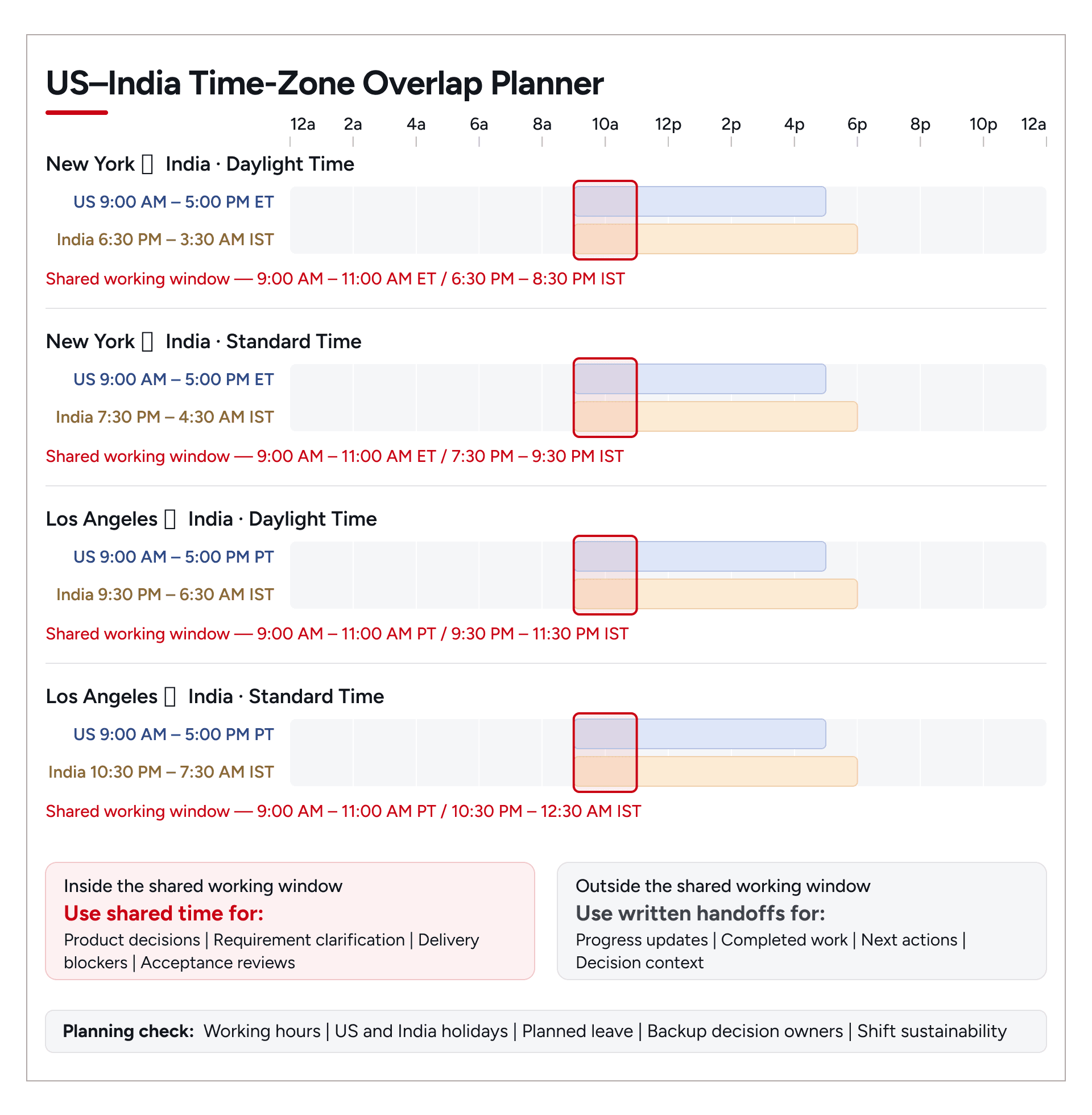
The shared window should cover product decisions, requirement clarification, delivery blockers, and acceptance reviews. Routine status updates can move through written handoffs, leaving shared working time for decisions that require participation from both teams.
Follow-the-sun delivery works when the receiving team has the context, access, and authority required to continue approved work after a handoff. Unresolved product decisions, missing access, pending approvals, or cross-team dependencies can interrupt that sequence and leave work waiting for the next shared window.
A usable overlap plan should account for sustainable working hours, US and Indian holidays, planned leave, and backup decision owners. Shifted schedules should be agreed as part of the staffing plan, with coverage distributed across the team where the engagement requires extended collaboration windows.
How Should US Companies Measure Offshore Engineering Costs Before Scaling a Partner?
The hourly or monthly rate represents one part of an offshore engineering investment. US companies should assess partner fees alongside internal management time, onboarding, rework, and coverage purchased outside the core engagement. This view connects engineering spending with the work the company accepts.
Estimated commercial impact from a delayed launch, sales commitment, or customer milestone should sit outside actual delivery spending. It can inform the investment decision while remaining a business estimate based on the company’s circumstances.
What Should an Offshore Delivery Cost Worksheet Include?
Cost item | Calculation | Hypothetical input |
Partner fees | Contracted fees for the pilot | $18,000 |
Internal management | 30 hours × $100 | $3,000 |
Onboarding | 10 hours × $100 | $1,000 |
Rework | 20 hours × $60 | $1,200 |
Purchased coverage | Additional coverage cost | $800 |
Actual delivery cost | Sum of incurred costs | $24,000 |
Accepted deliverables | Work accepted against agreed criteria | 8 |
Cost per accepted deliverable | $24,000 ÷ 8 | $3,000 |
Hypothetical figures for planning purposes.
Companies should apply a consistent calculation when comparing partner options. A partner with a lower delivery rate can have a higher cost per accepted deliverable when the engagement requires more client management hours, onboarding effort, rework, or purchased coverage. This gives leadership a cost measure tied to accepted output.
How Can a 30-Day Pilot Test the Investment?
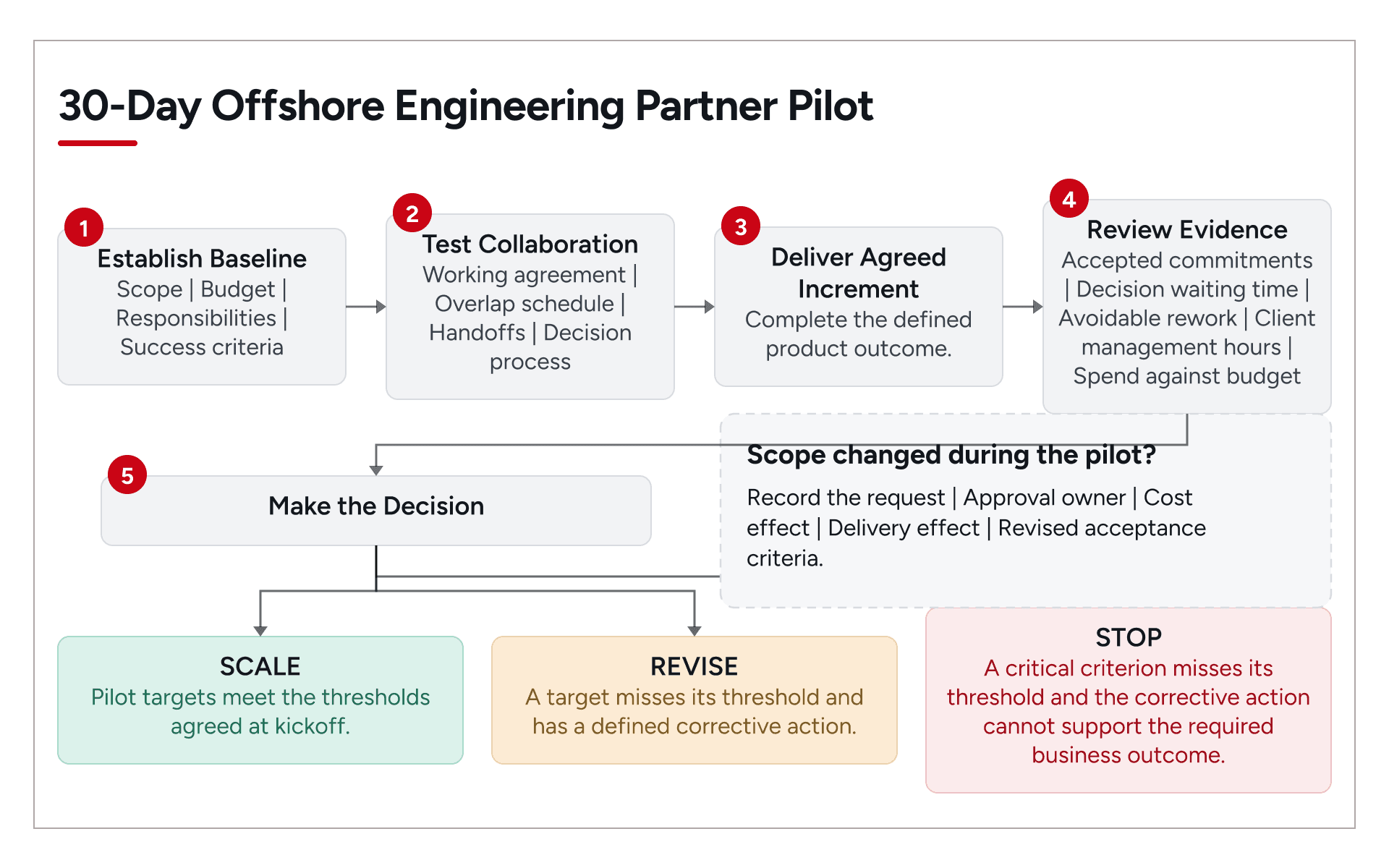
A proposed 30-day pilot should focus on a defined business outcome. The pilot can establish a baseline, test the working agreement, deliver an agreed product increment, and assess the result. The scope should determine the pilot duration when the work requires a different assessment period.
Pilot measure | Definition | Owner |
Accepted commitments | Pilot commitments accepted against agreed criteria | Client and partner delivery leads |
Decision waiting time | Time recorded while work waits for a required decision | Assigned decision owner |
Avoidable rework | Repeated work caused by missed agreed requirements or acceptance criteria | Partner delivery lead |
Client management hours | Internal time spent managing the engagement | Client engineering leader |
Budget performance | Actual pilot spending measured against the approved budget | Client commercial owner |
Before kickoff, both parties should record the target for each measure and the conditions for the final decision.
Decision | Criteria |
Scale | All critical pilot targets meet the thresholds agreed at kickoff |
Revise | A target misses its threshold and the issue has a defined corrective action |
Stop | A critical criterion misses its threshold and the agreed corrective action cannot support the required business outcome |
Scope changes during the pilot should record the request, approval owner, cost effect, delivery effect, and revised acceptance criteria. The final assessment can then use the approved pilot scope and documented changes as its evaluation baseline.
The commercial measure I focus on is cost per accepted deliverable. Partner fees are one input. Client management hours, onboarding effort, rework, decision delays, and the product or commercial milestone attached to the work shape the investment case. Leadership needs to know how much usable output the engagement produces within the budget and management capacity allocated to it.
 Kunal KumarChief Revenue Officer
A pilot gives leadership evidence for the investment decision. Accepted commitments, cost per accepted deliverable, client management hours, onboarding effort, rework, decision waiting time, and budget performance show the economic demands of the engagement. Results that meet the success criteria can support a scale decision. Correctable gaps can support a revised model. Failure against critical criteria can support a stop decision. Product and commercial milestones provide context for each outcome.
How Can US Companies Assess GeekyAnts as an Offshore Engineering Partner?
US companies evaluating GeekyAnts can assess the engagement across five areas: ownership, overlap, visibility, flexibility, and evidence from comparable product delivery. These criteria connect partner selection with the management capacity, working agreement, and pilot measures covered in this guide.
Buyer criterion | What to establish with GeekyAnts |
Ownership | Technical and delivery responsibilities assigned to GeekyAnts and responsibilities retained by the client |
Overlap | Proposed working hours, shared decision window, holiday coverage, and escalation coverage |
Visibility | Delivery owners, acceptance criteria, escalation contacts, decision authority, and review process |
Flexibility | Team composition, engagement model, profile review, and role changes across delivery stages |
Evidence | Comparable product work with a documented challenge, engagement scope, operating arrangement, and result |
How Does a Managed Engagement Affect Client Workload?
In a managed engagement, GeekyAnts can assign technical and delivery responsibilities across roles based on the agreed scope. A Tech Lead or Solution Architect can take responsibility for architecture and technical decisions with client stakeholders. A Delivery Lead can manage delivery responsibilities, while business analysis support can cover requirements and acceptance clarity.
This structure places agreed technical direction and delivery coordination with GeekyAnts. The client retains product priorities, business context, commercial decisions, scope approvals, and acceptance authority assigned through the engagement agreement.
Team augmentation follows a different structure. GeekyAnts engineers join the client’s delivery model, while the client can retain planning, work allocation, reviews, and delivery management.
What Should the Discovery Conversation Establish?
Team composition can reflect the product stage, complexity, and engagement model. Clients can review proposed profiles, and the role mix can change across discovery, development, testing, release, and support.
For US clients working with India-based teams, working-hour overlap and meeting windows form part of the engagement agreement. Shifted working hours can form part of the proposed schedule. The discovery conversation should confirm staffing availability, proposed overlap hours, escalation coverage, initial scope, retained client responsibilities, acceptance criteria, and commercial terms.
This process gives the client a defined engagement structure covering ownership, schedule, decision authority, and delivery expectations.
I look for evidence across both organizations before supporting an increase in engineering capacity. The client needs clear product priorities, strong product ownership, decision capacity, and room to absorb additional delivery. The partner needs demonstrated performance against agreed criteria, sustainable overlap, and defined escalation coverage. Those conditions give leadership a sound basis for deciding the next scope and team size.
Kunal KumarChief Revenue OfficerScaling an offshore engineering partnership depends on readiness across the client and partner. Delivery evidence should show performance against agreed commitments, while the client should have stable priorities, available decision owners, review capacity, and sufficient demand for added engineering output. Sustainable overlap and escalation coverage support the operating structure. A focused scope remains appropriate when these conditions require further validation. Expansion can follow evidence from delivery performance and organizational capacity.
What Should You Confirm Before Scaling an Offshore Engineering Partnership?
The decision to expand an offshore engineering partnership should reflect three constraints: management capacity, a sustainable working schedule, and the approved delivery budget. The partner should operate within these boundaries while meeting the ownership, communication, acceptance, and pilot criteria established at the start of the engagement.
Complete the working agreement and define the pilot success criteria before expanding the delivery scope. Use the pilot results to assess accepted commitments, decision delays, rework, client management effort, and budget performance. These findings should determine whether the next partner discussion focuses on scaling the engagement, revising the working model, or keeping the current scope.