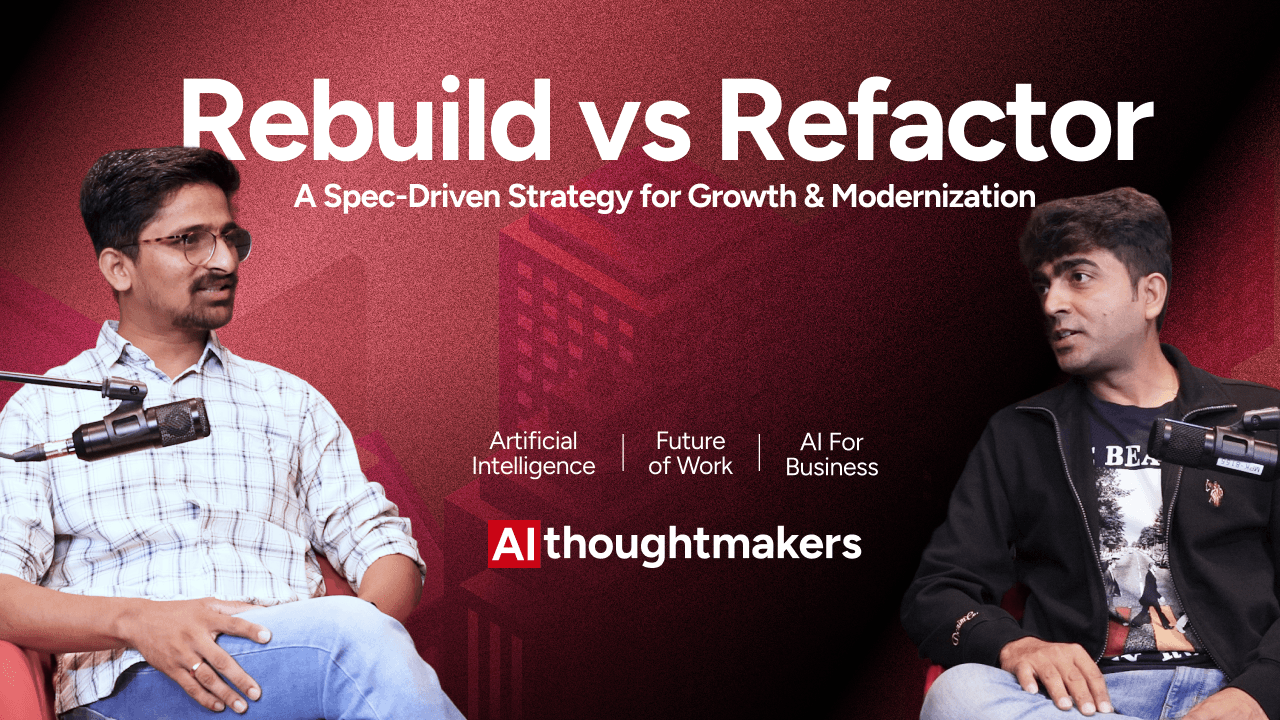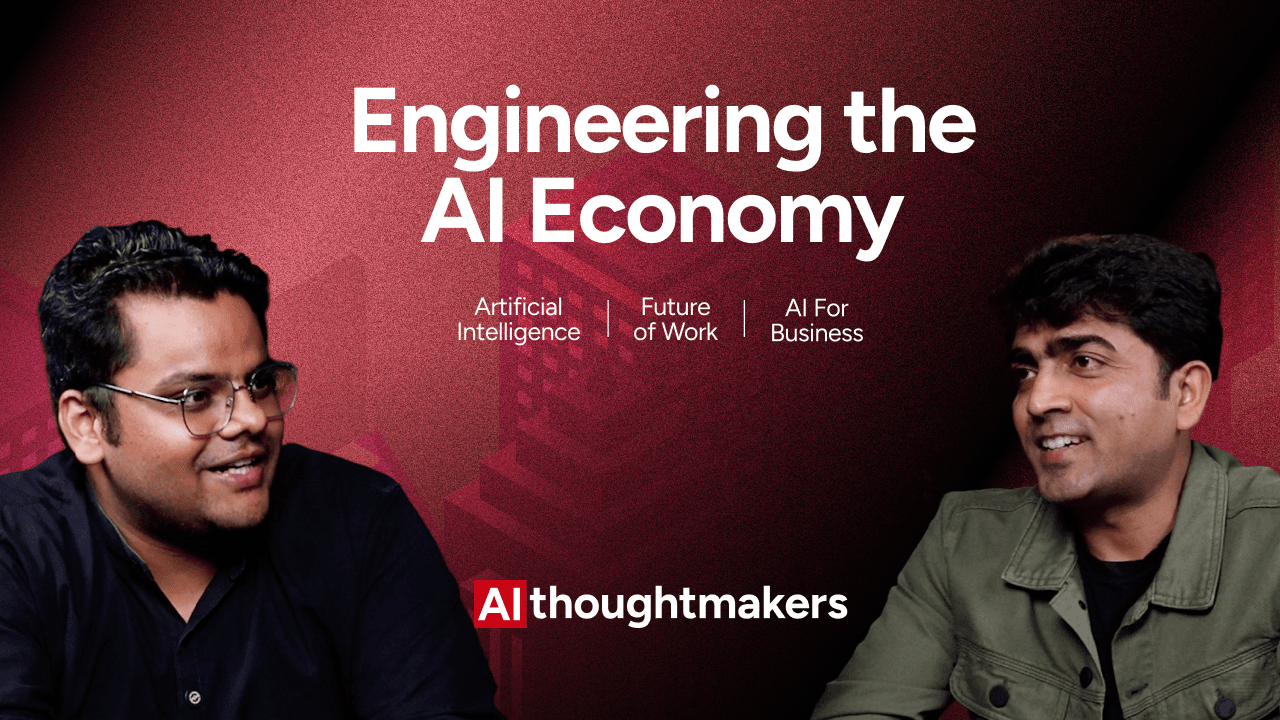


Editor’s Note: This blog is adapted from an episode of the AI ThoughtMakers podcast featuring Manav Goel, Principal Technical Consultant at GeekyAnts, in conversation with host Prem Prakash Goswami. Drawing on his work building production-grade AI systems, Manav looks at why most AI prototypes stall before production. He explains how the fundamentals change once real users arrive; why security, compliance, and token cost matter; how agentic workflows add value across the software development life cycle; where data quality and user trust decide success; and why the developer’s role is shifting rather than disappearing.
Why So Few AI Prototypes Reach Production
A prototype is often built for investors, to test whether a solution works at all. Production applications have to work under pressure, for tens of thousands of users and every edge case. Reality usually hits during development, when token consumption climbs, agentic workflows multiply, and generated code gets messy.
Market pressure also pushes teams toward impressive demos, though real value comes from solving an actual business problem or improving a user's life.
A related misconception holds that AI is plug-and-play: one foundation model, one large prompt with a huge block of context, and a complete application in one pass. In practice, agentic workflows take real effort to connect and need metrics such as token consumption, cost, and how closely output matches intended features.
Watch the full talk, straight from the AI ThoughtMakers podcast:
Production Fundamentals: Security, Compliance, and Cost
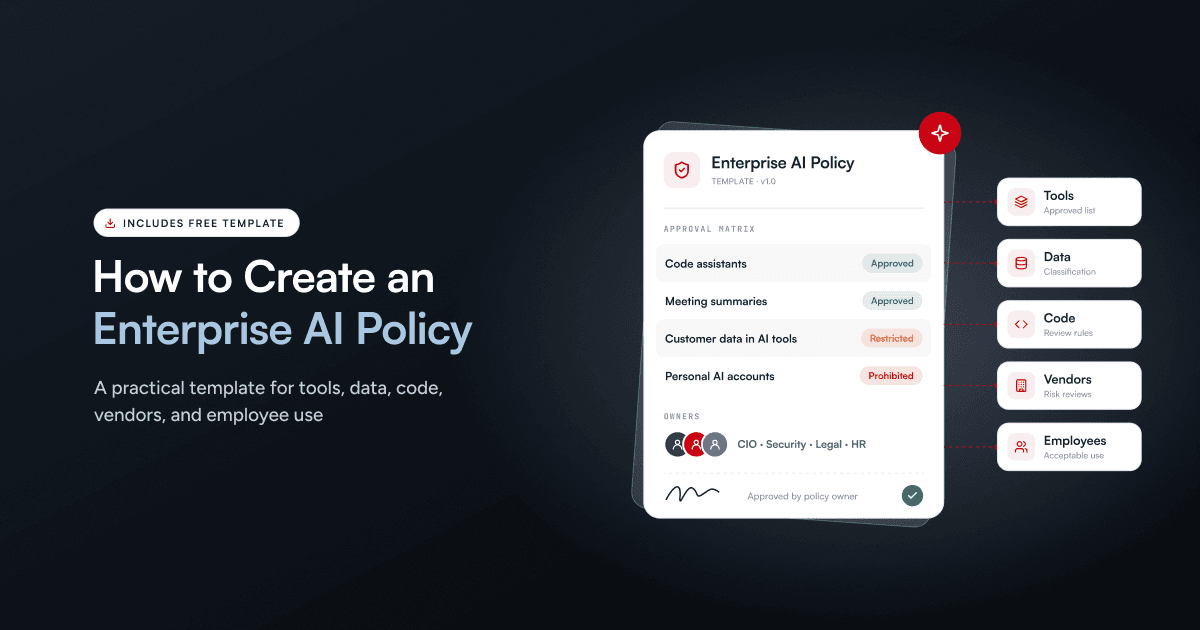
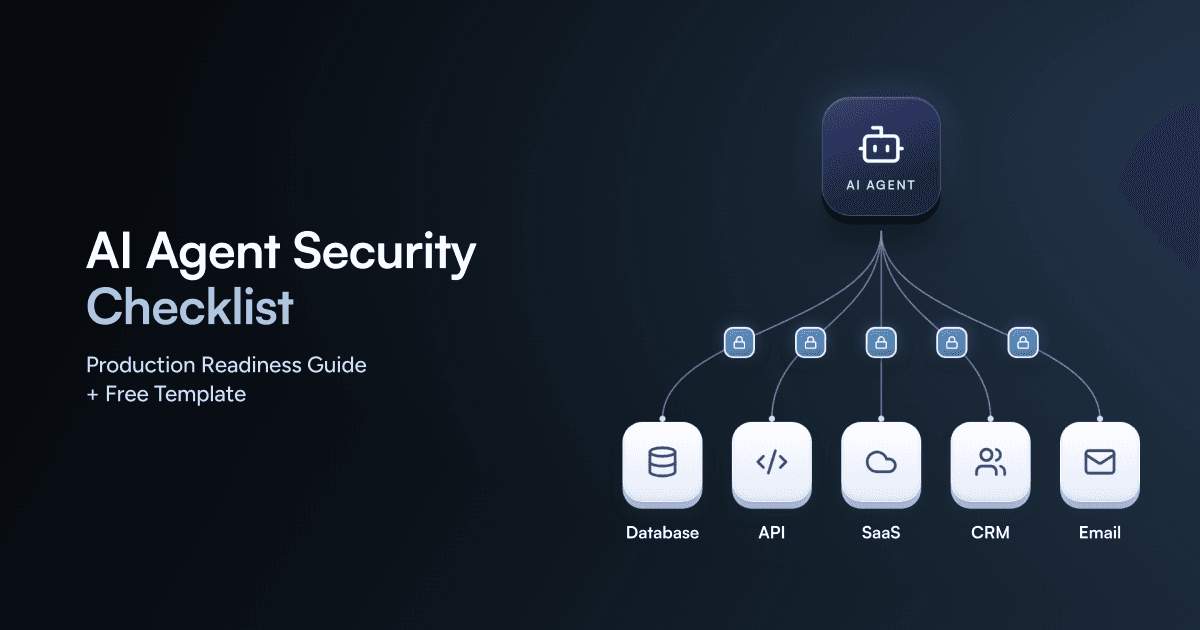
A prototype answers to speed and proof of concept, and it has to look impressive. Production answers to a different set of fundamentals, and security leads them. The application has to protect the data moving through it, and any feature built with an agentic workflow has to carry that same data security and privacy rather than treat it as an afterthought.
Compliance follows close behind, and it depends on the domain. A fintech or healthcare application has to meet the rules that govern it, such as GDPR, before it can go live. Reliability is the third demand, because a system that holds up for a handful of demo users still has to hold up for tens of thousands of real ones.
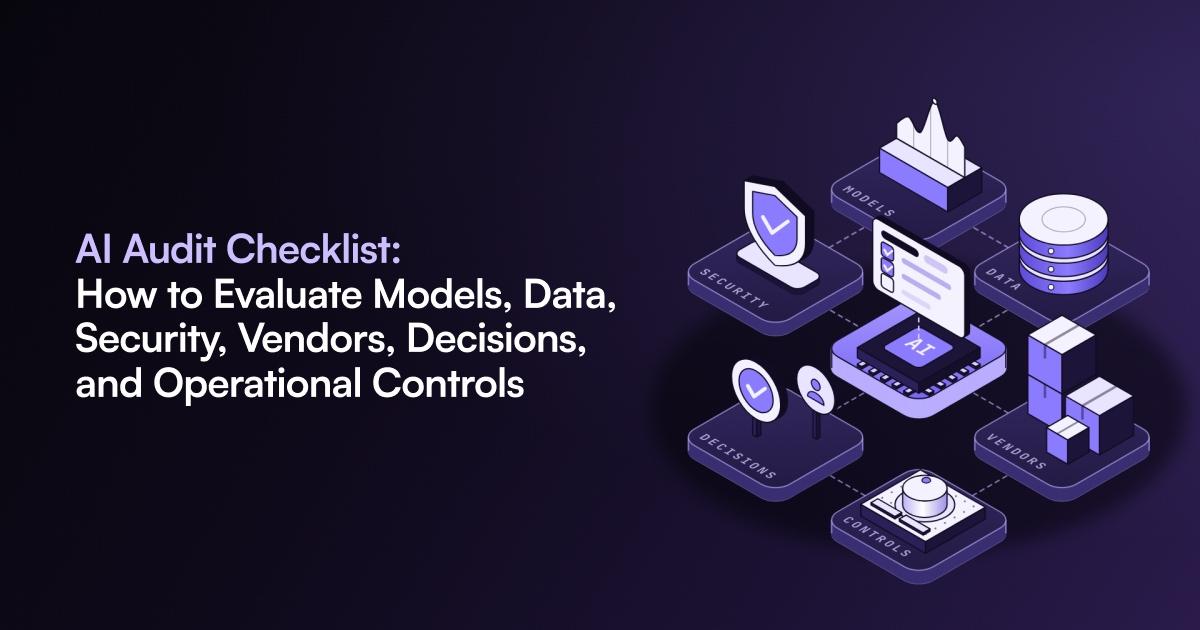
Security review at this stage includes checking the application against the OWASP Top 10 for LLM applications.
Agentic features still need the data security and privacy regulated domains required, checked against the OWASP Top 10 for LLM applications.
LLMOps carries equal weight, since teams need to know how many tokens a task consumes and what it costs. In one recent case, a drift analysis took a million tokens, which forces a check on whether the task returns enough value.
Data Quality and User Trust at Production Scale
Prototypes usually run on clean data with little scale or diversity. A prototype pipeline with ingestion, processing, and egress proves the concept, while its production version has to account for data frequency, rate limits on source APIs, and how much cleansing the data needs before downstream systems consume it.
User trust is the other production concern. A dental application GeekyAnts worked on takes a transcript of the doctor-patient conversation and generates a treatment plan. The prototype works well, but in production the audio input can contain anything. If the plan drops a recommended root canal, the exact type of crown, or an anesthesia dosage, it becomes less usable. An agent that confirms ambiguous or missing details with the person entering the data closes those gaps.
Agentic Workflows Across the SDLC
Agentic workflows add value at every stage, from ideation through maintenance. The approach that works is task decomposition: dedicated agents for each stage, with evaluation checks between stages to confirm the outputs connect. A single prompt produces low-value results.
Research, Estimation, and Proposals
AI-driven market research and competitor analysis replace much manual work. GeekyAnts also uses an internal estimation and proposal tool that breaks an idea into features and sub-features, then assigns cost and effort estimates from reasoning, prior project data, and LLM calls. A refined proposal takes minutes, and salespeople can produce one without technical help.
Development, QA, and Deployment
Development runs smoothly only when planning comes first. Spec-driven development means architecture diagrams and technical requirement documents for each module, with use cases and edge cases defined, so an agent can code against them. Validation at every stage stops agents from running in infinite loops and wasting tokens. QA follows the same discipline, and deployment can use a dedicated infrastructure-as-code agent.
Aligning CXOs and Developers Through Observability
Developers focus on feasibility and performance, while CXOs care about business impact and ROI. Clear observability brings both into the same room.
Traditional observability covers metrics, traces, logs, and events, and agentic workflows extend each one. Traces now capture internal and external agent calls and the agent's reasoning. Alongside CPU usage, spikes, and database storage, token consumption becomes the metric that defines ROI, since a single request can reach a million tokens.
How Developer Roles Are Changing
Given the layoffs across the industry, the fear of replacement is real. The more accurate view is that AI elevates these roles. Blind vibe coding, which runs development on autopilot instead of as a copilot, is disastrous.
Evaluation-driven development is the next phase, with ethical inference, hallucination checks, and continuous evaluation built into the definition of done. Developers in this model work as strategic orchestrators.
The larger shift is organization-level adoption of AI workflows. Using Cursor, Claude Code, or similar tools well means building on defined specs and auditing output to avoid infinite loops and token exhaustion. Human-in-the-loop review stays central, and developers remain essential.
Takeaway
Speed matters, along with building for users, scale, and actual business problems. For organizations, ROI, token consumption, and surgical precision in execution decide whether an AI product holds up in production.
Explore GeekyAnts AI Prototype to Production Services to see how AI products move from prototype to production. To discuss a product or engineering challenge, contact the GeekyAnts team.