

Key Takeaways
- AI agent development cost will depend on the complexity of the workflow, integration into the systems, preparedness of the data, and the degree of agent’s autonomy.
- Realistic budgeting will consist of expenses for development, operations, maintenance, and scaling.
- Expense per completed task and savings will allow businesses to calculate the ROI and the payback period of the investment.
- Selecting from building AI agents in-house, buying a platform, or developing a custom solution should be based on comparison of initial budgets and ownership.
Why Does AI Agent Development Cost More Than Your First Estimate?
Most teams are clear on the use cases their AI Agent would have to solve. However, they fail to consider the cost to build an AI agent- one that will hold up in production.
AI agent development costs rise when systems move beyond producing outputs. Rather, they have become decision-makers that rarely require human approval.
McKinsey's State of AI in 2025 survey reports that 88% of organizations now use AI in at least one function and 62% are at least experimenting with agents, while no more than 10% have scaled agents in any single function.
Meanwhile, Gartner predicts that over 40% of agentic AI projects will be canceled by the end of 2027, due to escalating costs, unclear business value, and inadequate risk controls. Teams underestimate the real cost and complexity of running agents at scale, so the cost inflates before the business case is finalized. The first quote normally includes the working demonstration. The moment you add what makes the agent usable in your business- like API integrations, orchestration layers, evaluation and monitoring and even maintenance and compliance work- the figure becomes ten-fold.
Most buyers come to us with a price in mind for building the agent. The cost that decides the project is the one that shows up after it goes live, when it starts touching real systems and real volume. We would rather set that expectation on day one than defend a budget overrun in month six.
 Kunal KumarChief Revenue Officer
For determining the cost to build an AI agent accurately, customers should specify - the level of autonomy required from the agent, on which systems and layers it will be able to operate and the price of its operation on the planned scale.
This guide takes you through the above considerations: pricing indications for indicative AI agent creation, the structure of costs for building, operational and maintenance costs, total cost of ownership within one and three years, determinants of the cost, buy versus build analysis, ROI and payback, and evaluation of delivery partners.
What Does It Cost to Build an AI Agent?
The short version?
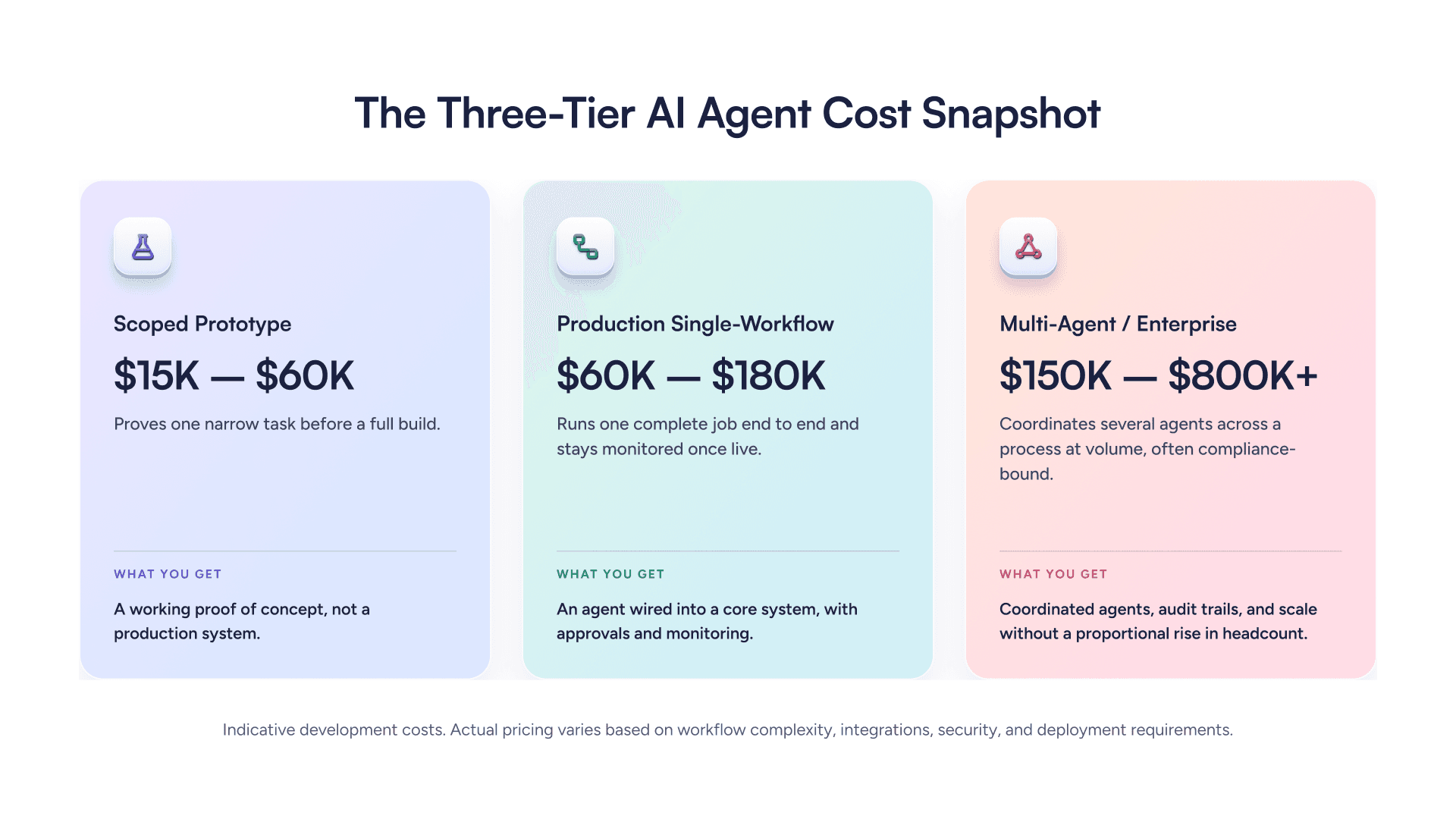
The cost to build an AI agent runs from about $15,000 to $800,000 or more.
The range is wide since the labeling of the agent itself does not indicate much about the work done to produce it. This is the reason why the same description of the work applies both to the small prototype and to the platform integrated with six live systems The difference between the two is the money that has been spent. All the numbers mentioned in this guide are indicative ranges for 2026 and do not include costs of running the agent.
Two firms ask for the same customer support representative and get estimates that are five times apart. The reason lies in the number of systems it can interact with, the level of autonomy it is given, and the quality of data it is based on. The model itself is usually not where the money goes.
 Shreya MagoSenior Consultant - Technical Sales
Three AI agent development cost tiers explain most of that spread, and each is easier to place by the work it does than by how it is built:
A. Scoped Prototype or Narrowly Scoped Agent
Handles one narrow task to prove the idea before a full build. GeekyAnts shipped this for Unojobs, a GPT-4 voice agent that screens candidates on its own.
- Answers a fixed set of questions or routes a request
- Drafts from a knowledge base for a human to send
B. Production-Ready Single-Workflow Agent
Runs one complete job end to end and stays monitored once live. GeekyAnts built Pillar Engine, an AI document-intelligence agent that cut manual effort by 99%.
- Retrieves company data and updates a core system such as a CRM
- Pauses for human approval before anything risky
C. Complex Multi-Agent or Enterprise System
Coordinates several agents across a business process at volume, often inside a compliance-bound workflow. GeekyAnts built Nexus, using AI agents and RAG to cut manual validation cycles by 50%, and accelerated testing by 30% using AI agents, RAG models, and BPM automation.
- Connects many systems and carries audit trails for regulated work
- Scales to high volume without a proportional rise in headcount
Once you have decided which tier your agent belongs to, the next step is to narrow the details that set the final AI agent development cost:
- How firmly the business requirements are defined
- How clean and ready your data is
- How many software integrations the agent needs
- How modern or legacy those connected systems are
- Where the engineering team sits, and the security and compliance bar it must clear
- The usage volume the agent is expected to serve
Integrations and data quality move the figure the most, and often form the largest single share of AI agent integration cost.
The production process relies on the messy data provided by the actual users. Engineering to prepare the agent for production, integrating the agent into live environments, and securing the agent is exactly why the build costs far more than the prototype.
AI Agent Development Cost by Complexity
The three tiers are easiest to judge side by side. Matching your use case to a row will give you a budget to start working with and the timeframe that you have for building it even before locking in any requirements. Each of these ranges should be viewed as a planning range and not a quotation.
The numbers in the table below reflect the entire journey that the production system makes starting from discovery and build, all the way to testing and deployment.
AI agent category | Indicative cost (USD) | Business use case | Complexity | Timeline |
|---|---|---|---|---|
Scoped prototype / single-task agent | $15,000 – $60,000 | FAQ deflection, ticket routing, or a knowledge-base assistant; a proof of concept | Low | 3 – 8 weeks |
Production single-workflow agent | $60,000 – $180,000 | Customer-support resolution or CRM updates, with retrieval, approvals, and monitoring | Medium | 3 – 5 months |
Multi-agent or regulated enterprise system | $150,000 – $800,000+ | Coordinated agents across departments, or a compliant finance or healthcare agent at scale | High | 6 – 12+ months |
The above ranges are indicative planning estimates for AI agent development in 2026. Figures cover discovery, build, testing, and deployment, and exclude recurring charges. The pricing tiers can overlap, since integration complexity, security needs, and workflow complexity could influence the cost separately from the number of agents. Validate a specific scope with an AI Solutions Architect before committing.
Location also changes the cost to build an AI agent. Engineering rates vary enough across delivery regions that on a six-figure build, where the team sits moves the total as much as the feature list does.
Region | Engineering rate (USD/hr) | Effect on an agent build |
|---|---|---|
United States | ~$145 (120 – 250) | Highest rate; the same scope costs the most here |
Western Europe | ~$110 (100 – 150) | Premium rates, strong compliance familiarity |
Latin America | ~$60 (50 – 85) | Mid-range, close US timezone overlap |
Eastern Europe | ~$55 (45 – 70) | Mid-range, deep senior engineering pool |
Asia | ~$30 (30 – 60) | Lowest rates; blended delivery holds scope below US totals |
AI Agent Development Cost Breakdown: What Are You Actually Paying For?
Price alone says very little. The same $120,000 in agent fees can equate to two entirely separate systems based on how it is allocated, and a quote that hides that allocation is where overruns begin.
The five lines below make up for upfront AI agent development cost, separate from the monthly charges an agent carries once it is live.
1. Planning, Architecture, and Data Preparation Costs
The first cost of building any AI agent is planning, design, and data preparation, and also the cost that most likely will determine if everything else will succeed.
Most of this budget goes to - cleaning and labeling your data, because if the AI agent is given bad or unlabeled data it will give faulty results, regardless of the model used.
- Covers discovery, solution design, and data preparation
- Data readiness is the most important factor
2. AI Model Selection and Agent Logic Costs
It is model selection and the agent’s logic where you actually pay for your choices, not for results. This handles decision making, calls the proper function, and recovers when an action fails, and most of the AI agent pricing for this stage goes there.
- Covers model choice, prompts, reasoning, and fallback behavior
- AI agent development cost rises with how much autonomy it is given to make decisions
3. Integration, Tools, and Workflow Orchestration Costs
Integration, tools, and workflow orchestration connect the agent to the systems it has to work with, and it is the most underquoted line in the build. A clean API takes days while a legacy system can take weeks, which is why most of the AI agent integration cost is decided by what you already run.
- Covers CRM, database, and tool connections plus workflow logic
- A modern API is cheaper than a legacy system
4. Evaluation, Testing, and Security Costs
Evaluation, testing, and security separate a demo from just first impressions. Agents fail in ways normal software does not, so you are paying to catch bad decisions, not just bugs.
- Covers test suites, guardrails, access controls, and audit trails
- AI agent development cost climbs sharply with compliance and risk
5. Deployment and Infrastructure Setup Costs
Deployment and infrastructure is what makes your agent go live and keeps it in sight once it is running. You are paying for the hosting it runs on and the monitoring that shows you what it is doing, since an agent that is not watched cannot be trusted.
- Covers hosting, CI/CD, and monitoring dashboards
- Cost scales with the volume the agent has to serve
AI Agent Development Cost Breakdown by Component
If you are comparing proposals, ask for exactly the following components. The goal is to get a quote with each component itemized.
Cost component | Indicative range (USD) | What you receive | If a vendor skips it |
|---|---|---|---|
Planning, architecture & data prep | $5,000 – $20,000+ | A scoped plan and clean, usable data | Wrong outputs no model can fix |
Model selection & agent logic | $20,000 – $80,000 | Reasoning that makes the agent reliable | A demo that fails on real inputs |
Integration & orchestration | $10,000 – $40,000 | An agent wired into your live systems | An agent that sits beside the work |
Evaluation, testing & security | $8,000 – $25,000 | Proof it behaves, and limits when it fails | Silent errors and compliance exposure |
Deployment & infrastructure | $8,000 – $30,000 | A controlled launch with monitoring | No visibility into cost or failures |
How Much Does It Cost to Run and Maintain an AI Agent Each Month?
Development of the agent is charged only once, separate from the recurring AI agent development cost that follows. Running it is charged every month, and that monthly charge determines whether the agent is worth keeping. A production agent bills for models, retrieval, hosting, monitoring, and the engineering effort to maintain its accuracy, every month it is live.
You will incur two types of costs:
- Fixed costs- stay constant regardless of what the agent does, and include hosting, monitoring, security, and maintenance labor.
- Variable costs- rise with usage, since every action the agent takes consumes model tokens and retrieval queries.
Maintenance is often overlooked when businesses estimate AI agent development cost. It is not a single effort but an ongoing one:
- Model upgrades when a provider deprecates or reprices a version
- Integration upkeep as connected systems change their APIs
- Monitoring that catches accuracy drift before users do
- Evaluation updates when a workflow or policy changes
- Incident support when the agent fails in production
Monthly AI Agent Operating Costs by Usage Level
The table below runs one workflow, a customer-support resolution agent, at three volumes, so the numbers compare like for like.
Expense category | Low usage | Moderate usage | High usage |
|---|---|---|---|
Model / API tokens | $100 – $800 | $600 – $3,000 | $8,000 – $25,000 |
Hosting & compute | $200 – $1,500 | $1,000 – $6,000 | $4,000 – $9,000 |
Monitoring & observability | $150 – $600 | $400 – $2,000 | $2,000 – $4,000 |
Maintenance & tuning | $400 – $1,200 | $1,250 – $4,000 | $2,000 – $4,500 |
Security & access control | $150 – $900 | $750 – $5,000 | $2,000 – $4,500 |
Total monthly | =$1,000 – $5,000 | =$4,000 – $20,000 | =$18,000 – $47,000 |
Cost per successful task | =$1.09 – $5.43 | =$0.43 – $2.17 | =$0.20 – $0.51 |
Assumptions: Cost per successful task is calculated by dividing total monthly operating costs by the estimated number of successfully completed tasks.One workflow (customer-support resolution agent) at roughly 1,000 / 10,000 / 100,000 tasks a month, ~92% success rate, failed runs retried.
Cost per successful task is the figure that counts, and it has to count the unsuccessful ones. A production agent fails 5-15% of its tasks, and a retry doubles the cost of a run, so even a small share of failed runs raises the variable cost of use behind a per-task fee.
Per-task cost falls as volume grows, until it stops falling. An agent that is cheap at a few hundred tasks a month becomes a different system at hundreds of thousands, where token spend makes up most of the bill and forces model routing, caching, usage limits, and a real support arrangement. This is why operating cost does not grow as a constant proportion of the build cost, and why a flat estimate underprices a growing agent.
How Do You Calculate the Total Cost of Ownership of an AI Agent?
The total cost of ownership (TCO) of an AI agent includes everything spent on building it, running it, and keeping it working over time. This covers development, model usage, infrastructure, maintenance, support, and future updates.
The calculation is straightforward:
TCO = One-time build cost + Recurring costs + Expansion costs + Contingency
To understand how these AI agent development costs add up, it helps to calculate them for a specific business use case over one year and three years.
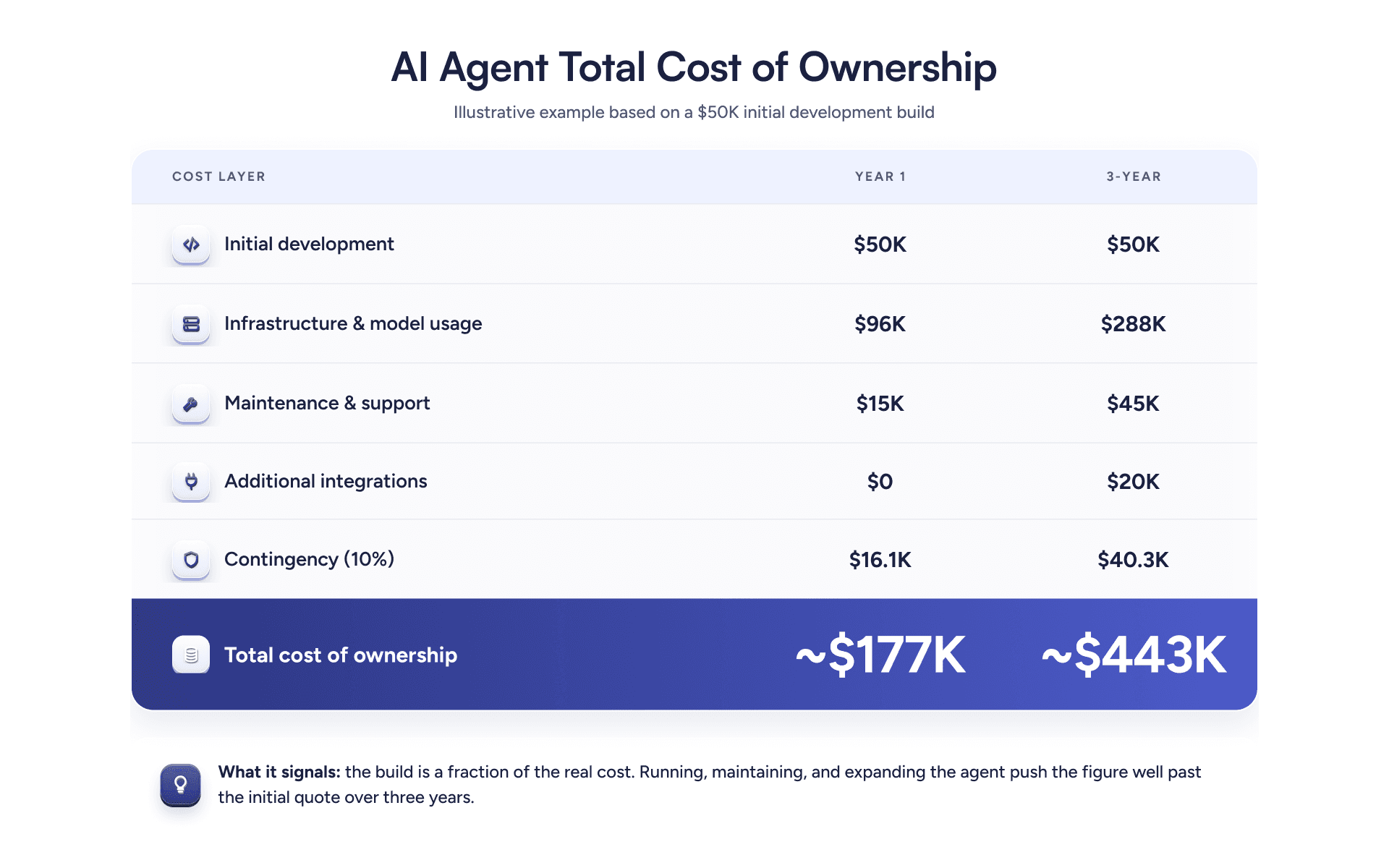
The example below utilizes a customer-support agent with a $50,000 build starting in the first year, to demonstrate total ownership costs over one and three years.
- Build: $50,000, including planning, integration, testing, and deployment.
- Running costs: $8,000 per month for infrastructure and model processing.
- Maintenance: $15,000 per year for updates, evaluations, and support, budgeted separately from infrastructure and hosting.
- Expansion: $20,000 for additional integrations during years two and three.
- Contingency: 10% of the combined costs, kept aside for unexpected expenses.
AI Agent Total Cost of Ownership: 1-Year vs 3-Year
Using these figures, the table shows how the cost to build an AI agent adds to the total over one year and three years, helping businesses understand what they need to budget beyond the initial build.
Cost component | First-year cost | Three-year cumulative cost |
|---|---|---|
Initial development | $50,000 | $50,000 |
Infrastructure and model usage | $96,000 | $288,000 |
Maintenance and support | $15,000 | $45,000 |
Additional integrations | $0 | $20,000 |
Contingency (10%) | $16,100 | $40,300 |
Total cost | =$177,100 | =$443,300 |
How these totals are calculated:
- First year: $50,000 to build + $96,000 to run + $15,000 for maintenance = $161,000. Adding 10% gives $177,100.
- Three years: $50,000 to build + $288,000 to run + $45,000 for maintenance + $20,000 for expansion = $403,000. Adding 10% gives $443,300.
For a growth-funded SaaS startup, fewer integrations can keep expansion costs lower. A mid-sized company connecting several existing systems may need a larger allowance. Both should revisit their estimates as usage increases, vendor prices change, and evaluation requirements grow.
Note: These are illustrative planning figures, not a project quote. Any savings they imply are economic benefits rather than guaranteed cash returns. Actual ROI depends on how much manual cost can genuinely be avoided, the value of staff capacity redeployed, realized resolution rates, additional oversight costs, and the time required to reach full stage. GeekyAnts' AI app development cost guide provides the reference ranges.
Which Factors Increase AI Agent Development Costs, and How Can Businesses Control Them?
AI agent development cost depends on the decisions made by the companies concerning autonomy, integration, model application, and security.
The management of the cost of development of an AI agent begins with a small scope that may be widened in accordance with requirements.
AI Agent Development Cost Drivers and Optimization Matrix
Each of the cost drivers provides companies with an opportunity either to manage expenses or to extend the scope of functions of the agent.
Factor | How it increases costs | How businesses can control it | Trade-off or risk |
|---|---|---|---|
Complexity and autonomy | More independent actions require additional testing and recovery logic. | Start with read-only access and require approval for sensitive actions. | Human approvals can slow workflows. |
Integration and data readiness | Legacy systems and inconsistent data require more engineering work. | Audit existing systems and prioritise essential integrations. | Some workflows remain manual initially. |
Model and usage requirements | Larger models, longer prompts, and repeated requests increase usage costs. | Test smaller models for simple tasks and limit unnecessary retries. | Cheaper models may affect accuracy. |
Security and compliance | Sensitive data and regulated processes require stricter controls and validation. | Identify regulatory requirements early and limit access permissions. | Stronger controls may restrict automation. |
Cost optimization | Expanding features before testing their value increases development and rework costs. | Set measurable pilot targets before approving additional features. | Some planned capabilities launch later. |
For organizations dealing with any confidential information, OWASP suggests restricting agent permissions and obtaining human authorization for critical actions. The controls should be part of the initial scope instead of adding them later on.
The objective is to invest in functionality that would enhance the workflow and increase the agent's scope only when it adds value for the money spent.
Which AI Agent Development Approach Fits Your Budget and Long-Term Control Needs?
AI agent development cost depends on the delivery methodology and post-launch resources. Startups need to balance investor pressure with product differentiation, and mid-sized companies require defense of existing integration and business continuity.
Build vs. Buy vs. In-House AI Agent Development Comparison
Compare the cost to build an AI agent with ready-made platform pricing, using the same workflow and support requirements. Look beyond upfront costs to assess licensing, integration requirements, maintenance responsibilities, and long-term ownership.
Decision factor | Custom development partner | Ready-made platform | In-house engineering |
|---|---|---|---|
Upfront cost | Scoped project fees | Setup and licence fees | Recruitment and salaries |
Delivery speed | Depends on milestones | Fast if features fit | Depends on team capacity |
Workflow fit | Custom logic and integrations | Limited to supported connectors | Custom, subject to team skills |
Ongoing costs | Hosting and contracted support | Renewals and usage fees | Payroll, hosting, maintenance |
Security and control | Responsibilities set by contract | Vendor controls and buyer configuration | Direct internal oversight |
Ownership and exit | Negotiate code and handover rights | Vendor owns platform IP; check data export | Code owned subject to licences |
Decision Framework: Choosing Based on Budget and Long-Term Business Control
Use this framework to decide which AI agent development approach best fits your business. Compare what you can afford initially with how much control you need over ownership, security, and maintenance in the long run. Then match your requirements to the options below.
- Purchase- Best when:
- Business processes are standard.
- Initial budgets are limited.
- Investor deadlines are tight.
- Platform licensing remains affordable.
- Development partner: Suitable for unique business processes or integrations when hiring is delayed and ownership terms are agreed upon.
- In-house- Suitable when:
- AI plays an important role in the product.
- Sufficient funding is available.
- Internal engineers can maintain it.
- Hybrid- Suitable for mid-sized companies requiring:
- Legacy integrations.
- Business continuity.
- Internal control over security and operations.
Estimate costs over three years under standard and intensive usage, accounting for license increases and ongoing maintenance.
How Do You Calculate AI Agent ROI and Payback?
Return on investment for the AI agent determines whether the cost of constructing and running the AI agent is worth the savings from the accomplished work. Companies can determine this through the comparison of their present costs of processing against the savings realized due to automation.
AI Agent ROI and Payback Scorecard
Let's assume the following business scenario to understand how ROI and payback are calculated. These figures are illustrative, and businesses can replace them with their own costs and pilot results.
Business scenario: A mid-sized company handles 10,000 customer-support tickets monthly, each costing $2.50 to resolve manually. It invests in an AI agent that successfully resolves 92% of these tickets, while the remaining tickets are handled by employees.
Cost assumptions:
- Development: $100,000 as a one-time investment.
- Monthly operations: $8,000 for infrastructure and model processing.
- Maintenance: $1,250 monthly, assumed to be separate from operating costs.
Using these figures, the scorecard shows how much the company could save, how long it would take to recover its investment, and the expected first-year return.
Metric | Illustrative calculation |
|---|---|
AI-resolved tickets | 10,000 × 92% = 9,200/month |
Manual processing costs avoided | 9,200 × $2.50 = $23,000/month |
Monthly agent costs | $8,000 + $1,250 = $9,250 |
Monthly net savings | $23,000 − $9,250 = $13,750 |
Payback period | $100,000 ÷ $13,750 = 7.3 months |
First-year ROI | ($276,000 − $211,000) ÷ $211,000 × 100 = 30.8% |
This calculation is based on the assumption that an AI-resolved ticket saves the $2.50 cost associated with handling the ticket manually. However, there are 800 tickets that will need to be handled by the staff, and fixed salaries could hinder the potential savings.
However, before investing in the development of the technology, companies are advised to conduct a pilot test in order to determine the accuracy and cost-effectiveness of the project.
Why Choose GeekyAnts as Your AI Agent Development Company?
GeekyAnts is an AI-powered digital product engineering and consulting company that has delivered software since 2006. Its AI agent development services combine product engineering and AI expertise, enabling businesses to integrate AI into their existing software systems without having to hire every specialist internally.
For companies moving AI agents from pilot to production, GeekyAnts provides fixed-scope assessments, AI development sprints, and engineering teams.
GeekyAnts' delivery experience includes:
- Property AI: Integrated an AI chatbot and QR code assistant into an existing real estate application, with automated data updates and human fallback for uncertain responses. The project remains in development, with early testing validating its document retrieval capabilities.
- Smart Pantry: Developed a personalized AI recommendation platform with scalable product architecture, enabling 3× faster iteration on AI-driven features.
The teams that get value from AI settle two things before the build starts. One is what the agent costs to run once it is carrying real volume. Ownership is the other: the code, the prompts, the evaluation suite, and a named owner on their side. Projects that agree on both spend month six expanding the agent, and the rest spend it deciding who pays for what.
Kunal KumarChief Revenue OfficerThe focus is on delivering software that fits existing business operations, with clear ownership, tested capabilities, and defined responsibilities after development.
How Can Businesses Plan Their AI Agent Investment With Confidence?
It is important for organizations to define the workflow that an AI agent will be tasked to execute, the systems the agent will have to interface with, and the degree of independence needed.
Moreover, organizations would have to allocate sufficient funding for the AI’s operations and ongoing costs during its lifespan. Comparing costs related to a one-year and a three-year period of ownership will provide organizations with better insight into their finances.
Finally, before proceeding to full-fledged development of the agent, conduct an experiment to verify its performance using certain benchmarks for efficiency, productivity, and cost. Only then would the ROI calculations make sense.