Mar 4, 2025

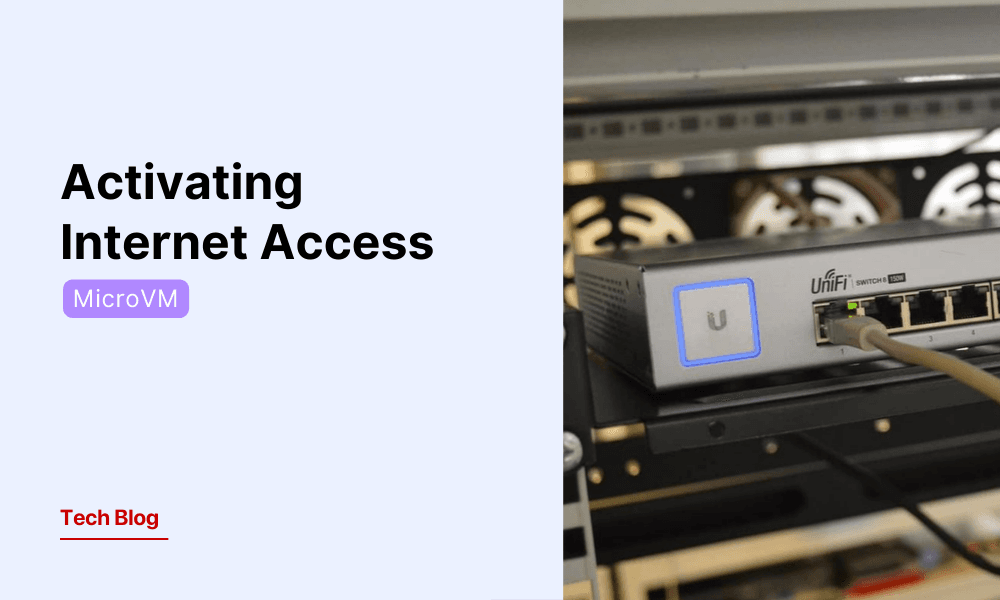
MicroVM: Activating Internet Access

Set up internet access in Firecracker microVMs using firectl. Learn how to configure IP, routes, and DNS with tun/tap devices for seamless networking.

Author

Faiz Ahmed FarooquiPrincipal Technical Consultant.
MicroVM: Activating Internet Access

Leveraging Firecracker for Optimal Functionality with Tun/Tap and Firectl

For individuals navigating the world of cloud computing, virtualization and containers, understanding and effectively utilizing Firecracker becomes imperative.

Firecracker microVMs are designed to enable customers to manage secure, multi-tenant container and function-based services. To control these microVMs, one can use the command-line tool called 'firectl'. This article elucidates the process of attaching a tun/tap device to firectl for facilitating internet access.

A tun/tap device is a virtual network kernel device often used for creating virtual network interfaces. Using tun/tap, data can be redirected from a physical network interface to a program, enabling the creation of virtual network stacks. When setting up firectl, components like the tun/tap device play an instrumental role in ensuring a seamless, optimized networking environment within the microVMs.

However, one key point to note is that simply attaching the tun/tap device to firectl wouldn't grant internet access. A user needs to run specific commands – the focus of our discussion:

For IP Address and Default Gateway, we are using things already prepared in my previous article - Open vSwitch: Create TunTap Devices

Setup the IP Address

To set up the IP address for your network interface, the ifconfig command is used.

Here, eth0 refers to your network device, and 172.168.1.100 netmask 255.255.255.0 is the IP address associated with the network mask:

ifconfig eth0 172.168.1.100 netmask 255.255.255.0 up

The 'up' option at the end of the command will activate the network interface immediately after configuring it.

Define Route

Route all traffic via the gateway at your specified IP using the ip route add default via command. 172.168.1.1 is the gateway in this instance, and dev eth0 specifies the device through which the traffic should be routed.

ip route add default via 172.168.1.1 dev eth0

Configure DNS

Then configure your Domain Name System (DNS) settings. To do so, use the 'echo' command to append a 'nameserver' record to your /etc/resolv.conf file. In the following command, '8.8.8.8' is a Google public DNS server:

echo "nameserver 8.8.8.8" > /etc/resolv.conf

This 'nameserver' command instructs the system to use the specified IP address for name resolution.

By running these specific commands, you can configure the internet access within your Firecracker microVMs using firectl. It is through these steps that we integrate a tun/tap device within the firectl setup, allowing a seamless and robust networking environment.

Conclusion

Setting up internet access in Firecracker microVMs using the tun/tap device with firectl requires executing specific commands.

These steps, despite being an extra part of the firectl setup, are crucial for efficient microVM operation. A clear understanding of these commands enhances microVM performance, security, and resource management efficiency.

Source: This blog is authored by Faiz Ahmed, Principal Technical Consultant at GeekyAnts. Originally published on Hashnode: Read here.
Subscribe to Our Newsletter

RELATED ARTICLES

More from the engineering frontline.

Dive deep into our research and insights on design, development, and the impact of various trends to businesses.
Building Interactive Cards from Design JSON Without Killing Your Feed: Overlays, Video, Mute/Unmute, and Lag-Free Lists

Sep 1, 2026

Building Interactive Cards from Design JSON Without Killing Your Feed: Overlays, Video, Mute/Unmute, and Lag-Free Lists
Learn how to turn design JSON into interactive, video-enabled cards using overlays, smart media controls, caching, and virtualization without slowing down high-cardinality feeds.
The Bug That Doesn't Show Up in Code Review: Why Your Flutter Web App Reloads on Safari

Aug 19, 2026

The Bug That Doesn't Show Up in Code Review: Why Your Flutter Web App Reloads on Safari
A real-world look at how oversized images can trigger Safari reloads and iOS crashes in Flutter apps and how smarter image decoding prevents them.
From Prompting to Process: What Changed When Flutter Shipped Agent Skills

Aug 19, 2026

From Prompting to Process: What Changed When Flutter Shipped Agent Skills
This blog explores how Flutter Agent Skills improve AI-assisted development by combining official framework workflows with project-specific guidance for more consistent development.
Why Everything Your AI Builds Looks the Same

Aug 19, 2026

Why Everything Your AI Builds Looks the Same
This blog explores why AI-generated interfaces often look alike and explains how design systems, product context, and reusable engineering practices help teams build distinctive, scalable
How We Built the Missing Bridge from Code to Figma
Technology

Jul 10, 2026

How We Built the Missing Bridge from Code to Figma
This blog explores how AI-generated React apps get turned into fully editable, designer-ready Figma files by reading React Fiber instead of the DOM.
Building a Resilient Hybrid-Cloud Network with WireGuard HA, Route-Based Failover, and Deep Observability
Technology

Jun 27, 2026

Building a Resilient Hybrid-Cloud Network with WireGuard HA, Route-Based Failover, and Deep Observability
A practical breakdown of building resilient AWS-to-on-premises connectivity with WireGuard HA, active-standby failover, and deep packet-forwarding observability.
We Built a 114-Second AWS-to-Azure Failover. Here’s What We Learned
Technology

Jun 19, 2026

We Built a 114-Second AWS-to-Azure Failover. Here’s What We Learned
A practical guide to building a 114-second multi-cloud disaster recovery failover between AWS and Azure — what we built, what broke, and what we learned.

The Right Conversation Can Save You Six Months.

Whether you’re navigating AI adoption, modernizing legacy systems, or scaling a product - we start by listening. No pitch deck. No template. A real conversation.

MicroVM: Activating Internet Access Configure Firecracker Networking - GeekyAnts