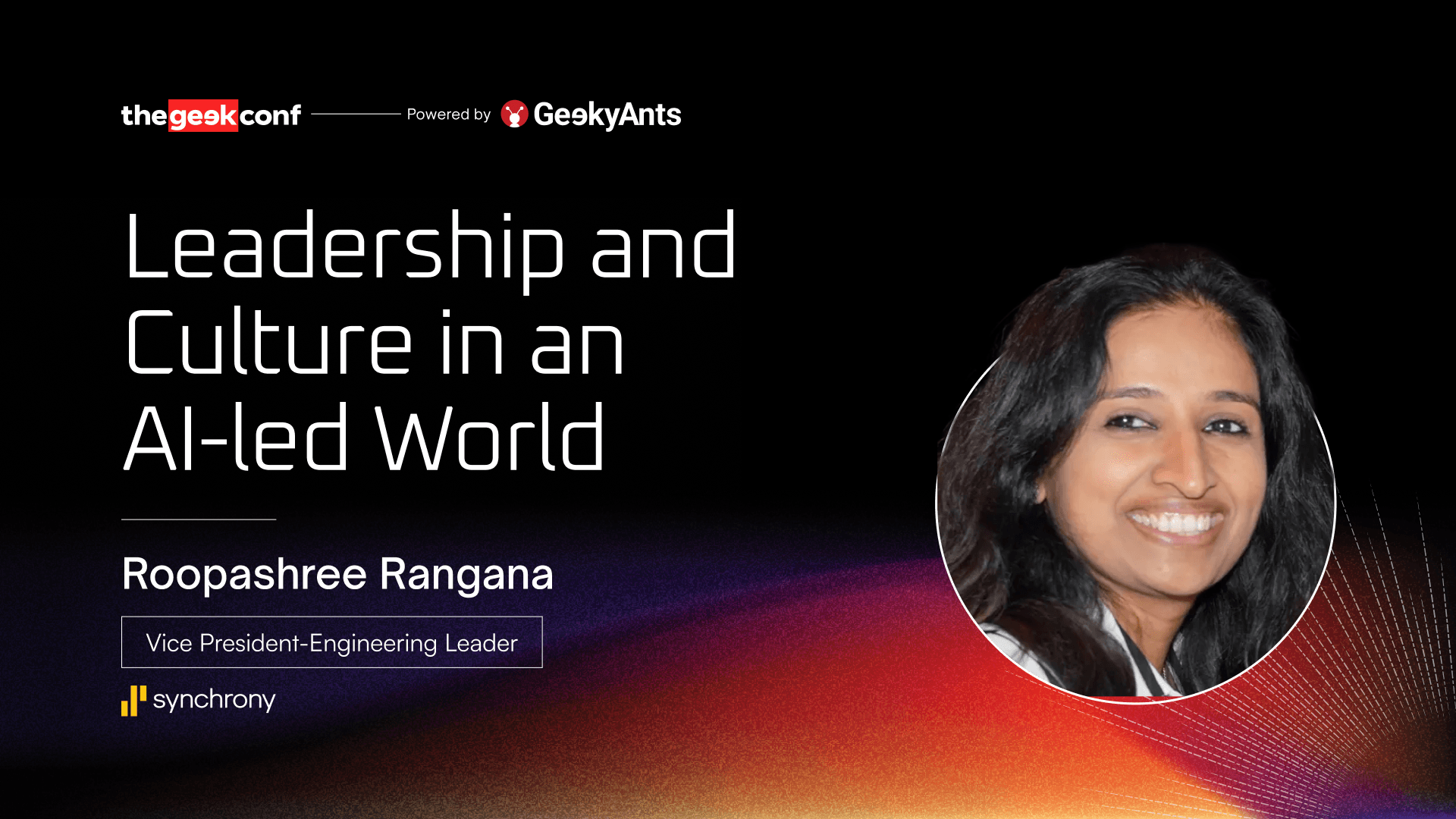

Editor’s Note: This blog is adapted from a session by Roopasree Ranganna at thegeekconf 2025. As the VP, Engineering Leader at Synchrony, Roopasree explores how the era of Artificial Intelligence demands a fundamental shift in leadership and culture. Her talk unpacks the transition from industrial command models to intelligence-led collaboration, emphasizing why staying human is the ultimate competitive advantage in an automated world.
Hi, I am Roopasree Ranganna, VP, Engineering Leader at Synchrony. I have spent 26 years in this industry and have watched every major technological shift from the early days of automation to the current explosion of Generative AI. I remember when we first questioned if machines could think, and today, I see that curiosity alive in my thirteen-year-old daughter. She verifies her schoolwork across four different AI models because she knows one interface might not have the correct answer. This taught me a vital lesson: if we cannot explain these complex systems simply to the next generation, we fail as an industry. I am passionate about removing the fear surrounding AI and refocusing our leadership on a clear, human purpose.
The Shift Toward Intelligence-Led Leadership
We are living through a turning point where old leadership styles no longer work. For decades, the industry relied on industrial leadership. This was the era of the factory revolution, where efficiency, command, and control were the primary requirements. Leaders were characterized as autocratic and aggressive; the style relied on instructions and standard operating procedures to deliver outcomes. That style sustained us for a long time, but the rise of AI and Machine Learning has changed the landscape forever.
I believe we must move toward intelligence-led leadership. This new approach is consultative and collaborative. Rather than dictate orders, we kindle curiosity within our teams. We provide the purpose, and we drive the team forward while removing the fear of the unknown. In this era, leaders are part of the team rather than distant authorities. We use technology to amplify our work, but we rely on our human intelligence to lead the way.
Navigating Failure and Psychological Safety
The current AI landscape is experimental and often intimidating. Recent data shows that 95% of Artificial Intelligence and machine learning projects are failing. We are in a hype cycle where we are still figuring out what will stick. These projects are expensive, requiring massive investments in tokenization, bandwidth, and high-end hardware like GPUs. When failure rates are this high, it creates a culture of fear.
As leaders, we must create a psychologically safe environment for our teams to experiment. We must shift away from the industrial demand for perfection and allow for the failure that comes with innovation. Investment in these foundations remains vital, even when immediate success is elusive. Our job is to give our teams the purpose they need to keep exploring while we manage the risks involved in these million-dollar investments.
The Three Cultural Paths for AI-Ready Teams
Building an AI-ready team requires a specific cultural focus. The first path is embracing the cycle of failure as a learning tool. We must lead our teams to understand that experimentation is the only way to build a lasting foundation. The second path prioritizes curiosity over certainty. We encourage our people to ask questions and find new use cases for AI across different departments. We invest in their curiosity because we do not yet know which ideas will define the company’s future.
The third path is establishing a shared purpose to eliminate the fear of downsizing. When we roll out tools like Copilot, the first question from the Board typically centers on headcount reduction. This creates a culture of "quiet quitters" who worry about their careers. We must articulate a vision where AI changes the business landscape for the better, focusing on the new products and features we can create rather than just the costs we can cut.
The Four Muscles of Modern Leadership
I see four essential muscles that every leader needs to develop in this era. The first is adaptive intelligence. We must be agile enough to pivot our strategies based on the data we see in real time. The second is ethical judgment. We are responsible for the data we feed our models. We must protect trust by ensuring that data preparation lacks bias, particularly during the labeling and annotation stages.
The third muscle is sense-making and storytelling. There is a massive amount of data available today, and it can easily overwhelm a team. Leaders must establish the big picture and tell the story of what that data means for the end user. The final muscle is empowerment. We must remove ourselves as bottlenecks and make every team member accountable. We empower them to make judgment calls and take ownership of their work in this experimental era.
The Human Advantage and Wiser Organizations
The ultimate advantage in an AI-led world is our humanity. AI scales operations and automates administration, but culture amplifies human potential. We possess empathy, care, and imagination. Machines can process data, but humans imagine the vision and the dream that gives that data meaning. We lead the AI in the right direction by using our unique human capabilities.
I believe we are building wiser organizations, not just smarter systems. A smart system runs a process efficiently, but a wise organization keeps the human element at its center. We lead with questions instead of answers. We reward the journey of learning rather than just the final product. By protecting trust and empowering our teams, we ensure our organizations remain relevant long after the current hype cycle passes.