
Most lending institutions have already run an AI pilot, whether a proof-of-concept for automated credit scoring, a sandbox model that predicted default risk with impressive accuracy, or a prototype that cut loan processing time from days to minutes. The results looked promising, and then the project stalled. According to IDC, for every 33 AI proofs of concept an enterprise starts, only four ever reach production. In lending, where regulatory scrutiny is high and the cost of a wrong credit decision is real, that gap between pilot and production is a system design problem.
Why Lending Pilots Stall Before They Scale
The AI performed well in the controlled environment it was built in. The problems surface when the model meets the actual operating conditions of a lending institution.
Loan data in most banks sits across multiple disconnected systems: core banking platforms, credit bureau integrations, loan origination software, and document management tools, none of which share a unified data layer. A pilot can work around this by pulling a clean, curated dataset, but a production system has to handle inconsistent data formats, missing fields, and records that update in real time across systems that were never built to communicate with each other.
Explainability requirements from regulators create a second obstacle. In the US, the Equal Credit Opportunity Act and the Fair Credit Reporting Act require lenders to provide specific reasons when a credit application is denied. An AI model that produces a risk score without a clear, auditable explanation cannot be used in production, regardless of its accuracy. The EU AI Act, which entered full enforcement for high-risk AI systems in financial services in August 2026, formalized similar requirements for explainability and bias auditing. A model built during a pilot phase without these requirements in scope will need significant rework before it can go live.
Credit markets shift and borrower behavior changes during economic downturns, so a model trained on 2021 or 2022 lending data may carry patterns that do not hold in a higher interest rate environment. Without a monitoring and retraining pipeline, the model degrades without any visible signal. McKinsey's 2025 State of AI research found that organizations reporting financial returns from AI are nearly three times more likely to have redesigned end-to-end data workflows before selecting their modeling approach, yet most pilots skip that step entirely.
What "Production-Ready" Means for Underwriting Systems
Production readiness in a lending platform demands infrastructure that sustains model performance under real operating conditions. A system that scores 92% accuracy in a test environment but lacks that infrastructure will not survive contact with production.
Credit decisions draw from multiple sources: bureau data, bank statements, payroll records, tax filings, and in some cases alternative data like utility payments or rental history. Each source carries its own update frequency, format, and error rate. A production system needs automated ingestion, validation, and normalization across all of them, with defined handling logic for missing or contradictory inputs.
Explainability at the decision level is a separate concern from pipeline reliability, and one that often gets underestimated. This means not just logging which features influenced a score, but producing a human-readable explanation for each credit decision that satisfies both the applicant and a compliance audit. Techniques like SHAP (SHapley Additive exPlanations, a method that breaks down how much each input variable contributed to a model's output) are now standard in regulated lending environments.
Without model monitoring, prediction drift goes undetected. If the distribution of incoming loan applications shifts, the model keeps producing scores with no indication that its outputs are diverging from expected behavior. That gap shows up later in default rates or a regulatory finding.
The Architecture Decisions That Separate Pilots from Platforms
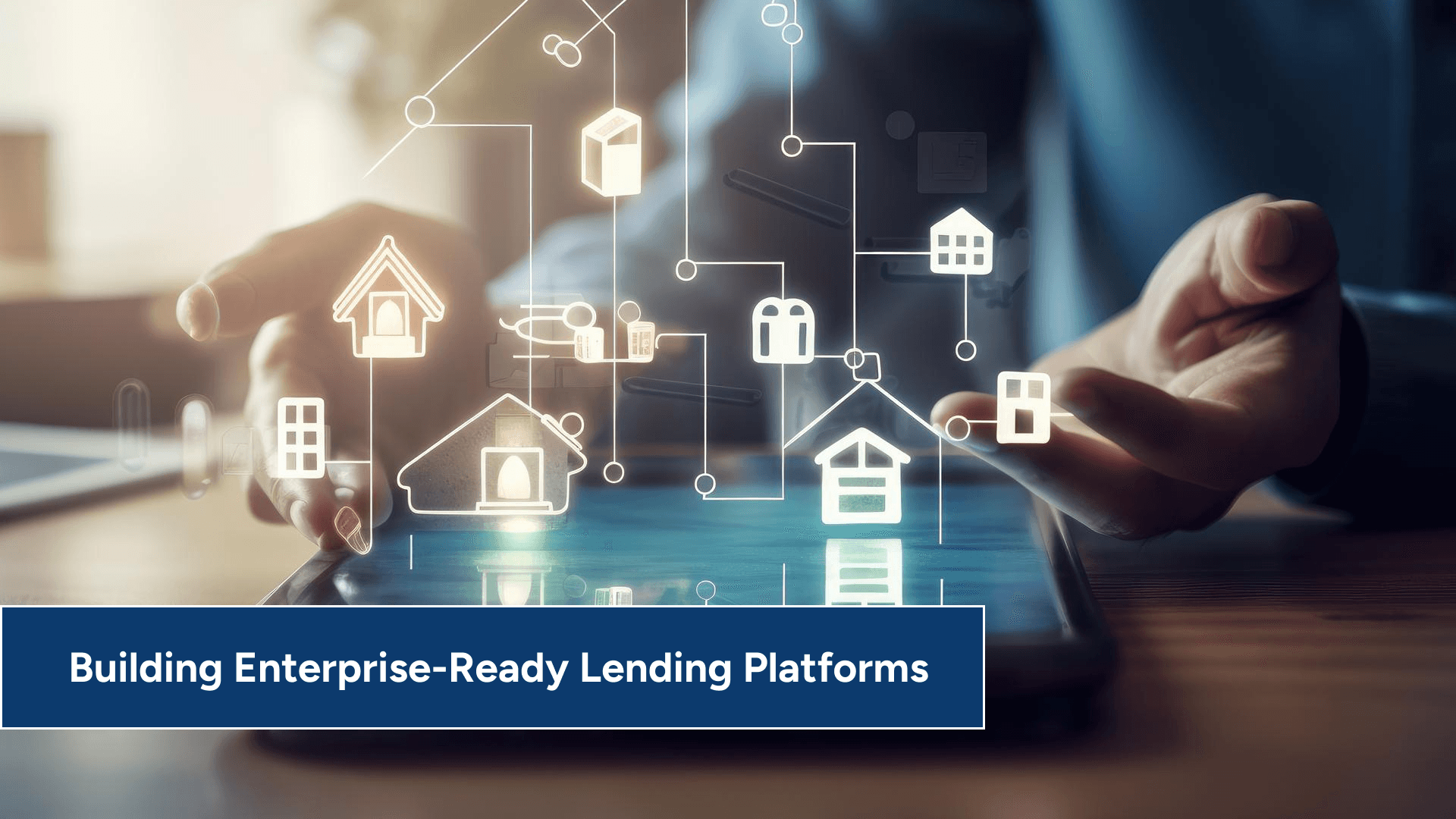
A production lending platform for underwriting and risk scoring is a set of connected components, each designed for the operational reality of a lending institution.
Hybrid architectures combine rule-based logic, which handles regulatory requirements, hard cutoffs, and known fraud signals, with ML scoring, which handles creditworthiness assessment across a wider feature set. A pure ML model creates compliance exposure that most regulated lenders cannot accept, and Forrester's research confirms that rule-based systems still run the backbone of core lending processes. The AI layer augments decisions rather than replacing the governance structure around them.
Automated underwriting can handle a large portion of standard applications, but a production system needs defined escalation paths for applications that fall outside the model's confidence threshold. Underwriters need a clear interface showing the model's reasoning, contributing factors, and data sources.
Integration with legacy core banking systems is a constraint that has to be addressed at the architecture stage. Most banks and credit unions run core banking platforms that are decades old. Building the AI layer as an API-first service from the start keeps integration costs predictable and avoids expensive middleware changes later.
The retraining pipeline belongs in the initial build, covering version control for models, a validation process before any retrained model replaces the live version, and logging that supports both performance review and regulatory audit. Upstart built its platform on training models across billions of repayment events with continuous retraining as new data patterns emerged, and by 2025 it was facilitating over $40 billion in loans annually with loss rates 73% lower than equivalent approval rates under traditional scoring. That outcome came from the infrastructure built around the algorithm.
Moving from Prototype to Platform
Lending institutions that have made AI work in production share a pattern. They treated data governance, explainability, monitoring, and integration as core engineering problems from the start.
The AI-powered risk assessment for lending market reached $7.4 billion globally in 2024, with a projected compound annual growth rate of 24.7% through 2033. Institutions that build production-grade systems now will hold structural cost and speed advantages that traditional underwriting methods cannot close.
GeekyAnts works with financial institutions to bridge the gap between proof-of-concept and production. If your team has a lending AI pilot that has not scaled, the likely cause sits in the architecture and the data layer. That is a concrete, addressable problem, and solving it is where the work of building a production lending platform actually starts.