

Choosing the right AI model is an important decision when building an AI-powered application. But that decision comes with risks. A model that performs well during development may become expensive at scale, struggle with certain tasks, produce inconsistent results, or experience an outage. For businesses handling sensitive information, accuracy, data privacy, and regulatory requirements add further complexity.
These challenges raise important questions for engineering teams. How do you choose the right model for each task? What happens when the preferred model becomes unavailable? And how can businesses switch AI providers without rebuilding the applications that depend on them?
At GeekyAnts, we address these challenges through decisions made throughout application development, from determining which features need AI to integrating multiple models, testing alternatives, and planning for provider changes. This article explains how we approach AI model selection, integration, and portability to build applications that remain reliable as business requirements and AI technologies evolve.
Which Parts of an Application Should Use Code, and Which Need AI?
Software engineers use the word deterministic for a task that follows clearly defined rules: given the same inputs and the same rules, the system is expected to produce the same result. Calculating a loan repayment from an agreed formula is deterministic. So is checking whether a user can approve an expense over a fixed limit. Those decisions can be expressed as code, tested against exact expected answers, and audited when something goes wrong.
Now consider an insurance claim arriving as a scanned PDF. The document may contain handwriting, inconsistent labels, or a description of an accident that does not follow a template. A model may be useful for reading the document and extracting the policy number, event date, and incident description. Once those details are captured, conventional code can check policy status, calculate amounts, enforce access permissions, and route the claim to the right approval queue. The model interprets the messy input; the application applies the rule.
This is the decision GeekyAnts makes at the feature level. If the requirement can be reliably written as an explicit rule, calculation, database operation, or fixed workflow, code is usually the safer, cheaper, more testable choice. If the task requires interpreting varied language, documents, speech, or context that cannot be exhaustively captured in fixed rules, a model may earn its place. Most useful enterprise workflows combine both. And when a wrong interpretation carries serious consequences, the output needs verification or a person’s approval before the system acts.
A documented family-records application shows this separation in practice. AI turns a person’s spoken description into a proposed family tree. The application’s own code chooses the next question, validates relationships, and waits for the user to review the draft before saving anything. That code stays in place if the transcription or extraction model changes. The less the core business logic depends on a provider, the less there is to rebuild later.
How Can One Application Connect to Several AI Providers?
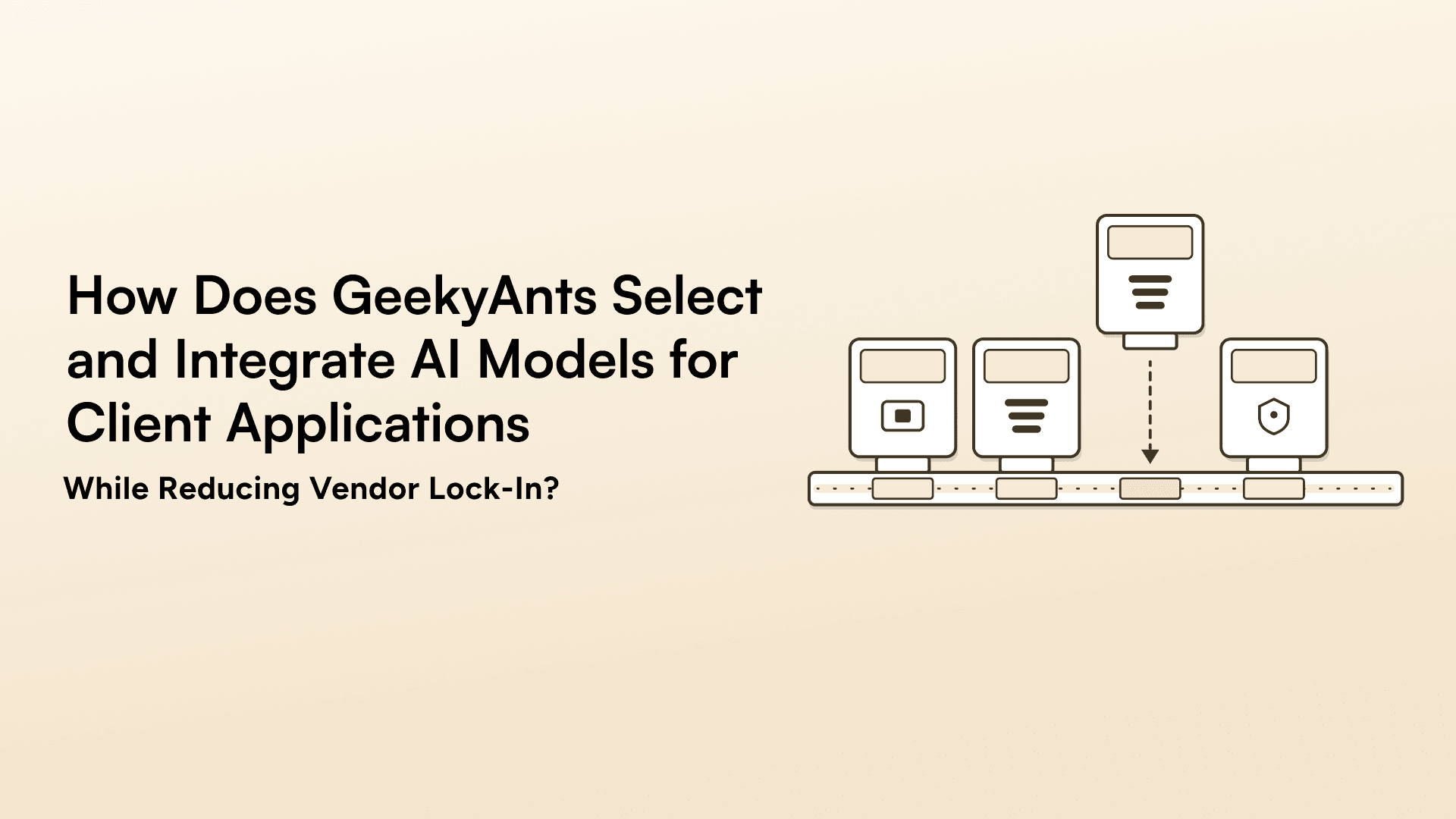
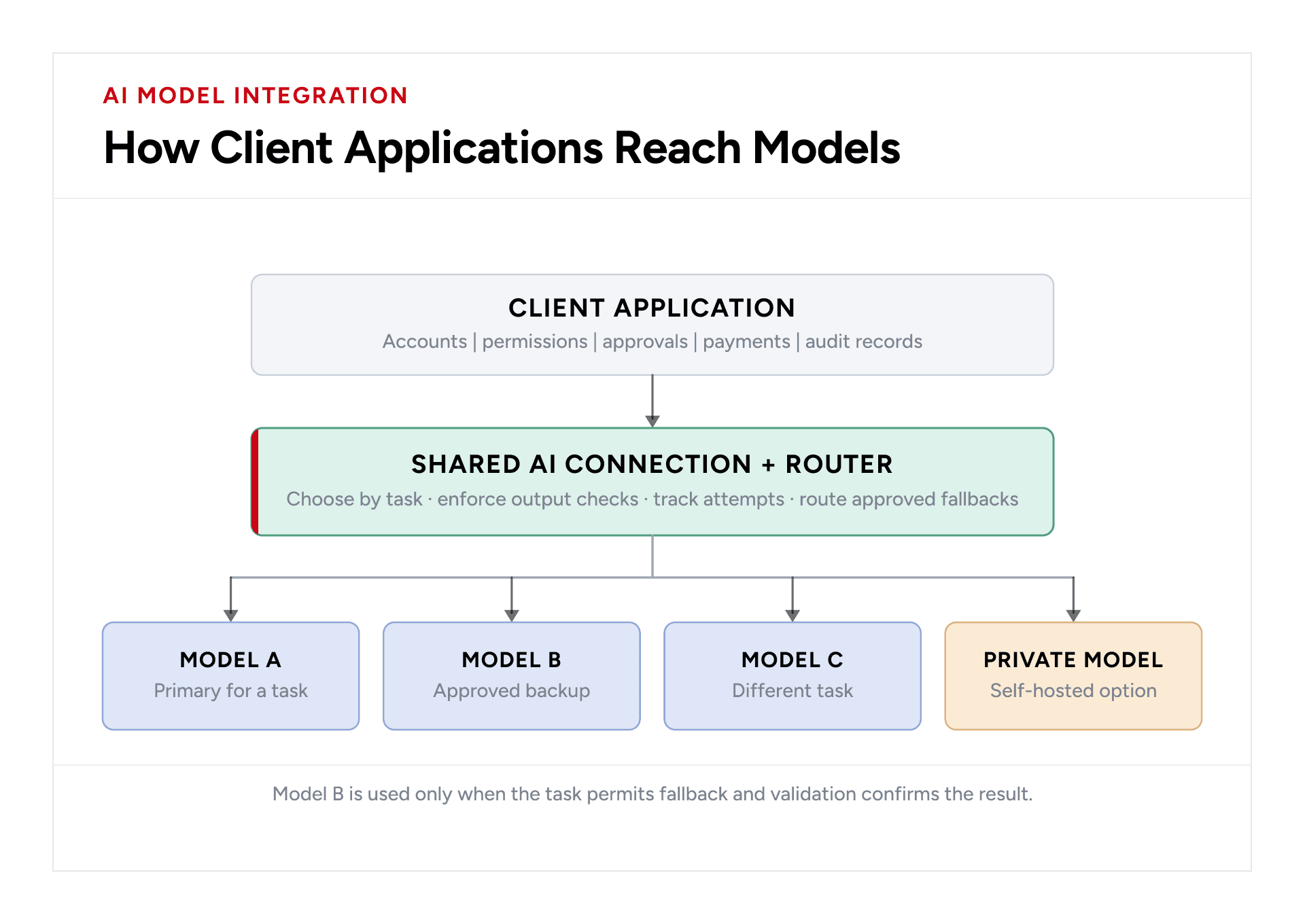
Directly wiring every application feature to one provider makes replacement expensive. Instead, GeekyAnts has implemented a common connection layer for the AI capabilities in two documented client products. The application makes a request in an agreed format. Small provider-specific connectors translate it for Gemini, Claude, OpenAI, or a supported self-hosted model, then return the answer in a format the application understands.
This does not make every provider interchangeable. Text generation, speech transcription, voice synthesis, structured output, and embeddings each have their own requirements. A connector has to account for the provider’s limits, response format, streaming behavior, and errors. The benefit is that those differences are contained in one part of the system instead of spreading through accounts, payments, permissions, and workflows.
The same architecture also supports more than a one-time vendor switch. Different tasks can use different models inside a single application. One model might read documents, another handle conversational explanations, and a third serve as an approved backup for the extraction step. A router, governed by application rules, determines which model handles each request.
In the clinical education platform, Gemini handles production text-generation and scoring tasks, while connectors also support Claude, OpenAI, OpenRouter, and self-hosted models through Ollama. The family-records application has several speech-provider implementations and a self-hosted option. These are implemented as multi-provider paths. They do not, on their own, establish that a complete production migration has already happened.
Can the App Try Model B When Model A Is Down or Gets the Task Wrong?
Yes, when the workflow permits it. Let’s consider a use-case: GeekyAnts sets up model-routing paths for document processing: a preferred model attempts the task first; if it becomes unavailable or returns an unusable result, an approved second model can be asked to try. The user continues through the same application, without having to know which provider handled the request.
There are two distinct types of failure. An outage, timeout, rate limit, or invalid response is usually visible to software. A poor answer is harder to detect. For document extraction, the application can check whether all required fields were returned, dates are valid, values reconcile with other records, and cited information appears in the source. If those checks fail, it may retry with a second evaluated model or send the item for human review. A fluent-looking answer is not proof that the model understood the document correctly.
Consider a real estate platform extracting dates and payment obligations from lease agreements. Model A works for most documents but fails to identify a required termination clause in an unusual layout. A validation rule flags the missing field, and the router sends that document to Model B. The second result faces the same checks. If it also fails, the platform sends the document to a reviewer rather than inventing an answer. This is an illustrative workflow, not a claim about a specific GeekyAnts client deployment.
For automatic routing to be dependable, both models need to be approved for that data and task, tested against the same acceptance cases, and monitored for cost, latency, retry frequency, and quality. The system also needs a limit on how many times it retries. A backup that sends protected information to an unapproved provider or repeatedly produces unreliable answers would create a new problem rather than solve the first one.
What Can Stay the Same When the Model Changes?
The most valuable assets belong to the client: application behavior, source data, permissions, business rules, approved prompts, and the tests defining a good result. Model portability protects those assets while isolating the parts that require adjustment.
Part of the system | What can be reused | What may need work |
|---|---|---|
Product features and rules | User accounts, permissions, workflows, approvals, calculations | Usually no model-related rewrite, provided those rules live in application code |
Prompts and output contracts | Business intent, instructions, required fields, approved examples | Prompt wording, response schemas, formatting and tool-call differences |
Evaluation tests | Labelled examples, acceptance criteria, safety and quality requirements | New baselines and repeated measurements for the replacement model |
Company knowledge | Source documents, access controls and metadata | Embeddings and search indexes may need rebuilding if the embedding model changes |
System connections | Business APIs and controlled actions | Provider-specific tool definitions, permissions and orchestration behaviors |
Records and reporting | Client-owned outputs, decision histories and model usage metadata | Export formats, retention arrangements and conversation-state compatibility |
Search over company documents is one place where the distinction matters. A client can retain the documents and access rules, but changing the embedding model may require generating a new set of search representations and rebuilding the index. The data moves; the search behavior still needs to be measured.
How Does GeekyAnts Choose the Right Model for Each Task?
The starting point is the job a client needs done, not which model has the most attention. A real estate business processing hundreds of differently formatted contracts might prioritize reliable field extraction, document length, and turnaround time. A customer-support workflow may care more about conversational quality, response speed, and cost per resolved request.
In healthcare and financial services, the consequences of a missed fact, unsupported answer, or misplaced record can be far greater. Managed proprietary options such as Claude and Gemini may be shortlisted when their measured capabilities and contractual controls suit the need. But the label proprietary cannot substitute for testing, security review, or approval. Open and self-hosted options can be assessed against exactly the same requirements when client hosting, privacy, or cost makes them relevant.
GeekyAnts also considers model families such as Qwen, Gemma, Kimi, Mistral, and MiniMax for suitable use cases. Each candidate must be tested in the client’s actual workflow. The preferred model for reading documents may be different from the best model for conversational assistance or a private deployment. A single application can deliberately use more than one.
How Do We Know a Replacement Is Good Enough?
A replacement that answers an API request successfully may still fail the business task. The relevant question is whether it handles real examples at an acceptable standard, repeatedly, with predictable costs and an approved data path.
On the anonymized clinical education platform, individual AI tasks have their own evaluation sets. The tests cover case-field extraction, scoring against marking criteria, and identification of safety-critical mistakes. The same example may be run repeatedly because a model that recognizes a critical error once but misses it on the next attempt is not dependable enough for that decision.
A candidate replacement should run through the real application, not a disconnected prompt demo. Engineers compare task accuracy, invalid or incomplete outputs, adherence to instructions, safety failures, latency, costs, language coverage, and consistency across repeated runs. Prompts or provider settings may need adjustment, but the business requirements and acceptance criteria should remain clear. For consequential features, a proposed switch also needs the appropriate human sign-off.
The evaluation needs to cover failure handling as well: what happens when the first provider refuses a request, returns malformed data, becomes slow, or reaches its quota? A model that performs well on clean test inputs but fails the recovery path is not a production-ready backup.
Is Switching AI Providers Really a One-Line Change?
Sometimes the configuration change is one line. The production decision takes more work. Changing a setting can tell an application which provider to call; it cannot establish that a new model follows the same instructions, respects the same data boundaries, or returns acceptable answers.
Moving to another managed provider
With tested connectors already in place, the engineering team updates credentials or configuration, checks provider-specific formats and limits, runs evaluations, reviews data-handling terms, deploys through the normal approval process, and watches performance after the cutover. The main effort depends on workflow risk and compatibility, not the number of lines edited.
Moving to a client-hosted model
Hosting the model privately adds hardware or cloud-computing capacity, model-serving software, scaling, monitoring, security, updates, and operational responsibility. The application may keep its existing features and interface, but the self-hosted candidate still needs to meet quality, capacity, and response-time targets.
Moving AI processing to a different region
A provider may offer the same model in an approved region, but the team must confirm where requests, logs, backups, support operations, and subprocessors process information. A model endpoint in the selected region does not automatically establish complete data residency.
Where Can Vendor Lock-In Still Enter the Design?
A shared connection layer reduces dependence, but it does not erase every difference between providers. Managed assistants, proprietary tool-calling behavior, fine-tuning formats, hosted retrieval, built-in memory, embeddings, prompt caching, and model-specific safeguards can tie a workflow more closely to one service.
Some of those features deserve to be used. A client might get materially better extraction accuracy or faster delivery from a specialized managed service. GeekyAnts can make that trade-off visible by documenting what is provider-specific, keeping source documents and core rules under client control, and estimating the effort of replacing that component later.
When Should the System Refuse to Switch Models Silently?
Availability matters, but the consequence of a wrong answer matters more. When a document extractor misses a required field, another model can make a useful second attempt. When an AI system scores a learner’s clinical response, switching models midway through a scoring decision could change the grade itself. An apparently seamless fallback might create an inconsistency that nobody can explain later.
For that reason, the documented clinical education project deliberately avoids automatic mid-request provider switching. It can use deterministic rubric scoring or report the failure until a person approves a change. The family-records app takes a different route: if voice onboarding fails, the user can continue with a manual form. Both designs keep the application usable without treating every alternative model as an equivalent decision-maker.
Fallback Strategy | When to Use It | How It Works |
|---|---|---|
Retry With Model B | Document extraction or other tasks where an alternate model can safely retry | If the preferred model fails or returns incomplete results, the system routes the task to a pretested backup model and validates its output. |
Use a Non-AI Alternative | Voice-guided onboarding or workflows that can continue without AI | If the AI service becomes unavailable, users can complete the task through a manual form or a rule-based process. |
Stop and Escalate | High-stakes tasks such as clinical scoring or consequential decisions | The system avoids switching models without approval. It uses an approved deterministic method where available or flags the failure for human review. |
What Have We Already Implemented for Clients?
On the clinical education platform, Gemini supports production scoring and text tasks, with additional provider connectors implemented for Claude, OpenAI, OpenRouter, and self-hosted models. Its prompts and evaluation data are kept with the application, and call records identify the provider and model involved. A documented exit procedure covers evaluating a candidate, addressing compatibility gaps, changing the configuration, and monitoring the result after deployment.
That is evidence of a portable architecture and a defined provider-exit path. The supplied project record does not establish that the client has already completed a full production migration. The distinction matters because working connectors are only part of a successful switch; the replacement must be accepted for the actual production workload.
The family-records application provides a different demonstration. It includes multiple speech-provider connections and a self-hosted path, with a manual alternative if voice service fails. The application keeps sensitive audio out of persistent storage and removes temporary transcripts on a schedule. Its engineering choices show how provider flexibility, recovery behavior, and privacy requirements must be designed together.
What Should Be Ready Before a Client Needs to Leave a Provider?
An exit becomes manageable when the important records already live outside the vendor’s service. The client needs access to source data and documents, its approved instructions, application code, test cases, decision history, and a record of which model produced each AI-assisted outcome. It also needs a way to export or delete data held by the outgoing provider under the applicable contract.
The two documented projects make different choices about what should be logged. Clinical scoring requires a more detailed record to support review of disputed results, held in the client’s own environment. The family-records system keeps provider, timing, and error information without retaining unnecessary voice content. Portability does not mean recording everything. It means preserving what must remain explainable while respecting the sensitivity of the underlying data.
Before a planned replacement or outage, a team should know which features call models, which alternate providers have been approved, which evaluations must pass, what backup behavior is allowed, and who has authority to enable a change. With those decisions made early, a vendor problem is less likely to become a crisis for the whole application.
Can the AI Change Without Disrupting the Product?
That is the engineering goal GeekyAnts works toward: the freedom to choose a better model, route an eligible failure to a backup, or meet a new data requirement while keeping the client’s application and business rules intact. The design rests on ordinary code where the rules are clear, AI where interpretation adds value, and testing at the boundary between them. A model may change overnight. The product should still behave in ways its users and owners can understand and trust.