

Key Takeaways
- Enterprises rarely lack project-management software; the missing layer is continuous project intelligence across Jira, Azure DevOps, GitHub, Slack, Teams, email, documents, and calendars.
- An AI project manager observes delivery signals across those systems, interprets project context, predicts emerging risk, recommends action, and escalates issues while humans keep decision authority.
- Value depends on signal coverage, contextual interpretation, prediction quality, and decision controls working together, which is why implementation should begin with read-only intelligence before any automation.
- Buyers should measure success through earlier risk detection, forecast accuracy, and delivery predictability rather than the volume of alerts an AI project management tool generates.
Why Do Enterprises Need an AI Project Manager When They Already Own Project Management Software?
Enterprise delivery teams rarely lack project-management software. The bigger gap is continuous project intelligence, because the health signals of a single program are scattered across Jira, Azure DevOps, Slack, Microsoft Teams, GitHub or GitLab, email, spreadsheets, documents, calendars, and vendor systems.
AI for project management earns its place here, reading those scattered signals into one current view rather than leaving each dashboard to summarize a fraction of the work. Without that layer, summaries stay fragmented and delays surface only once they have already happened.
Enterprises are already spending on AI project management solutions to bridge that gap:
- Grand View Research values the AI in project management projects at $7.7 billion by 2030, a 17.3 percent CAGR.
- McKinsey finds 88% of organizations using AI in at least one function while only 7% report it fully scaled.
- Mckinsey’s 2026 symbiotic enterprise report shows 62% experimenting with AI agents while fewer than 10% scale them in any single function.
An AI project manager closes it by working as one layer over the tools you already run.
It watches the delivery signals those systems generate, reads each one against the wider program, forecasts where risk is building, proposes the next action, and routes the issue to whoever can resolve it while there is still time to act.
An AI project manager addresses that distance:
- A system that continuously observes project signals across connected tools
- Understands delivery context.
- Predicts emerging risk.
- Recommends action.
- and Escalates issues to the right people.
When I look back at the projects that went wrong for us or for our clients, the warning signs were almost always sitting in a pull request, a Slack thread, or an approval that never came, weeks before any report turned red, and what leaders really need is a way for those scattered signals to reach them while there is still time to change the outcome rather than after the delivery date has already been decided by events.
 Kunal KumarChief Revenue Officer
What Is an AI Project Manager, and How Is It Different From Project Management Software?
An AI project manager applies AI agents and predictive models to project planning, execution, risk detection, reporting, and escalation across an organization's existing delivery tools.
It works as an intelligence layer that reads delivery signals continuously and turns them into earlier, better-supported decisions, rather than replacing the platforms teams already use.
How Does an AI Project Manager Compare With Traditional Project Management Software?
Traditional project management software is built to record and organise what teams report. An AI project manager goes a step further by interpreting signals across tools and identifying what may need attention before it appears in a status update.
The difference becomes clearer when the two are compared capability by capability.
Capability | Traditional PM Software | AI Project Manager |
Task tracking | Stores task status, ownership, and due dates | Interprets activity across tools to identify stalled, unowned, or at-risk work |
Risk management | Depends largely on risks being logged and updated manually | Looks for early warning signals and surfaces emerging risks before they are formally reported |
Dependencies | Relies on teams to create and maintain dependency links | Connects documented dependencies and can help surface relationships across teams and systems |
Deadlines | Tracks planned dates and overdue work | Uses progress, capacity, and dependency signals to forecast likely delivery dates |
Blockers | Usually requires someone to report or tag the blocker | Detects patterns such as inactive tasks, approval delays, review queues, and failed handoffs |
Reporting | Pulls together recorded project information into dashboards and reports | Continuously synthesizes signals across connected systems into current project-health views |
Prioritization | Teams manually rank work using agreed priorities | Helps reassess priority using deadline pressure, dependencies, business impact, and risk |
Escalation | Uses manual follow-ups or predefined notification rules | Routes issues based on severity, context, ownership, and defined governance rules |
Cross-project visibility | Often limited to the data held inside the platform | Connects signals across projects and systems to reveal portfolio-level patterns and dependencies |
AI Assistant vs. AI Agent vs. AI Project Manager: Which Do You Need?
The comparison above separates an AI project manager from the software it applies to. But the next distinction separates it from the other AI labels that vendors tend to attach to said software.
MIT CISR's 2026 digital colleagues research, based on a survey of 132 organizations, supports where the real line falls: AI creates enterprise value when it operates within workflows, connects across systems, and escalates consequential decisions to accountable humans.
Type | What It Does | Scope | Where Humans Fit |
Responds when prompted: summarizes, drafts, answers | Single conversation or tool | Human initiates every action | |
AI automation | Executes predefined rules | Single workflow, fixed triggers | Human designs the rules upfront |
AI agent | Observes, reasons, and acts toward a goal | Multiple systems, one objective | Human sets the goal and boundaries |
AI project manager | Applies agents to project work with context, prediction models, and escalation logic | Entire delivery stack, portfolio-wide | Human approves consequential decisions |
A buyer weighing a SaaS AI feature, a standalone agent, or a custom AI project manager is choosing between these levels of workflow depth, and the sections below give the criteria for that choice.
Why Does Enterprise Project Management Break Down Even With Good Tools?
Good tools rarely fail on their own- enterprise project management breaks down because the state of a program is scattered across the systems teams work in daily.
The same breakdown shows up in cloud migrations, platform modernization, compliance-heavy releases, and customer-facing product launches, where the plan reads on track while the real signal sits in a stalled infrastructure change, an unresolved security approval, a slipping vendor dependency, or a feature waiting on QA capacity.
This is the gap AI for project management is meant to close, reading across those systems rather than adding one more place to update. The four breakdowns below explain where the visibility goes and why another tracker never recovers it.
Project Data Lives Across Too Many Systems
Chances are your current project data is structured like this:
Milestones → in Azure |
The problem is obvious- since no single tool holds the complete state of the program, every status view is partial due construction.
Project Status Is Often Outdated When Anyone Reads It
Here’s a scenario:
Let's say you have an API for payments workstream, and it has shown green for two weeks. You’ll see an updated dashboard, as a result.
What you might not notice right off the bat is how leads might be left unreviewed or sign-offs have gone into email threads- left unchecked. Unfortunately, the report will only tell you what someone last typed into a status field. However, by the time it turns red, the delay has already happened.
Dependencies Cross Team and Project Boundaries
A typical AI MVP is held up by a chain that looks like this:
AI MVP delivery → Data-platform team readiness → Infrastructure change → Vendor contract sign-off |
Where, every arrow represents a dependency. While each team in the chain is capable of tracking their work independently, the entire consolidated chain goes unchecked.
But projects are rarely this linear- one delayed item and the entire pipeline is blocked affecting several teams at once.
Risks Appear in the Data Before Teams Report Them
If you’d like more evidence:
- Rising PR cycle time
- Reopened tickets
- Review queues piling on one engineer
- Milestones with no linked activity
These are further measurable signals that human reporting cadences catch up weeks after the pattern starts.
Managers Spend Their Time Collecting Status Instead of Acting on It
Lastly, program managers on customer-facing launches spend a large share of each week assembling updates from Jira, Git, chat, and email into decks that fall stale on arrival. The breakdown is structural rather than a failure of discipline, which is why another tracking tool never fixes it.
How Does an AI Project Manager Actually Track Project Health?
So how do delivery leaders get ahead of these problems without adding more status meetings, more spreadsheets, or yet another tool for teams to update?
Simple. Add a layer to read signals instead of asking anyone to report more.
Consider this working model for project management with AI:
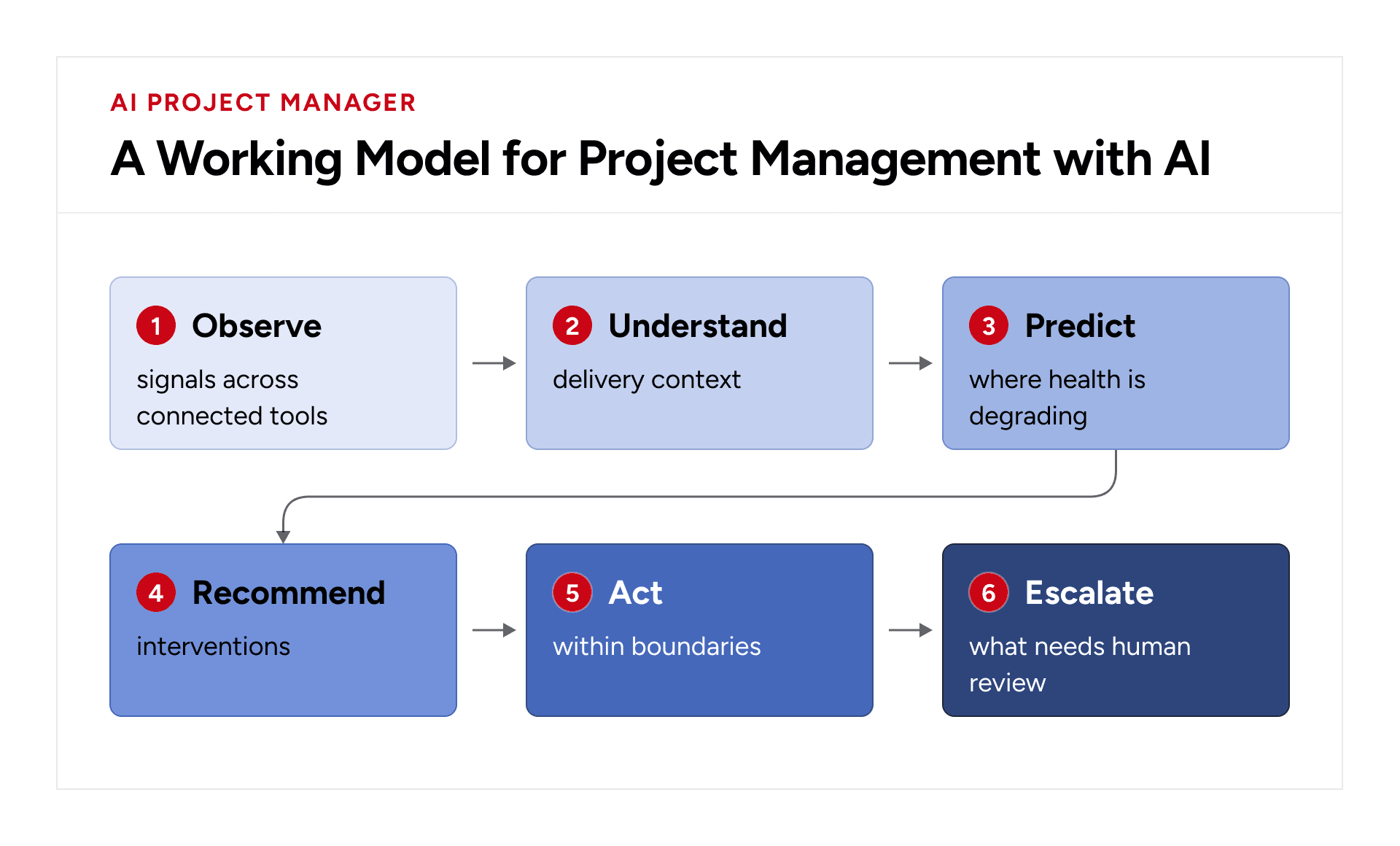
See what happens when you point this loop at your actual delivery stack below.
How Does AI Track Tasks Across Fragmented Tools?
Tasks are where fragmentation shows up first, because there is a distinct gap between discussions in meetings and documented audits. What task intelligence can do for you is treat every connected tool as a source of task truth, covering the following:
Task intelligence checklist |
☐ Captures commitments made in standups, meeting notes, and chat threads and converts them into structured tasks with an owner and a date before they evaporate |
☐ Scans the backlog for work carrying no owner, which is common for items created in a hurry mid-sprint |
☐ Flags stale tasks whose linked activity - commits, comments, status changes - has gone quiet for longer than their priority justifies |
☐ Surfaces overdue items grouped by the milestone they threaten, instead of a flat list nobody reads |
☐ Estimates completion from how similar work actually ran in your history, rather than from whatever number was typed in at planning |
☐ Re-ranks the backlog continuously against deadline, dependency, and customer impact, so priority reflects the business instead of entry order |
Not only does this save time per week but also helps optimize and streamline tickets across tools.
How Does AI Detect Blockers Before They Stall Delivery?
Check your regular signals repeatedly. Because detection runs in the following pipeline:
Detect → Classify → Impact → Recommend → Escalate |
Here's what each stage of that pipeline focuses on:
A. Detection watches four signal families at once:
- Technical signals such as a build failing repeatedly on the same branch
- Resource signals such as one reviewer holding six open PRs
- Approval and vendor signals such as a sign-off request
- Communication signals such as a decision thread that simply ends.
B. Classification names what kind of blocker it is
C. Impact scoring measures how much depends on it
D. Recommendation carries a suggested owner and next action
E. Escalation arrives as something a manager can act on rather than another notification to triage.
As a result- the security sign-off that gets lost in email threads even when the dashboard signals otherwise can get caught on day 1 rather than week three.
How Does AI Map Dependencies, Including the Ones Nobody Documented?
Every delivery organization has two dependency graphs: the one in the plan and the real one. Mapping both makes cross-project intelligence possible.
The documented graph is the easier half
- Task-to-task links
- Cross-team handoffs
- Cross-project chains
- External vendor dependencies
These typically can be maintained with AI assistance, and the critical chain computed from them stays current as work moves.
The undocumented graph is materially harder, because it must be inferred so every link carries its supporting evidence and waits for human confirmation before entering the plan.
What-if analysis then runs on the confirmed graph: ask what happens to the product launch if the API team misses its Friday milestone, and receive a traceable answer instead of a shrug.
The result is a MVP-to-vendor chain that is in a documented plan which owners have access to.
How Does AI Predict Project Risks?
Risk prediction works because the leading indicators of every major risk type already exist in your delivery data; humans just see them in separate tools on separate days.
Correlate them in the following manner:
Risk type | Leading signals the system correlates |
Schedule | Velocity trend against remaining scope, milestone burn rate |
Resource | Allocation data, leave calendars, review-queue concentration |
Scope creep | Requirement churn, tickets added mid-sprint against the baseline |
Dependency | Upstream slippage propagated through the confirmed graph |
Quality | Defect rates, reopened tickets, shrinking test coverage |
Compliance | Pending approvals measured against regulatory deadlines |
Customer impact | At-risk items mapped to customer-facing commitments |
Prediction quality rises with the depth of historical delivery data available and risks reach you much faster reducing the cost of fix.
How Does AI Track Deadlines and Predict Delays?
A calendar can tell you what is due; only a forecast can tell you what will actually land, and the difference between those two answers is where commitments get saved or lost.
Forecasting combines historical completion patterns, remaining work, team capacity, and upstream dependency delays into an estimate of each milestone's genuine landing date, then converts that estimate into early warnings and at-risk escalations while intervention still changes the outcome.
Honest forecasting also carries uncertainty rather than false precision and it degrades openly on novel programs with sparse history instead of pretending otherwise. Instead of a report that turns red after the delay has already happened, you get the warning while the date can still be saved.
How Does AI Handle Prioritization and Escalation?
Detection and prediction only matter if the right person hears about the right thing while there is still time to act. Prioritization gives the system a consistent way to rank everything it sees, and each factor below pairs the question being asked with the signals that actually answer it:
Factor | Question the system keeps asking | What it weighs to answer it |
Deadline | Which commitments land first? | Forecasted landing dates, not just calendar due dates |
Business impact | What does this work protect or earn? | Revenue, contractual, and OKR weight tagged on the work |
Dependency | How much is waiting behind this? | Downstream items gated by it on the confirmed graph |
Risk | How bad does this get if ignored? | Predicted severity and likelihood from the risk models |
Resource | Where is capacity genuinely scarce? | Constrained skills and single-person bottlenecks |
Customer impact | Does this delay reach a customer? | Links between at-risk work and customer-facing commitments |
Escalation then climbs a graduated ladder, where each rung has a defined trigger, a defined recipient, and a payload they can act on rather than a bare notification:
Task due in three days with no linked activity → Owner: with the task's evidence trail attached
Task overdue → Project Manager: grouped by the milestone it threatens, with a suggested reassignment
Critical dependency at risk → All affected Project Owners: with a what-if projection
Milestone forecast to miss a contractual date → Leadership: nothing moves until they approve
Every escalation is logged with the evidence that triggered it, and the thresholds on each step are tunable per program, so the ladder enforces your governance rather than a vendor's defaults.
Where Does AI for Project Management Deliver the Most Value for Enterprise Engineering Teams?
The capabilities above are generic until they meet a specific kind of delivery organization, because what counts as a meaningful signal in a sprint differs from what counts in a compliance program. Here is what an AI project manager tracks in each environment.
Software Development
For a VP of Engineering the system track:
- Sprint progress against forecasted completion
- Pull-request queues for review delays that predict slippage
- QA readiness against the release cut
- Developer capacity from actual allocation
- Backlog priorities as deadlines and dependencies shift
- Release plans across engineering and QA and approvals and dependent work
A release at risk gets flagged while every individual ticket still shows in progress.
Platform Engineering
Platform teams sit upstream of everyone, so the system tracks:
- Infrastructure dependencies as a graph of consuming teams
- Migration milestones against the workstreams waiting on them
- Shared-service blockers before they propagate
- DevOps handoffs between infrastructure and platform and application teams
- Release dependencies that can delay downstream teams
A slipping platform commitment surfaces with the possible issues being highlighted attached instead of being discovered team by team.
Digital Transformation
Transformation programs fragment status worse than anything else, so the system tracks:
- Parallel workstreams in one model
- Vendor dependencies against their contractual commitments
- Business-unit handoffs where coordination stalls.
- Transformation milestones across teams and vendors and systems
- Executive reporting that gives leadership a consolidated view of programme health
McKinsey's researchfinds the largest AI gains come from redesigning workflows end to end, and transformation is where that applies to delivery itself.
Customer Experience and Digital Product Teams
Product leaders get tracking weighted by customer consequence:
- Launch deadlines forecast from real progress
- Feature dependencies across squads
- Design-to-engineering handoffs
- Release readiness assembled from build, QA, and approval signals.
A customer-facing delay outranks an internal slip of equal size.
IT and Enterprise Operations
Operations leaders run the highest signal volume in the company, so the system tracks:
- Requests and incidents against SLA clocks
- Infrastructure milestones alongside competing tickets
- Compliance items aging toward regulatory deadlines
- Approval workflows where pending sign-offs can hold up operational work
That volume and structure make operations the natural first candidate for read-only intelligence.
What Does an Enterprise AI Project Manager Architecture Look Like?
Every time we architect one of these systems, the temptation is to let it act from day one, but the sequence that actually survives production is the opposite: give it read access to everything, write access to nothing, and let it spend its first weeks proving that what it says about your projects is true, because once teams have checked its alerts against reality and it has earned that trust, expanding into approval-gated actions is a small step. Whereas an agent that acted wrongly in week one never gets a second chance with the engineers it embarrassed.
 Saurabh SahuChief Technology Officer (CTO)
The value of AI for project management rests on its architecture, since AI project management software reports project health reliably only when its layers are built to read signals, interpret them, and route decisions to people.
A reference model makes those layers concrete, running from the source tools through to the dashboards leaders work from.
Which Layers Make Up the Reference Architecture?
A production-grade AI project manager stacks ten layers: data sources, an integration layer, a project knowledge layer that normalizes signals into a unified model, an LLM and reasoning layer, risk and prediction models, agent orchestration, workflow automation, a human approval layer, an audit and governance layer, and dashboards on top.
Which Core Systems Should an AI Project Manager Integrate With?
Integration priority should follow signal density rather than convenience, because each connected system unlocks a different kind of visibility. The matrix below maps the core sources and what each one adds:
System | Data AI Can Use | What That Visibility Unlocks |
Jira | Issues, sprints, dependencies | Work-item truth and sprint health |
Azure DevOps | Work items, releases, pipelines | Release and build risk |
GitHub/GitLab | PRs, commits, issues | Real engineering progress behind the status fields |
Slack | Blockers, decisions, discussions | Blockers surfaced in conversation before anyone logs them |
Microsoft Teams | Meetings, messages, decisions | Decisions and commitments made verbally |
Requests, approvals, deadlines | Approvals aging silently outside the tracker | |
Calendar | Meetings and milestones | Time actually available against time planned |
Confluence/SharePoint | Project documentation | Scope and decision history for context |
HR/resource systems | Capacity and availability | Leave and allocation feeding resource risk |
The key architectural argument follows from this matrix: an AI project manager becomes more valuable with access to relevant project context, well ahead of access to more AI models.
A modest model reading Jira, Git, chat, and approvals will outperform a frontier model reading Jira alone, because project health lives in the connections between systems.
How Do You Implement AI in Project Management Across an Enterprise?
For enterprises, project management with AI should begin as read-only intelligence, and any power to act should be earned in stages after that. Engineering organizations have the least reason to start otherwise, because their delivery stack already produces the signals, so the work is wiring those signals together and proving accuracy first.
The reliable path runs through read-only intelligence first, expanding into automated actions only after each stage below has cleared its gate.
Step 1: Identify High-Value Project Workflows
Choose one or two workflows where earlier risk detection visibly changes outcomes-
a release train with contractual dates, a migration gating other teams- and name the executive who owns the result. A high-stakes, signal-rich workflow with a committed owner proves value faster than a broad, shallow rollout that belongs to nobody.
Step 2: Audit Existing Project Data
Prediction quality depends on history, so measure what your data can actually support before promising intelligence it cannot. A practical audit checks the following:
Data audit checklist |
☐ Jira hygiene: do tickets carry real owners, dates, and status transitions, or placeholder values |
☐ Git-to-ticket linkage: can commits and PRs be traced to the work items they serve |
☐ Historical depth: do at least two or three quarters of comparable delivery history exist for forecasting |
☐ Status semantics: does "blocked" or "done" mean the same thing across teams |
☐ Communication accessibility: are the channels where blockers actually surface available to connect under policy |
The audit output doubles as the data-quality backlog your teams fix in parallel with the rollout.
Step 3: Connect Core Systems
Integrate the highest-signal sources first- the work tracker, the code platform, and the primary chat tool - through least-privilege, read-only service accounts, and record what each connector may access as part of the audit trail. Every later integration follows the same permission discipline it establishes.
Step 4: Establish a Unified Project Data Model
Normalize tasks, owners, dates, dependencies, and status semantics into one schema so that a blocked item, a milestone, and an approval mean the same thing regardless of source system. Cross-system intelligence is impossible without this shared vocabulary, and the mapping decisions made here determine what every later prediction can see.
Step 5: Define AI Decision Boundaries
Specify in writing what the system may observe, what it may recommend, and what it may never change, and have the owners of each connected system sign the document. PMI's 2026 Standard for Artificial Intelligence in Portfolio, Program, and Project Management, the first global standard for AI in project work, builds human-in-the-loop oversight into every lifecycle stage, and boundaries defined before deployment are what make that oversight real rather than aspirational.
Step 6: Start With Read-Only Intelligence
Run status synthesis, project-health views, and risk alerts with no write access, and hold the output to a traceability standard: nearly every material statement should link back to the source evidence behind it, and managers should adjudicate alerts as true or false during this phase. The accuracy record built here is what every later expansion of power rests on.
Step 7: Introduce Controlled Automation
Permit low-risk, reversible actions: reminders, draft escalations, task-hygiene updates- once read-only accuracy has been demonstrated, with every action logged and a human able to undo it. Recipient targeting deserves its own check, since an escalation sent to the wrong owner erodes trust faster than a missed one.
Step 8: Establish Human Approval Gates
Route consequential recommendations- reprioritization, deadline changes, anything touching an external commitment through named approvers who see the supporting evidence alongside the recommendation. Approval friction at this layer is a feature, and it maps directly to the automate-versus-human table in the governance section below.
Step 9: Measure Accuracy and Business Impact
Track alert precision and recall, detection lead time, forecast error against your current baseline method, and time returned to managers, and keep a no-AI baseline period for comparison, because without one a pilot proves the system produces output while revealing nothing about incremental value. The numbers then govern each expansion of scope: an implementation that measures itself earns autonomy gradually instead of assuming it.
The gates below turn the rollout into something you can measure. Every figure in the table is an illustrative pilot threshold rather than a market benchmark, since no published industry standard exists for any of them. Treat each number as a starting point and tune it against your own delivery history, risk tolerance, data quality, and current forecasting method before you hold a phase to it.
Pilot phase | What to test | Illustrative success gate | Duration |
Read-only synthesis | Daily project health, owners, blockers, no write-back | ~95% of material statements traceable to evidence; meaningful reduction in status-prep time | 2 weeks |
Risk early warning | AI alerts running alongside existing risk reviews, humans labeling each | Precision ~80%, recall ~70% against adjudicated risks; positive detection lead time | 3–4 weeks |
Dependency reconstruction | Explicit chains plus known undocumented ones seeded in authorized data | ~90% of critical explicit dependencies correct; zero AI-created links without approval | 3 weeks |
Deadline backtest | Historical snapshots predicted forward, compared with your current method | Forecast error beats the baseline by ~15%; predictions carry uncertainty | 4 weeks |
Controlled action | Approval-gated reminders and escalations | 100% of actions logged; near-perfect recipient targeting; nothing high-impact autonomous | 2 weeks |
Read every percentage in this table as "roughly," measured against your baseline rather than an external target.
Should You Build or Buy AI Project Management Software, or Take a Hybrid Path?
For AI project management software, the decision turns less on the build-or-buy label than on how much of your enterprise delivery stack an option can see, because a tool that reads only part of that stack can explain only part of your project risk.
Most published answers to this question come from platform vendors, whose products naturally sit on the "buy" side of it.
The framework below is deliberately neutral: the table maps requirements to paths, and the scorecard underneath gives you a way to evaluate any option against the same criteria.
Requirement | Buy | Build | Hybrid |
Commodity tracking, boards, and reports | Solved out of the box | Never worth building yourself | Keep the platforms you have |
Native AI summaries and status drafts | Included and improving | Rebuilding vendor features adds no value | Comes free from the platforms |
Workflows specific to your organization | Your process bends to the vendor's model | Modeled exactly as your teams run | Custom layer encodes them over standard tools |
Intelligence across Jira, Git, chat, and email | Stops at the vendor's connector list | Full coverage of your actual stack | Custom layer reads across every system of record |
Escalation rules that encode your governance | Vendor defaults with limited tuning | Written to your decision rights | Custom logic routes over platform data |
Proprietary delivery history as an asset | Learnings accrue inside the vendor's product | Stays yours, trains only your models | Stays yours in the intelligence layer |
Regulated workflows and audit obligations | Certified platform, generic controls | Controls built to your specific obligations | Custom controls, platform as system of record |
Time to first value | Days to weeks | Quarters | Weeks to a pilot, then staged |
Cost shape over time | Per-seat licensing that scales with headcount | Upfront engineering, then operating cost | Moderate build cost on top of existing licenses |
Read down each column and a pattern appears: buying wins wherever the requirement is commodity, building wins wherever the requirement is yours alone, and the hybrid column inherits the best cell of the other two on almost every row, which is why most enterprises land there.
When Does Existing AI Project Management Software Make Sense?
Buying fits when delivery lives mostly inside one platform ecosystem, workflows are close to standard, and the vendor's native AI features- status drafting, risk flagging, workload analysis cover the need. Speed to value is the decisive advantage, and the honest test is whether the platform can see enough of your delivery stack to detect the risks that actually hurt you.
When Does a Custom AI Project Manager Make Sense?
Building fits when intelligence must span systems no single vendor connects well, when escalation rules encode your governance rather than a vendor's defaults, or when proprietary delivery data and regulated workflows demand controls off-the-shelf tools cannot express.
Ownership of the intelligence layer, and of everything it learns from your history, stays with you.
When Is a Hybrid Approach Right?
Most enterprises land here: keep existing platforms as systems of record and build a custom intelligence layer that reads across them, adding prediction and escalation logic while every team keeps its current tools. The hybrid path delivers cross-system intelligence without a migration, which is why the integration architecture above matters more than any single product choice.
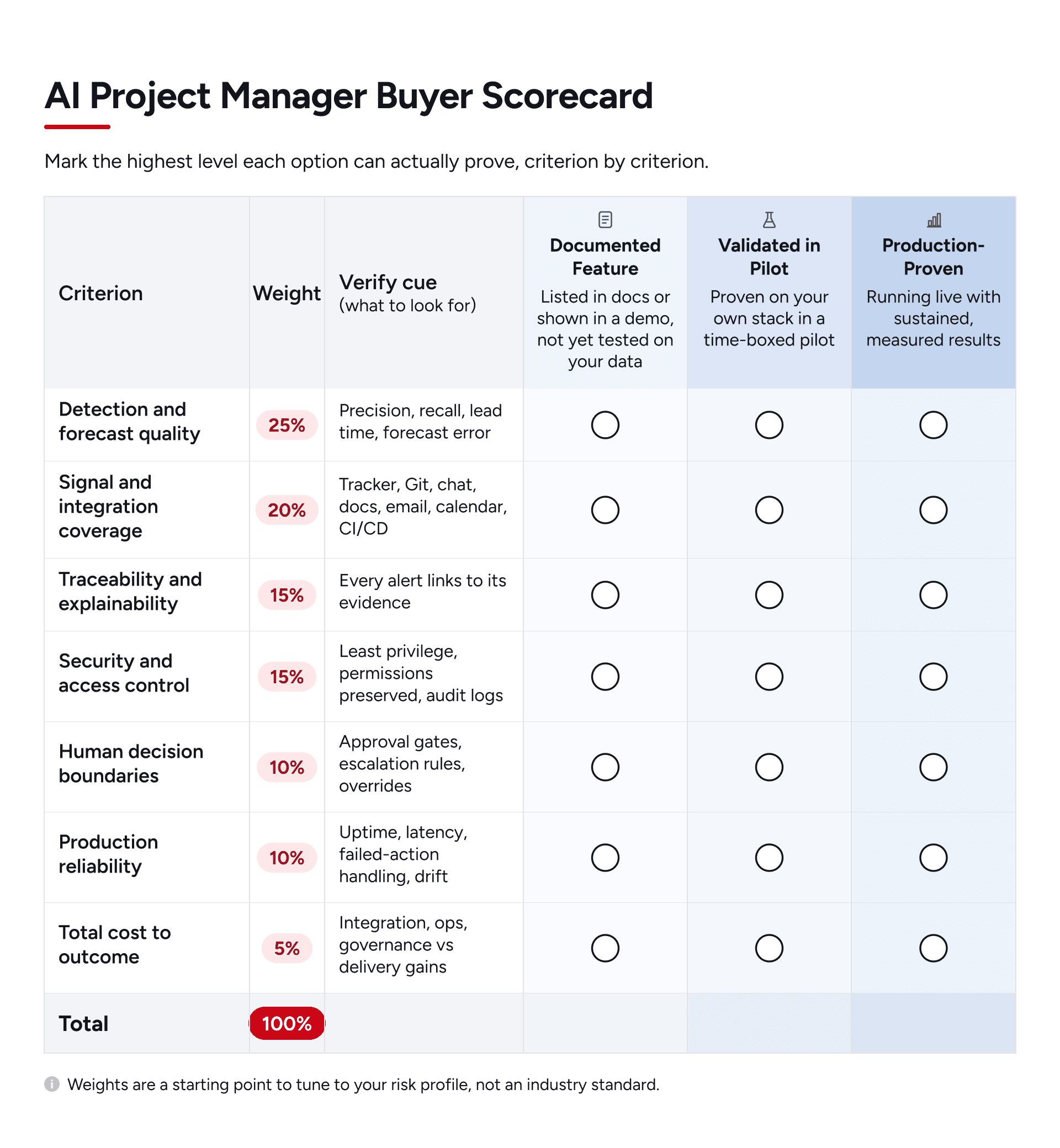
Whichever path you evaluate, score the candidates on the same weighted criteria. The weights below are an editorial starting point to tune for your risk profile rather than an industry standard:
Criterion | Suggested weight | What to verify |
Detection and forecast quality | 25% | Alert precision and recall, blocker lead time, forecast error and calibration |
Signal and integration coverage | 20% | Work tracker, Git, chat, docs, email, calendar, CI/CD, vendor systems |
Traceability and explainability | 15% | Every alert links to the events, messages, or documents supporting it |
Security and access control | 15% | Source permissions preserved, least privilege, audit logs |
Human decision boundaries | 10% | Approval gates, escalation rules, overrides, safe failure behavior |
Production reliability | 10% | Uptime, latency, failed-action handling, drift monitoring |
Total cost to outcome | 5% | Integration, operations, and governance cost against measured delivery gains |
What Are the Risks of AI in Project Management, and What Should Stay Human?
Every capability in this article has a failure mode, and enterprise trust depends on naming them before a vendor demo glosses over them. The three groups below cover data, operations, and decision rights.
Explainability decides whether leaders trust any of this. A project leader should be able to trace every alert or escalation back to the exact ticket, pull request, approval, message, or dependency that triggered it, and a system that cannot show its evidence gets overruled the first time it is wrong.
Incomplete Data and Confident but Wrong Answers
Intelligence is only as honest as the signals feeding it. A system with gaps in its view produces confident answers that happen to be wrong, in a few recurring ways:
- A system reading only Jira misjudges work being discussed in Slack or held up in email, and does so with full confidence
- Activity gets mistaken for progress, since commits, comments, and meetings can show motion while the milestone comes no closer
- False alerts pile up until managers learn to ignore the detector, which is why precision, recall, and alert burden all need measuring
- Every alert should link to its evidence, so managers can challenge the system instead of obeying it
- Forecasts degrade on novel programs, reorganizations, and sparse history, which is why they must carry uncertainty
Over-Automation, Integration Complexity, Security, and Adoption
Reading your systems and acting on them are different risk classes, and the operational failure modes cluster around that line. Four deserve naming before any rollout:
- Write access granted before accuracy is proven turns detection errors into action errors, so an acting agent needs the same permission, identity, and audit rigor as any production service
- Source-system permissions must survive into the intelligence layer, or it becomes a side channel around your access controls
- Each connector adds latency, credential, and failure modes that operations must own for as long as it runs
- Adoption collapses the moment teams read the system as surveillance, and the strongest countermeasure is having them co-define its alerts and boundaries
Human Oversight: What to Automate and What to Keep
Decision rights work best written down as explicit tiers rather than discovered during an incident. Three tiers cover it: what the system does freely, what it does only behind a named approver, and what it never touches.
Runs freely | Needs a named approver | Stays human entirely |
Task creation and hygiene | Reprioritizing work across teams | Scope changes |
Status summaries and routine reporting | Deadline changes on tracked milestones | Contractual commitments |
Reminders and meeting action items | Escalations that reach leadership | Major resource decisions |
Risk alerts and dependency monitoring | Reassigning ownership of at-risk work | Stakeholder negotiations and executive decisions |
The dividing line is the consequence. NIST's draft TEVV-Athlon framework argues AI should be evaluated against intended use and real-world outcomes rather than generic benchmarks, and the same logic governs oversight: the higher the consequence, the stronger the human gate.
How Do You Measure the ROI of an AI Project Manager?
License price misses most of the economics, so measure the full cost and hold it against delivery outcomes.
A working formula:
Total Production Cost = Software and Model Spend + Integration Work + Data Normalization + Security and Governance + Monitoring and Operations + Human Review + Change Management + Error and Rework Cost. |
Operational Metrics
Track whether delivery itself is improving through:
- On-time delivery rate
- Schedule variance
- Blocker resolution time
- Risk detection lead time
- Dependency resolution time
- Task completion rate
Task completion rate shows whether work is actually moving to completion rather than simply remaining active across the project system.
Detection lead time deserves particular attention because an alert that gives leadership five extra working days is far more useful than one that identifies a problem after the deadline has passed.
Management Metrics
Track whether managers are spending less time collecting project status and more time acting on it through:
- Time spent on status reporting
- Time spent on review preparation
- Manual escalation volume
- Forecast accuracy against the previous baseline
- Project review quality
Project review quality measures whether reviews become more useful through stronger evidence and clearer risk visibility and better decision support.
Calibration belongs here too. When the system marks ten milestones as 70 percent likely to slip roughly seven should.
Business Metrics
Delivery predictability, resource utilization, cost variance, customer-impacting delays, and portfolio risk exposure translate the gains into executive language.
One executive measure ties everything together-
cost per reliable project outcome: the total operating cost of the capability divided by projects or milestones delivered while meeting your agreed reliability thresholds.
A working metric rather than a research standard, and comparing it against a no-AI baseline period turns a pilot report into an investment case a CFO will accept.
Conclusion: From Project Tracking to Project Intelligence
So how do you judge your AI project manager?
- You can evaluate the system against outcomes
- Are risks being identified earlier?
- Are forecasts becoming more dependable?
- Are project reviews based on stronger evidence?
- Are managers spending less time reconstructing project status?
The answers to these questions should determine whether the system expands beyond observation into automation.
Afterall, the real test of an AI project manager is if the project signals lead to better project decisions that help in the long term.
Why Choose GeekyAnts to Build Your AI Project Manager?
GeekyAnts treats AI and project management as an engineering integration problem first: connecting the systems where delivery signals live, grounding every recommendation in evidence, and adding automation only behind explicit approval boundaries. The clearest proof of that approach is already in production as the Execution Intelligence AI Signal Bot, part of the GeekyAnts AI Accelerator hub.
The Problem it Solves
In field-based, operational, and service-oriented teams, the latest information about a project exists in a WhatsApp group as opposed to the tracking tool. Information about delays, commitments, work reassignments, and interdependencies are communicated in the chat discussion but make their way to Jira or Asana only once people make an effort to log them in.
The leaders end up receiving an outdated version of the delivery because a risk flagged on Tuesday may not get to the one who needs to do something about it until Thursday.
How it works across delivery signals
A specially assigned assistant becomes part of the team that is sanctioned to work on a project and goes through the written project update provided in that particular context.
It picks up the signals that drive a project, including task status, task owner, task priority, blockage, dependency, and risk, and maps them to the appropriate project, owner, and deadline.
Thereafter, it formulates a well-structured action in the form of creating a task, changing the status, reassigning, or escalating the signal. Each action suggestion passes through a human gate, where the authorized lead or manager approves or modifies or declines the suggested action. The action suggestion that gets approved then returns the action back to Jira, Asana, ClickUp, or Azure DevOps.
Layers that are Utilized
The accelerator works on the same reference architecture presented in this article.
- An integration layer connects the conversation channel to systems of record
- The knowledge layer standardizes every update to a shared model of work and owners
- A reasoning layer classifies the input and proposes an action
- A human approval layer authorizes every write
- Role-based dashboards present the output for leads, managers, and executives with the source message and approval history included.
- Security and deployment cover everything, with options for client-hosted models and audit logging when needed.
The Outcome for Delivery Leaders
The results are presented through the time gained back and early identification of risks. The teams gain back 5 to 8 hours a week previously invested in gathering the status updates, cut down 2 to 4 hours preparing for every leadership review, and identify execution risks 1 to 2 days faster compared to manual reporting.
Every individual gets the same version of delivery reality according to his needs – from portfolio overview for CEO to task-level queue for the team leader.
What building execution-intelligence systems has taught us is that the signals leaders need were in their tools all along, and the moment those signals started reaching decision-makers days earlier — with the evidence attached — the conversations changed from explaining what slipped to deciding what to protect, which is the shift every delivery organization is actually buying.
Kunal KumarChief Revenue Officer
Sources and Citations
- Grand View Research — AI in Project Management Market Report
- McKinsey — AI at Work but Not at Scale
- McKinsey — The Symbiotic Enterprise
- MIT CISR — Leveraging Digital Colleagues for Enterprise Value
- PMI — The Standard for Artificial Intelligence in Portfolio, Program, and Project Management
- NIST — AI Risk Management Framework
- NIST — TEVV-Athlon Framework for Evaluating AI Systems