
In the fast-moving world of software development, organizations constantly face the challenge of delivering high-quality applications at speed. Customers expect frequent updates, bug-free experiences, and robust security. Traditionally, testing was treated as a separate phase that happened only after development was complete. This “test at the end” approach often led to last-minute defect discovery, high rework costs, and delayed releases.
To overcome these limitations, many teams have adopted Shift-Left Testing. This approach ensures testing is no longer a final checkpoint but a continuous activity that begins at the very start of the software development lifecycle (SDLC). By shifting left, teams prioritize quality early, enabling faster delivery and more reliable applications.
What is Shift-Left Testing?
Shift-Left Testing is a strategy where testing activities are moved “left” in the project timeline, meaning closer to the initial stages of development. Instead of waiting until code is written, testing begins during requirements and design discussions, continues through coding and integration, and supports the entire lifecycle.
In traditional SDLC:
Requirements → Design → Development → Testing → Deployment
In Shift-Left SDLC:
Testing + Requirements → Testing + Design → Testing + Development → Deployment
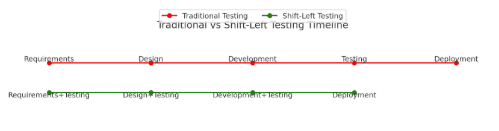
This visualization makes it clear—traditional testing waits until the end, while Shift-Left integrates testing at every phase.
Why is Shift-Left Testing Important?
One of the biggest motivations for adopting Shift-Left is cost reduction. Fixing a defect during the requirement phase may cost a few hours of discussion, while the same bug found after release can cost days of debugging, patching, and customer support. Moreover, in today’s Agile and DevOps-driven environment, speed is critical. You cannot afford long test cycles at the end of development.
By bringing testing early, teams achieve:
- Faster feedback loops.
- Higher-quality code.
- Reduced integration issues.
- Stronger collaboration between business analysts, developers, and testers.
In short, Shift-Left Testing ensures that quality is built into the product, rather than being added at the end.
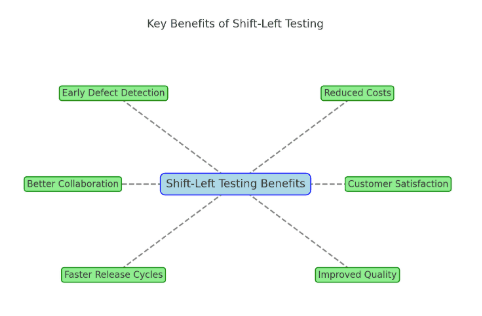
Benefits of Shift-Left Testing
The advantages of shifting left can be looked at from both technical and business perspectives.
Technical Benefits:
- Early defect detection and prevention.
- Improved code quality with unit testing, static analysis, and automation.
- Reduced integration risks and production bugs.
- Continuous quality checks aligned with CI/CD pipelines.
Business Benefits:
- Reduced rework and lower overall project cost.
- Faster release cycles and improved time-to-market.
- Better compliance and security validation.
- Enhanced customer satisfaction and trust.
How to Implement Shift-Left Testing
Adopting Shift-Left Testing requires both cultural change and technical practices. Below are practical steps teams can take:
1. Involve QA Early
Rather than bringing testers in at the end, involve them in requirement workshops and design reviews. They can highlight ambiguities or missing scenarios before coding begins.
2. Adopt Test-Driven Development (TDD)
TDD ensures developers write tests first and then implement just enough code to pass those tests. This not only enforces discipline but also guarantees code aligns with requirements.
Example (JavaScript):
//Function to check if a number is even

// Step 1: Write the tests
test('returns true for even numbers', () => {
  expect(isEven(4)).toBe(true);
});

test('returns false for odd numbers', () => {
  expect(isEven(5)).toBe(false);
});

// Step 2: Write the minimal code
function isEven(num) {
  return num % 2 === 0;
}
3. Use Static Code Analysis
Static analysis tools like SonarQube or ESLint detect code smells, vulnerabilities, and style violations before execution. This prevents low-level issues from reaching production.
4. Automate Tests in CI/CD
Embed automated unit, integration, and end-to-end tests into pipelines. Every code change triggers tests, giving instant feedback.
Example (GitHub Actions):
name: CI Pipeline
on: [push]
jobs:
  build:
    runs-on: ubuntu-latest
    steps:
      - uses: actions/checkout@v3
      - name: Install dependencies
        run: npm install
      - name: Run tests
        run: npm test
5. Embrace Behavior-Driven Development (BDD)
BDD uses simple language (often Gherkin syntax) so that business users, developers, and testers all share the same understanding.
Feature: User Login
Scenario: Successful login with valid credentials
Given the user is on the login page
When they enter a valid username and password
Then they should be redirected to the dashboard
Metrics to Track
To know whether Shift-Left Testing is working, organisations should measure:
- Defect Detection Percentage (DDP): % of defects caught before release.
- Mean Time to Detect (MTTD) and Mean Time to Resolve (MTTR) defects.
- Code Coverage: % of code tested by automated suites.
- Release Velocity: Time from commit to deployment.
- Cost Savings: Reduction in rework efforts compared to past releases.
Challenges in Adopting Shift-Left
No change is without hurdles. Common challenges include:
- Cultural resistance: Developers may see testing as outside their responsibility.
- Skill gaps: Testers may need to learn coding and automation frameworks.
- Tooling complexity: Setting up pipelines, automation, and monitoring requires investment.
- Initial overhead: Writing tests early may slow down the first few sprints.
The key to overcoming these is training, clear communication of benefits, and gradual adoption.
Best Practices
- Foster a quality-first mindset across teams.
- Start with small wins, such as unit testing + CI integration.
- Invest in training developers and testers on automation tools.
- Ensure tests are reliable and fast to avoid slowing down pipelines.
- Maintain a balance between automated and exploratory testing.
Real-World Example
Consider an e-commerce company developing a checkout system.
- Without Shift-Left: During user acceptance testing, QA discovers that certain payment methods fail. Fixing requires redesigning integration with payment gateways—a costly and time-consuming rework.
- With Shift-Left: Testers join requirement workshops, developers write unit and integration tests for payment flows, and automation validates APIs during development. Issues are caught early, resolved quickly, and the release proceeds without delay.
This example illustrates how Shift-Left reduces both cost and risk.
Conclusion
Shift-Left Testing is not just a methodology but a cultural transformation in how teams approach quality. By embedding testing into requirements, design, and development phases, teams can prevent defects rather than just detect them.
From a technical standpoint, it strengthens code quality, accelerates CI/CD, and reduces integration issues. From a business perspective, it lowers costs, speeds up delivery, and ensures customer trust.
In an Agile and DevOps-driven world, adopting Shift-Left is no longer optional—it is essential. By shifting left today, you not only move defects out of your way but also move your software quality right where it belongs: at the heart of development.