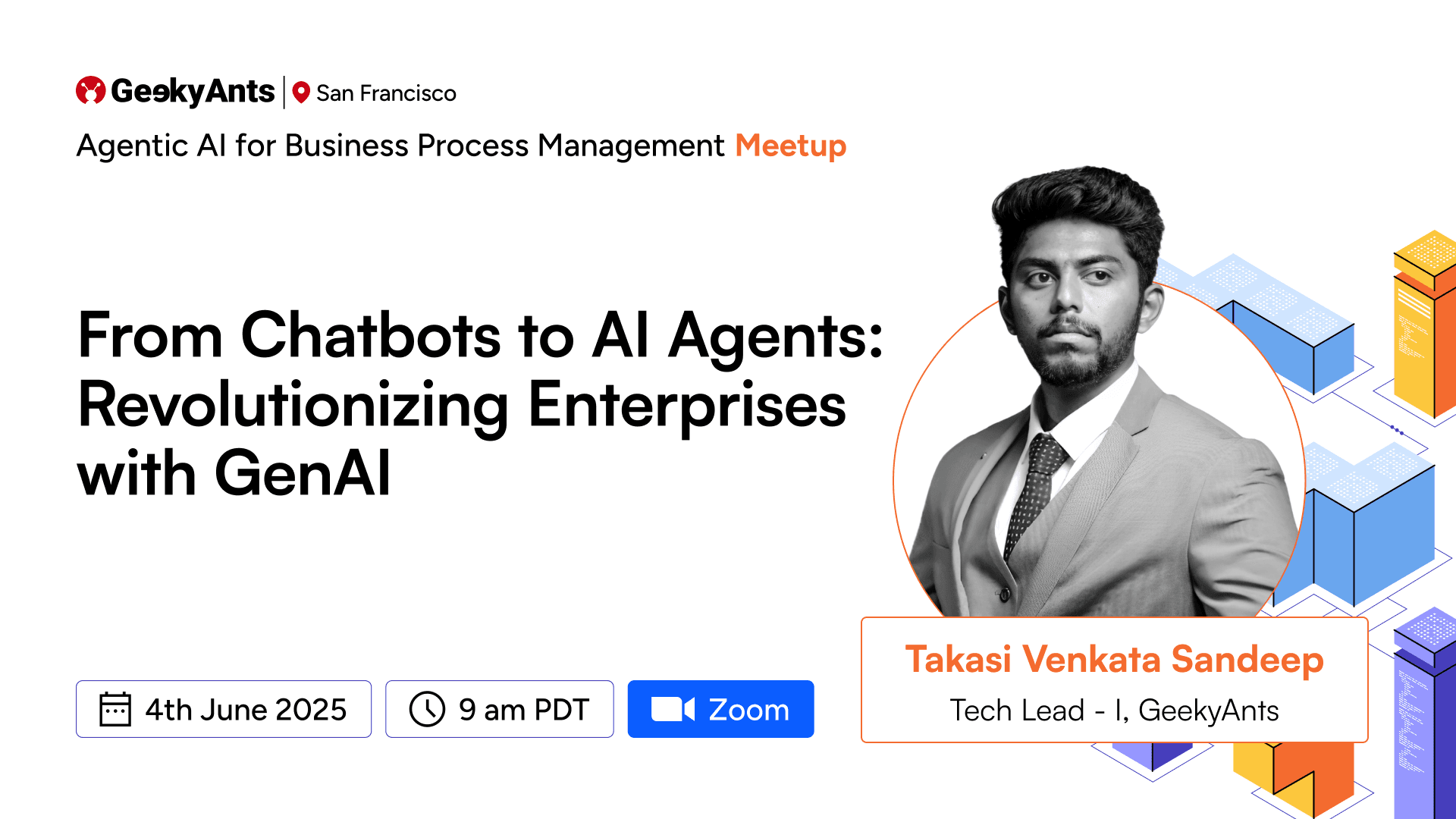

Editor’s Note: This blog is adapted from a talk by Takasi Venkatesh Sandeep, Tech Lead at GeekyAnts. In this session, Akai walked through the current evolution from simple chatbots to enterprise-ready AI agents. He offered technical insights, real-world use cases, and a grounded view of how generative AI is already transforming operational workflows.
Understanding the Shift from Prompts to Performance
My name is Takasi Venkatesh Sandeep. I work as a Tech Lead at GeekyAnts, where my team and I focus on developing AI-native tools and systems. Over the past year, I have been researching and implementing intelligent agents for enterprise use—systems that go beyond question-answering and begin to make decisions, take actions, and collaborate across roles.
We have seen the rise of generative models. We have used chat interfaces and prompt tools. We have explored fine-tuned assistants and retrieval systems. What we are building now belongs to the next stage. These are not just models with better prompts. These are structured agents designed to operate inside complex environments.
This is where our attention is shifting. This is where the real work begins.
What Makes an Agent Different
A chatbot receives a question and returns a response. An AI agent receives a task and begins to work.
This difference is structural. Agents combine multiple components—reasoning logic, memory, external tool access, and adaptive feedback. Instead of responding once, they move through steps, evaluate intermediate outputs, and adjust their behaviour based on both instruction and outcome.
Each agent is built around four concepts. There is a persona that defines its role. There is a memory that allows it to retain past interactions. There is a toolset that lets it access external data and perform actions. Finally, there is a model that drives its thinking process.
In practical terms, this means an agent can read logs, identify issues, consult documentation, submit a ticket, and notify a human—all without writing a single prompt.
The Workflows That Can Be Transformed
Let us consider how this applies to real systems. In a software engineering context, an AI agent can monitor error reports and trigger alerts when production stability is at risk. In a support context, agents can resolve tickets by checking knowledge bases, updating CRM records, and confirming follow-ups with customers.
In a hospital, a single agent can receive a query from a patient, book an appointment, update the clinical database, and inform the attending doctor of the case summary and flagged symptoms.
We are not speculating here. These workflows have already been implemented in various settings. The structure is simple, but the execution requires alignment between models, APIs, business rules, and human oversight.
This is where engineering teams need to focus.
Working with LangChain and Beyond
At GeekyAnts, we have used the LangChain framework to build and orchestrate these agent workflows. LangChain provides a foundation that supports memory, decision flow, and tool integration. With extensions like LangGraph and LangSmith, it becomes possible to create multi-agent systems that reason in parallel and share information.
In one prototype, we built a collaborative setup with three agents. One parsed customer request. Another evaluated the technical feasibility. A third prepared responses with cost and time estimates. They worked together, passing structured messages between nodes.
This structure mimics how teams collaborate in real-world companies. The difference is that these agents do not need scheduling. They do not require meetings. They are ready to respond as soon as context is available.
Defining a Useful Architecture
A strong agent system does not begin with a model. It begins with a clear process.
We define that process by identifying repetitive, predictable workflows. We map the tools involved—databases, APIs, and internal dashboards. We label decision points. Then we assign agent responsibilities using well-scoped personas. Each persona is aligned with a specific set of tasks and tools.
Memory is configured to retain what matters. This can include past decisions, user preferences, or episodic logs of multi-step interactions. With this setup, agents do not operate in isolation. They evolve through feedback and context retention.
When implemented well, this design reduces turnaround time, improves consistency, and increases system-level responsiveness.
Why This Matters Now
According to recent industry research, over sixty percent of enterprises are planning to deploy agentic systems in the next year. Agent-based fraud detection, document summarisation, inventory prediction, and contract analysis are already in motion.
In healthcare, a Chinese hospital recently launched a fully agent-driven diagnostic system. In the automotive industry, BMW is using predictive agents to manage inventory. In finance, teams at JP Morgan have integrated agentic risk assessment layers into compliance workflows.
These changes are not temporary experiments. They reflect a broader movement toward intelligent automation, where systems are built to observe, decide, and act.
Constraints and Considerations
Agents require clarity. Vague goals and poorly defined workflows will lead to hallucinations, failed outputs, and high costs. Security and compliance also matter. Sensitive systems need proper authentication, traceability, and explainability. Models should be auditable, and decisions must be reviewable by humans.
Feedback loops help here. When agents log actions, store context, and receive validation from users, they improve over time. This does not mean that risk disappears, but it becomes visible and manageable.
We recommend starting with a single workflow. Choose one that repeats often and carries measurable value. Then build the agent to match. Iterate quickly. Review outputs. Scale when stability is reached.
Where to Begin
You do not need a full platform to begin. Tools like LangChain, AutoGen, and AWS Bedrock already provide what is needed to assemble basic agent flows. For those working in code, these libraries are flexible and developer-friendly. For teams exploring no-code interfaces, platforms like SuperAGI offer visual orchestration.
In either case, the key requirement is intent. You need to understand what the agent must do and what defines success. Once those two things are clear, building becomes easier.
Final Thoughts
We are moving toward systems that take initiative. These systems will not replace all work, but they will reshape how work is structured and delivered.
If you are interested in building or experimenting with intelligent agents, I would be glad to share what we have learned at GeekyAnts. You can reach out to me through our community or on LinkedIn.
This is a good time to begin. The tools are ready. The frameworks are available. The rest depends on how we design the work.