
“The customer’s perception is your reality.”
The quote above which was said by Kate Zabriskie, a veteran from the development industry, is the ethos that the concept of having a product mindset runs on. We come from an agile software development background and have seen two extremes. At one extreme is big upfront planning, requirements gathering, long project estimates, and minimal customer input. The other extreme is no planning and just throwing developers at a new feature and letting them build it without much context to what is coming ahead. Neither approach really works well in the long term and leads to many problems.
To avoid these issues we use a product mindset where we focus on our customers' needs first and deliver products that delight them from the outset.
What is the product mindset and how to adopt it?
With fast-paced technical innovation entering the marketplace, a product mindset means putting the customer first. Breakthroughs happen when we innovate together by focusing on the customer, not when we aim to claim credit alone. The product mindset is a formula for unleashing breakthroughs that customers love.
Your customers are out there - what are you going to do?
Product Mindset helps us to understand the app’s users in order to deliver exactly what they really want, when they really need it and ship the right features to the right customer at the right time.
Product Mindset Benefits
Product mindset is beneficial for software development teams for two primary reasons.
- Firstly, it encourages the entire team to think about development through the lens of customers.
- Secondly, it helps the team think holistically about what their goals are. When we work to achieve product centricity, we are moving towards a quicker business outcome using data-driven decisions which lead to a better understanding of what works.
Why should we apply a product mindset in software development?
Lots of organisations care about software, but very few of them really understand the craft of good product management. When trying to create a great software product, we must be both empathetic product owners and visionary product thinkers. This helps to remove obstacles, bridge the gap between business and engineering and represents a product to the world. Product thinking is concerned with understanding the motivations of users, the problems they face, their context and how a product might add value to their lives.
Product thinking suggests a twist on our habitual approach to software delivery. It turns the normal process of building/testing/shipping/supporting software inside out, to make it better. With product thinking, you build only when there is a real user need for what you are building. And you don’t start work on something until you have a clear picture of the outcome. This way of working creates organisations where teams ship very high-quality software frequently, and having fun in the process.
How Product Mindset Helps With Product Estimation -The Paradox of Estimation
The estimation of software development is only one aspect. When we estimate for a project by product, let’s say like the estimating for a section of software, we estimate for each of the activities – say testing and coding. By summing up these individual estimates, we arrive at an estimate for the section of software that needs to be delivered.
How do we get to an estimate that is the least contentious and is in line with the client’s budget? It needs to be feasible, achievable and realistic. An estimation that doesn’t match or meets the buyer’s expectations will most likely lead to a possible cancellation of the project. Another important thing to consider is that while it is important to adhere to the budget, we also need to keep the product and mind and ensure that it is giving a great experience possible to customers.
Practising Product Mindset At GeekyAnts
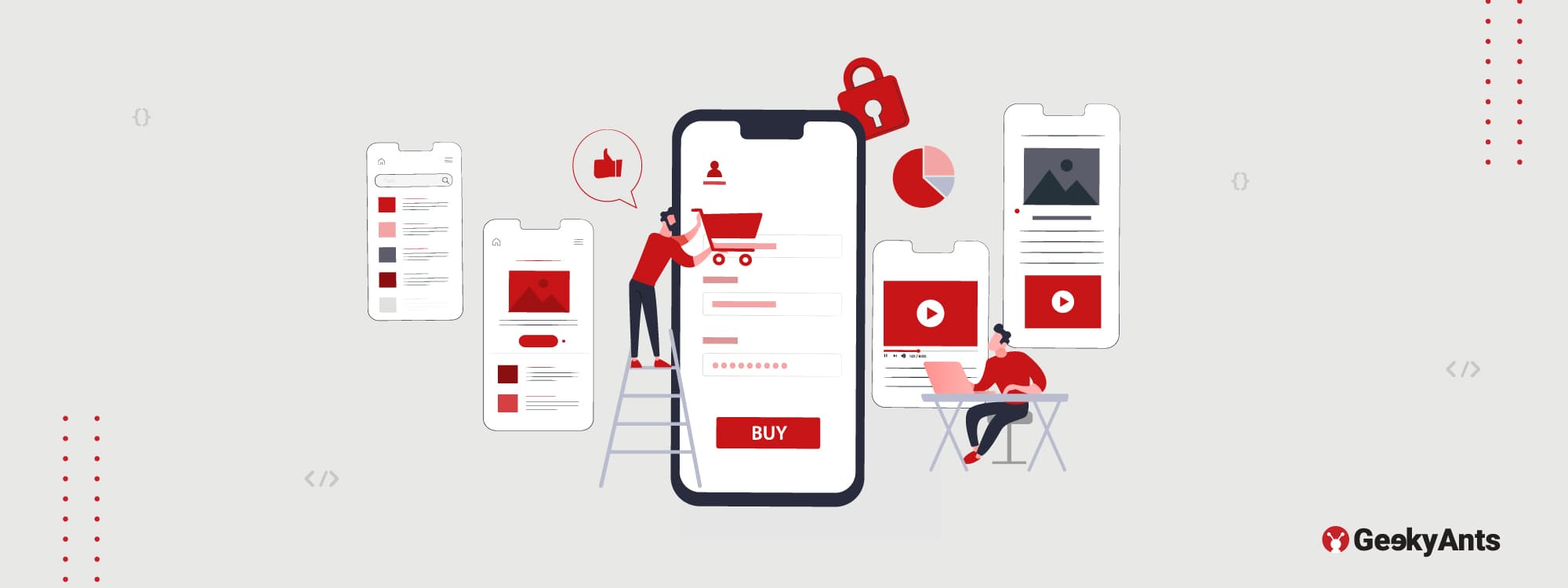
At GeekyAnts, we don't just develop software; we create customer experiences that delight users. We think technology should be helpful in life and not feel like a hindrance. That's why our application designs have a user interface that is intuitive, the experience of interacting with it is pleasant, and the software is stable. We try to understand the customer’s requirements, both functional and aesthetic, and plan accordingly.
We created an app with one of our client partners to tackle the increasing menace of mental health. This app was targeted at an audience who were going through mental health issues to provide symptomatic relief and educational content on mental health. The user interface was designed keeping in mind the sensitivity and empathy towards people suffering from mental illnesses.
We also had a client come in who wanted to visualise their app idea and they thought that the best way to go forward was to develop a Minimum Viable Product (MVP). After extensive research, we convinced the client that the best way forward was to take on full-fledged development and we had to practice thinking from the product's perspective instead of the project to manage miscommunication and we had an app ready for them in four months.
Conclusion
In today's digital business, market trends change at mind-boggling speed. In order to stay competitive, IT teams have to be more agile than ever before: a vision that calls for the integration of technology, business and people in an empowered fashion. That is why many enterprises are switching from traditional project-based to product-based approaches, becoming agile by design. Your company's most important asset is its customers and it is time to create software products that speak directly to the needs of your customers.
I hope this article has helped you to understand the importance of thinking in terms of the product and how we do it at GeekyAnts to deliver apps which provide a great experience for users.