

Key Takeaways:
- The EV apps that win are those that can predict charger availability and optimize routes, giving drivers certainty instead of features alone.
- Long-term growth depends on building scalable systems from day one—modular backends, reliable data, and compliance baked into the architecture.
- Data becomes the moat: apps that turn usage patterns and integrations into intelligence gain a durable edge and market leadership.
Building an EV charging app seems straightforward. Find stations, show availability, and enable payments. Simple, right?
Wrong.
With 18.7 million electric vehicles expected on U.S. roads by 2030 (Becheanu, 2021, Hayek College) and $39 billion estimated for publicly accessible charging infrastructure investment (Atlas Public Policy / World Resources Institute, 2021), everyone is racing to build the next big EV app. Yet most will collapse within 18 months.
The market is littered with million-dollar projects that failed to attract users, while scrappy startups with basic interfaces have scaled to millions of downloads and nine-figure acquisitions. The difference is not funding, features, or first-mover advantage. It comes down to a single strategic choice: winners build prediction engines, losers build feature lists.
Tesla’s Supercharger network doesn’t just map stations — it now uses predictive availability to estimate how many stalls will be free when drivers arrive, helping reduce wait times (Electrek, 2023). PlugShare has transformed millions of user check-ins — over 6.5 million and counting — into a powerful crowd-sourced data layer that improves station reliability and accuracy (BusinessWire, 2023). ChargePoint, which has recorded more than 172 million charging sessions across its global network, leverages this data to optimise operations and enhance user experience (BusinessWire, 2023).
The pattern is clear: intelligence-first apps create market leaders; feature-first apps create costly failures. Most teams will spend the next year building the wrong foundation. This guide shows you how to make the right one from day one
How to Build an EV Charging Station Finder App That Wins
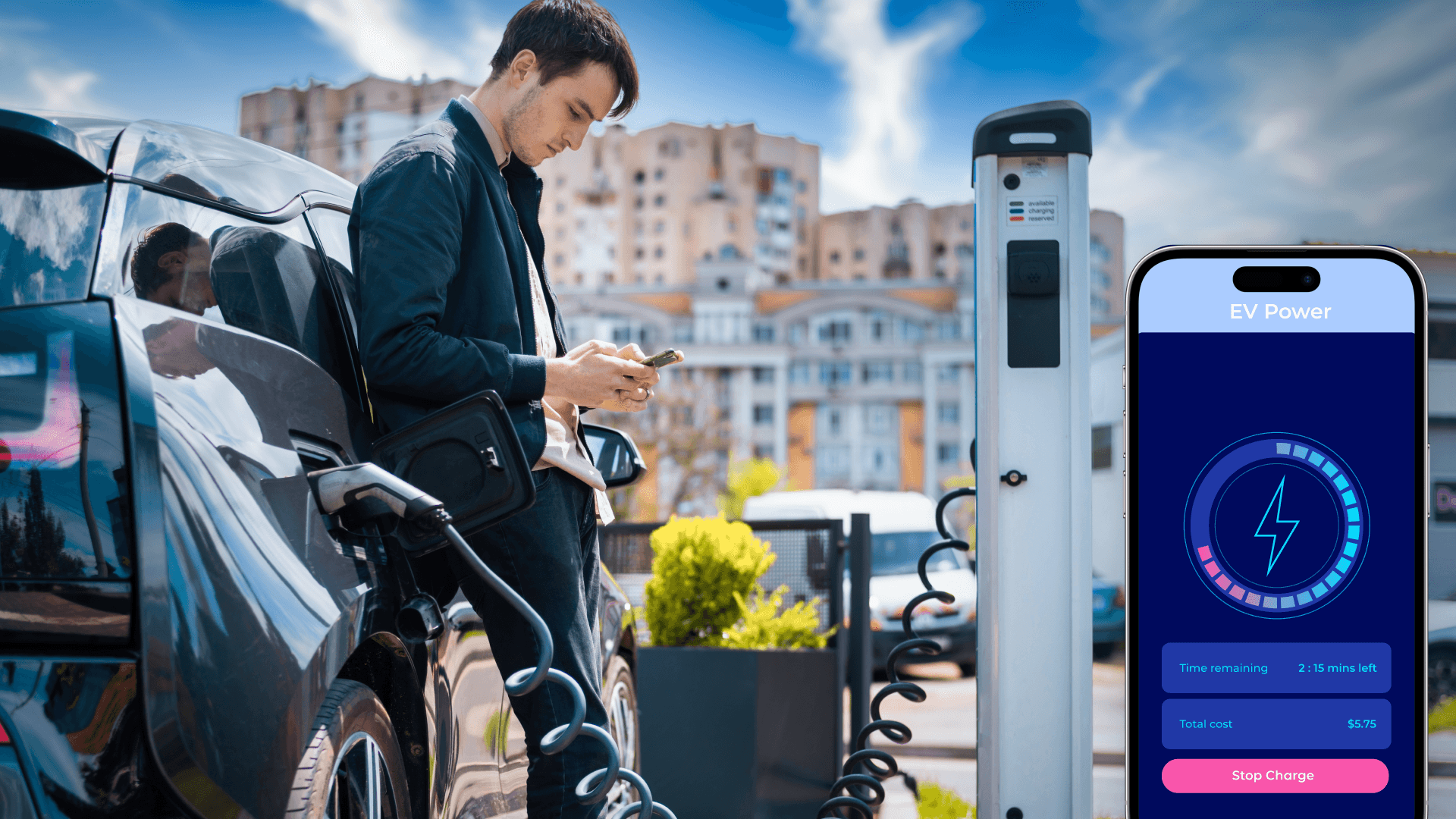
An EV charging app succeeds when it can forecast station availability, reduce wait times, and guide drivers with confidence
 Saurabh SahuChief Technology Officer (CTO)
Most EV app tutorials start the same way: “Integrate Google Maps, connect a charging station API, add payments.” On paper, the result looks complete. In practice, these apps fail.
The flaw is fundamental: tutorials treat EV charging like finding restaurants or gas stations—static and transactional. But EV charging is different. It is predictable, time-sensitive, and behavior-driven. Users don’t want to simply find charging stations. Drivers want to know which stations will be available when they arrive, how long they will wait, and whether the detour adds value.
The lesson is clear: your app’s value doesn’t come from showing the present state of the network, it comes from predicting its future state. Tesla, PlugShare, and ChargePoint all succeeded because they embedded prediction into their core.
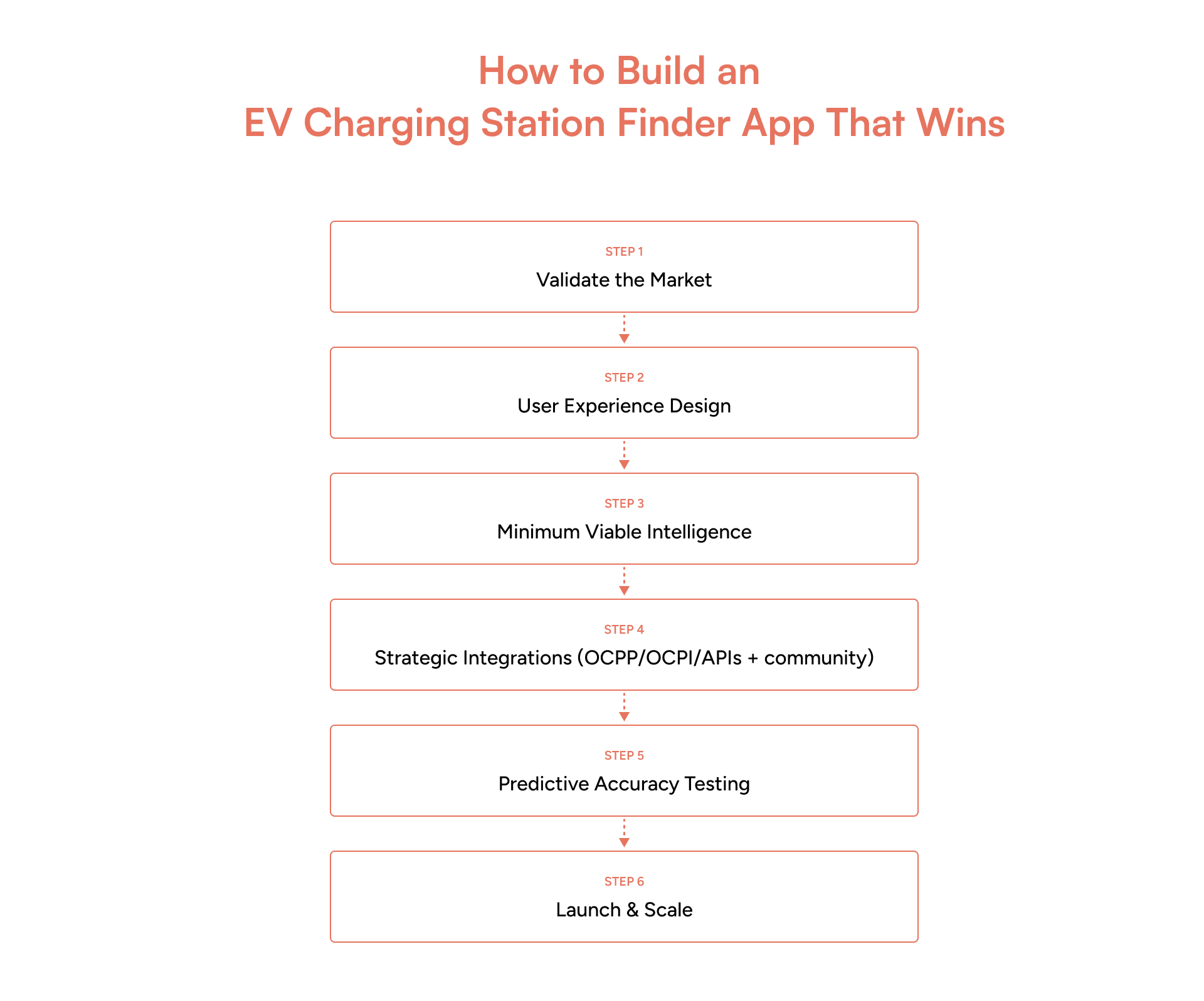
To help our partners build EV apps that scale, we use a six-phase Data-First Framework:
1. Validate the Market First
EV charging apps often fail not because of weak technology, but because the market fundamentals were ignored. Successful entry depends on three factors: EV adoption forecasts, charger density, and the strength of policy incentives.
PlugShare illustrates this discipline. By launching in EV-dense regions and supplementing unreliable operator feeds with community check-ins, it created the industry’s most trusted data platform and scaled to millions of users. In contrast, some of the heavily invested competitors ventured into low-density markets, depleted capital, and never had a sustainable adoption.
Result: A clear picture of what to construct, where to construct and whether to construct.
2. User Experience Design
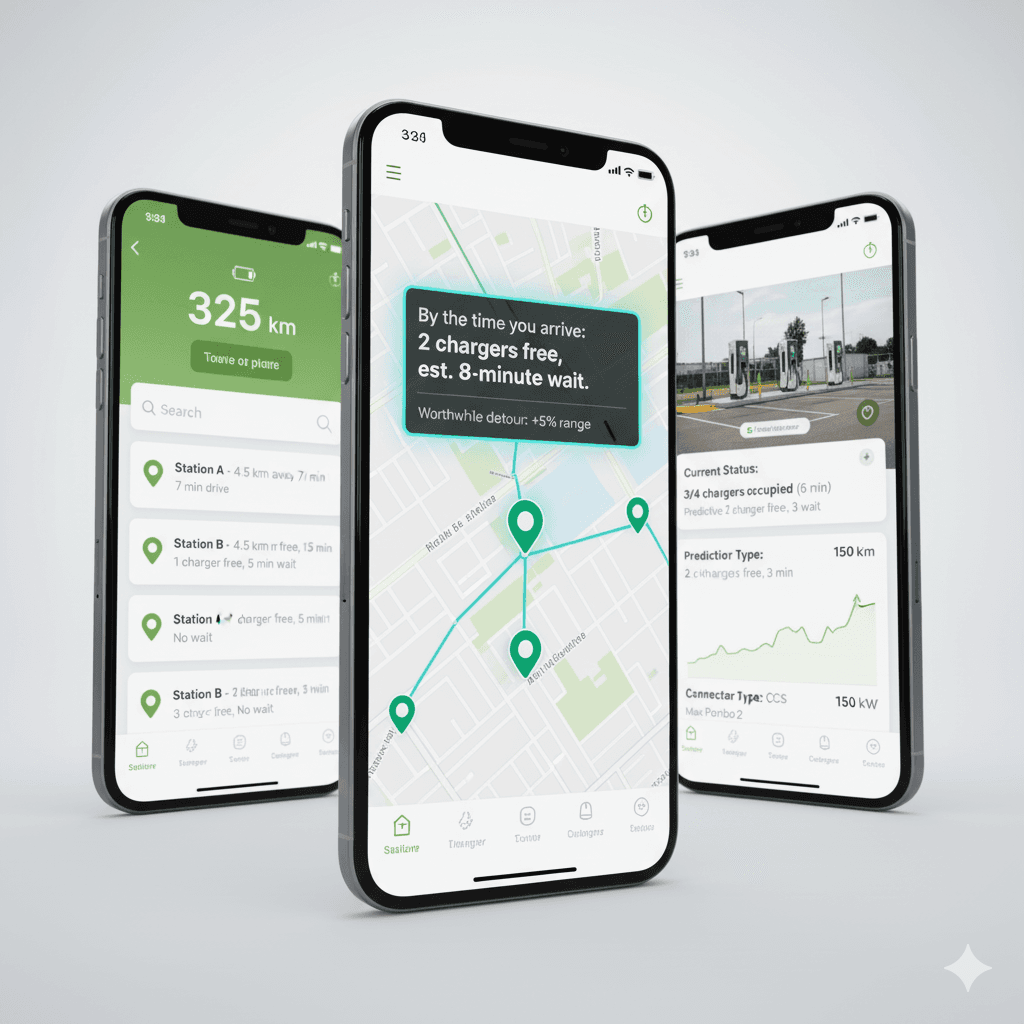
Great EV apps earn loyalty by reducing uncertainty. Drivers make decisions based on three factors: range, expected wait time, and whether a detour is worthwhile. Interfaces must surface these answers instantly, embedding prediction into every interaction. Instead of displaying “4 chargers available,” the app should project “By the time you arrive: 2 chargers free, est. 8-minute wait.”
Tesla achieved this by integrating predictive routing directly into the user journey, while PlugShare turned simple check-ins into a feedback loop that made its network data more accurate with scale. In both cases, design became a trust vehicle—and trust became the foundation for adoption.
Outcome: Interfaces that create confidence, strengthen loyalty, and continuously improve through user engagement.
3. Build a Minimum Viable Intelligence
The first version of an EV charging app should focus on predictive intelligence. This means the app can forecast station availability, optimise routes based on wait times, and model demand patterns as user behaviour changes. With these features ready from the start, the system does more than guide drivers; it learns continuously. Each interaction generates new data, enhancing predictions and making the app more reliable over time. The more it tests its predictions, the smarter it becomes.
Outcome: An MVP that delivers predictive value from the start and grows smarter with every session.
4. Build Integrations as Strategic Infrastructure
API integrations determine whether an EV charging app can scale with reliability. Charging networks vary in data quality, uptime, and update frequency, which means the strength of the app depends on how these feeds are managed. The right approach is to design integrations early, diversify across open standards such as OCPP, OCPI, and NACS, and layer them with supplementary intelligence from community check-ins or proprietary data pipelines.
The architecture ensures that correct station information is provided, resiliency is ensured when a single data source fails, and continuity is guaranteed through redundancy. An example is the longevity of PlugShare: combining a score of operator feeds with crowdsourced information on them. It constructed an environment that the competition could hardly imitate.
Deliverable: A sound data infrastructure that guarantees a steady increase in user confidence, and the development of an unparalleled edge that competitors cannot have.
5. Predictive Accuracy Testing
Testing an EV charging app means validating how well its intelligence performs in dynamic, real-world conditions. The focus should be on forecasting accuracy during peak traffic, weather disruptions, and fluctuating energy prices. Each scenario provides critical feedback that strengthens the predictive engine and improves user confidence.
The most advanced teams establish continuous testing frameworks where every charging session acts as a new data point. Quality assurance is made a kind of learning system- every new session fine tunes the prediction as it grows through reliability and trust between the user is a competitive edge which is expressed through the user that is difficult to duplicate by its competitors.
Outcome: A predictive engine that improves continuously, ensuring trust, reliability, and long-term user loyalty.
6. Launch and Scaling Strategy
A successful launch marks the beginning of intelligence building. The most effective approach starts with a focused regional pilot designed to capture diverse usage patterns and validate predictive accuracy in real-world conditions. Every driver session becomes a source of feedback, improving demand models, refining routing algorithms, and strengthening trust in the system.
Scaling works as a function of data, not geography. As predictive accuracy improves, the platform earns higher engagement, which generates richer datasets and accelerates learning. This compounding loop creates the conditions for expansion into new markets with confidence, where intelligence drives growth strategy and secures long-term advantage.
Outcome: Controlled pilots evolve into scalable platforms, where every new market entry is backed by proven intelligence and reinforced by network effects.
Essential Features for a Market-Ready EV Charging App
An EV charging app cannot be characterized by the number of features it includes in the application, but by the business value that each feature produces. The components other than the latter are necessary not because they would be so good on a product roadmap, but because they directly affect the adoption, retention, and monetization.
1. Real-Time Charging Station Locator
There is a High Definition Station Locator called Real-Time Charging Station Locator.
The user experience is supported by the presence of a live map where one can filter by charger type, speed, and prices. Predictive models are enhanced by using data that appears in real time, making searches easier and building Dublin. In the view of operators, the increased visibility of the station means more utilization rates and an improved ROI.
Business impact: Better usage, better utilization of the chargers and better demand forecasting.
2. Slot Dealing and Booking
Providing the option of booking a charging spot to users removes the uncertainty and avoids churn at the point of choice. There are also revenue opportunities given through reservation charges or priority booking levels.
Business ramifications: Fewer user drive-offs, more sources of revenue and increased customer satisfaction.
3. Basic Multiple Pay Gateway Support
Such smoother payments between the different cards, wallets, and in-app credits can minimize a smooth experience at the point of purchase. Being flexible boosts the number of transactions that would be completed, and space is created where finance can form alliances.
Business impact: Increased level of business, fewer cart disapprovals, and possible fintech collaborations.
4. User Reviews and Ratings
When operators provide less data on the type of feedback on a given station, crowdsourced opinion enhances information availability. To the businesses, reviews are a form of quality control that is free and informs them on which stations are not doing so well, therefore investment decisions are made.
Business effect: Higher retention, community-based credibility, and stronger brand trust, enhanced understanding of the business that comes through its community efforts.
5. Status Update Push Notifications
Real-time messages like plugging and charging status, slot, and completed sessions engaged users outside the application, and helped promote app stickiness without depending on regular user logouts.
Business impact: Increased retention rate, better session turnover, and reduced user churn.
6. Car Navigation Intercompatibility
Integrating charging routes into vehicle navigation systems will make things easier, and this way, the app would become a routine for the driver. B2B with automakers is also made available for this integration.
Business impact: More active use/day, more partnerships and protection by ecosystem lock-in.
7. Rewards Programs and Loyalty
Offering points or discounts or early access make options that make customers stick to the service. This is an aspect that gives lifetime value without having to pay hugely.
Business impact: Customer retention, lower switching and increased brand loyalty.
Advanced Features for Competitive Advantage
Although the above features are the basic pillars of leadership, the more eminent features usually make the difference between the leaders and the followers.
1. AI-Based Route Optimization
Encourages a step beyond what existed as navigation means it reveals the best routes to use in terms of traffic, energy use and the presence of chargers at the points of reckoning. This increases the dependency on using the app on each journey.
Business impact: Increased user dependency, high pricing possibilities.
2. IoT-Based Station Brilliance
Direct feeds of chargers get higher availability information than manual feeds or slow operator updates.
Business effect: Less data breakage, enhanced trust, and effectiveness.
3. Subscription Plans
Basic schemes (e.g., basic free, premium predictive intelligence, enterprise fleet packages) splash cash in different ways as well as funnel users into different blocs.
Financial impact: Greater predictability in the recurring revenue, more financial strength and increased customer lifetime value.
Tech Stack for an EV Charging Station Finder App
Scalability, speed to pickpocket the market, and cost effectiveness is made possible by the right tech stack.
Layer | Technologies | Business Value |
|---|---|---|
Frontend | React Native, Flutter | Single codebase for iOS and Android → apps launch up to 4× faster and at lower cost. |
Backend | Node.js, Django | Scales effectively and processes real-time data with reliability. |
Maps & Navigation | Google Maps, Mapbox | Precise routing builds user confidence and trust. |
Payments | Stripe, PayPal | Safer, universal payments with limited drop odds. |
Cloud Infrastructure | AWS, GCP, Azure | On- science and worldwide coverage. |
Security & Compliance | PCI DSS, GDPR | Secures information, gets compliance, fosters trust. |
How to Receive Real-Time Data from EV Charging Stations
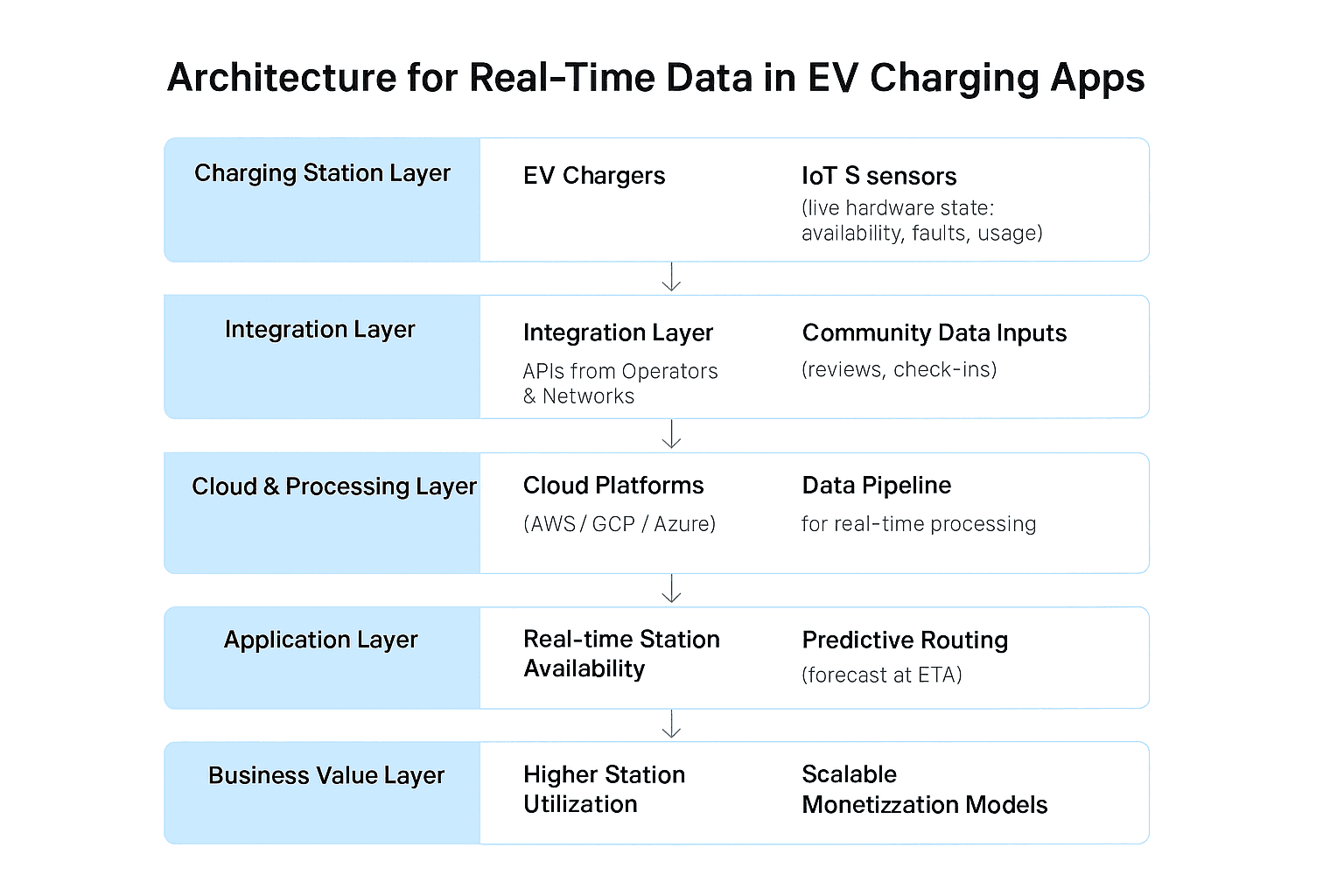
Real-time data is the foundation of user trust and the engine of monetization in EV apps. Drivers rely on accurate availability to plan routes with confidence; operators depend on usage intelligence to optimize station performance; and platforms unlock recurring engagement when every interaction feels reliable. Without real-time visibility, adoption stalls. With it, retention compounds and revenue models—from reservations to dynamic pricing—become possible.
Delivering this data requires the right technical enablers, but the business value comes from how they are implemented. Standardization and normative protocols such as OCPP are used to control communication with charging points, live hardware state is captured by IoT sensors, APIs connect networks and community inputs, and cloud services provide scaling and reliability. These are the technologies that make the pipeline, but the competitive advantage is in integrating them into an elegant ecosystem that is resilient and content.
This is the area in which GeekyAnts can be strategic. The core principles behind our solution include attention to data accuracy, the ability to control latency, and the resilience of the system to make sure that your application not only shows the locations of a charger, but also tells more precisely whether someone can use the charger. Together with investment in open standards and bespoke data intelligence, we enable businesses to transform real-time feeds into indisputable business benefits: greater utilisation, increased customer retention, and bigger monetisation options on a scalable basis.
The Challenge in Building EV Charging Station Finder Apps
The EV charging app market is brutal. Most developers think they can slap together a map interface and payment system, but the real challenges hit hard once you have actual users.
Scaling becomes your biggest nightmare. It's Friday evening, traffic is heavy, and everyone's heading out of town. Your app crashes right when drivers need it most. We have watched promising startups crash because they couldn't handle growth. Smart teams plan for this early—break your system into independent pieces that can scale separately.
Data privacy regulations are constantly shifting. California has CCPA, Europe has GDPR, and new rules keep appearing. One company we know spent six months retrofitting privacy controls they should've built initially. Architecture Compliance is not an add-on at all.
Trust dies with broken station data. Send someone to a dead charger once, and they'll never use your app again. You need multiple data sources that cross-check each other. Community reports help, but they need validation against sensor data and usage patterns.
Car manufacturer integrations are messy. BMW's API differs from Tesla's, which differs from Ford's. Even "industry standards" get implemented differently. Start with one manufacturer, perfect that integration, then expand gradually.
Generic features won't save you. Every app shows nearby stations and handles payments. The winners predict availability, learn driving patterns, and recommend chargers based on your specific vehicle and route. This takes real data science investment, not just copying competitors.
The companies surviving long-term solve deeper problems than just "find the nearest charger." They become indispensable by understanding actual user behavior.
Business & Revenue Models for EV Charging Apps
Monetization in EV charging apps is no longer about a single transaction stream. The companies that lead this market layer different models, ensuring revenue grows as adoption scales.
Pay-Per-Use
The simplest model charges users per session. It scales naturally with EV adoption, but margins are slim if left alone. ChargePoint built early traction this way, taking a fee from each charging transaction. At scale, this created a predictable revenue base while opening the door for advanced services.
Subscription Plans
Recurring subscriptions bring stability. Drivers pay for premium features like route prediction, priority booking, or discounts on charging. PlugShare Premium is a small but telling example—offering ad-free access and advanced filters for a fee. For B2B fleets, subscription bundles tied to predictive analytics can transform one-off payments into long-term contracts.
Operator Commissions
Marketplaces thrive on volume. Apps that funnel traffic to charging stations can take a percentage of each completed session. For operators, higher utilization offsets the commission; for platforms, revenue compounds as more stations join. This dynamic explains why partnerships have become central to growth models across North America.
Advertising & Partnerships
Once an app reaches scale, its data becomes an advertising asset. EV drivers check availability multiple times per week, creating a captive, high-intent audience. Businesses along popular routes—coffee chains, retail outlets, automakers—are willing to pay for placement. This is a revenue layer that matures only with user density.
Fleet Integrations
Commercial fleets represent a different scale of opportunity. Blink Charging’s tie-ups with logistics operators show how B2B demand can exceed consumer usage in volume and predictability. By offering real-time insights on charging availability, fleet packages lock in enterprise contracts worth millions annually, insulating apps from consumer market volatility.
Cost Breakdown of EV Charging Station Finder App Development
The price of setting up an EV charging station finder application can differ in accordance with the quantity of in-depth features, scalability, and long-term perspectives. Rather than considering it to be a single figure, it is better to consider development in phases, each of which brings functionality, intelligence and business value. Below are a few things that you should expect at various levels:
App Level | What You Get | Timeline | Investment |
|---|---|---|---|
Quick MVP | Maps, station search, basic payments | 12–16 weeks | $50K – $80K |
Market-Ready | Live availability, booking, user accounts, and admin panel | 18–24 weeks | $100K – $160K |
Full Platform | Predictive intelligence, fleet tools, enterprise features | 24–32 weeks | $200K – $350K |
Ongoing | Hosting, updates, new features, support | Monthly | $5K – $15K/month |
Why GeekyAnts Is the Right Partner for EV App Development
EV apps succeed when technology is designed for scale, intelligence, and long-term adoption. That is the benchmark we bring to every project.
Saurabh SahuChief Technology Officer (CTO)At GeekyAnts, we combine deep expertise in mobility, mapping, IoT, and real-time applications to help businesses transform EV app concepts into scalable platforms. From predictive routing engines to API-driven ecosystems, we design solutions that create user adoption and lasting revenue impact.
What Sets GeekyAnts Apart
- Scalability-First Architecture – Modular backends, resilient data pipelines, and cloud-ready frameworks designed to handle growth seamlessly.
- Proven Expertise in Data Intelligence – Predictive algorithms, real-time insights, and integrations that create competitive moats.
- Cross-Industry Experience – Success stories in mobility, fintech, and IoT that translate directly to the EV ecosystem.
- Compliance & Security by Design – PCI DSS, GDPR, and global standards embedded into development from the start.
- Strategic Partnership Approach – Beyond development, we collaborate to position your app for long-term market leadership.
Ready to build the EV charging app that defines the market? Schedule a consultation with GeekyAnts and see how our expertise can accelerate your roadmap.
Conclusion
The future of EV charging apps will not be defined by features but by intelligence. Success depends on predicting availability, scaling with confidence, and turning data into trust. As EV adoption accelerates and infrastructure investment surges, only platforms built on data-first foundations will endure. Those that prioritize predictive accuracy, user confidence, and scalable design will not just compete—they will set the standards for how drivers, operators, and fleets connect in the electric future.