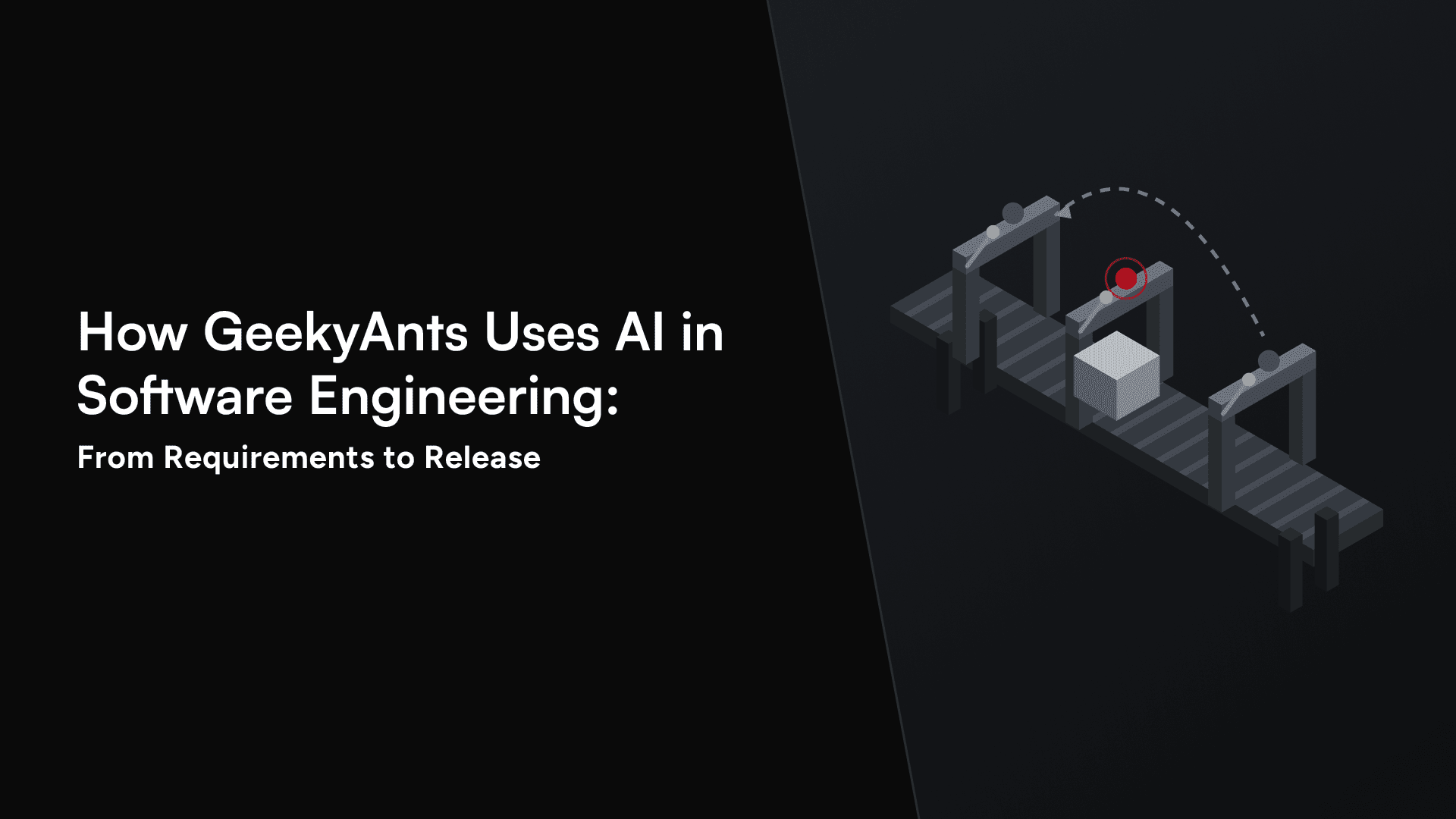


AI coding agents can turn a feature request into screens, database changes, and tests. The risk begins with an unresolved business rule. Generated code may meet the written instructions while missing the intended behavior. Google's 2025 DORA research found that AI amplifies an organization's existing strengths and weaknesses. Across three GeekyAnts projects built with AI coding agents in 2026, engineers retained decision-making authority while agents handled substantial development work.
The projects were a clinical education platform developed over six months with around 1,500 commits, a family-records mobile and web app built in four weeks across 73 working sessions, and ga, an internal engineering assistant. A commit records a set of code changes. AI models appeared as co-authors on 429 of ga's 439 commits. These examples reflect the practices of the project teams involved.
Which Engineering Activities Use AI at GeekyAnts?
The teams assigned agents tasks with written inputs and defined stopping points. The responsibilities followed a shared pattern, with differences in tools and approvals across projects.
Activity | AI responsibility | Engineer responsibility |
|---|---|---|
Requirements | Draft specifications and identify conflicts in source documents | Confirm scope and resolve open decisions |
Planning | Divide approved requirements into tasks with acceptance criteria, the conditions for completion | Approve the plan and system design |
Implementation | Produce application code, database changes, and system connections | Review changes against approved requirements |
Testing | Create test cases and exercise application workflows | Judge failures and accept completed work |
Review and debugging | Inspect code changes and trace defects | Assess findings and authorize fixes |
Documentation | Draft technical guides, test reports, and release notes | Check claims against the delivered software |
The clinical education team created task-specific commands for each stage. Its technical requirements document (TRD) described data, system connections, risks, and performance targets. Development commands followed linked designs in Figma, a screen-design tool, and used the project's existing components. Reviewer and debugger agents could inspect files but lacked permission to edit them.
For the family-records app, one engineer directed Claude Code, an AI coding tool, across a server application, mobile app, and website. The agent performed 534 actions in simulated iOS and Android devices, giving the engineer running screens to inspect for design and usability problems. ga took another approach: it organized client documents, designs, and existing code into a knowledge base with references to the original material. That record supplied context for implementation tasks.
Which Decisions Require an Engineer's Approval?
On the clinical education platform, a specification remained a draft until an engineer approved it. The implementation command checked the approval status and stopped on an unapproved document. Front-end planning required links to Figma designs. Missing designs triggered a request for input from the team.
In the family-records project, the agent raised 52 structured product and architecture questions, each with proposed answers. The engineer's responses became numbered decisions used throughout the build. During development, the engineer interrupted the agent 14 times and rejected eight proposed tool actions. Corrections addressed work outside the approved scope, hand edits to generated database schemas, and raw database errors appearing in user-facing responses.
The ga assistant enforced four rules beyond project configuration: permission before destructive actions, protection of secrets, permission before pushing code to a shared branch, and human approval of knowledge entries. A push transfers code to the shared project record. A merge combines a proposed change with the shared code. The clinical team kept proposed changes in feature branches, separate workspaces for changes pending review. Pushes, merges, and releases required engineer authorization. In the family-records app, merging an AI feature and enabling it were separate approval decisions. ga required a fresh approval for each outward-facing action, including release tags.
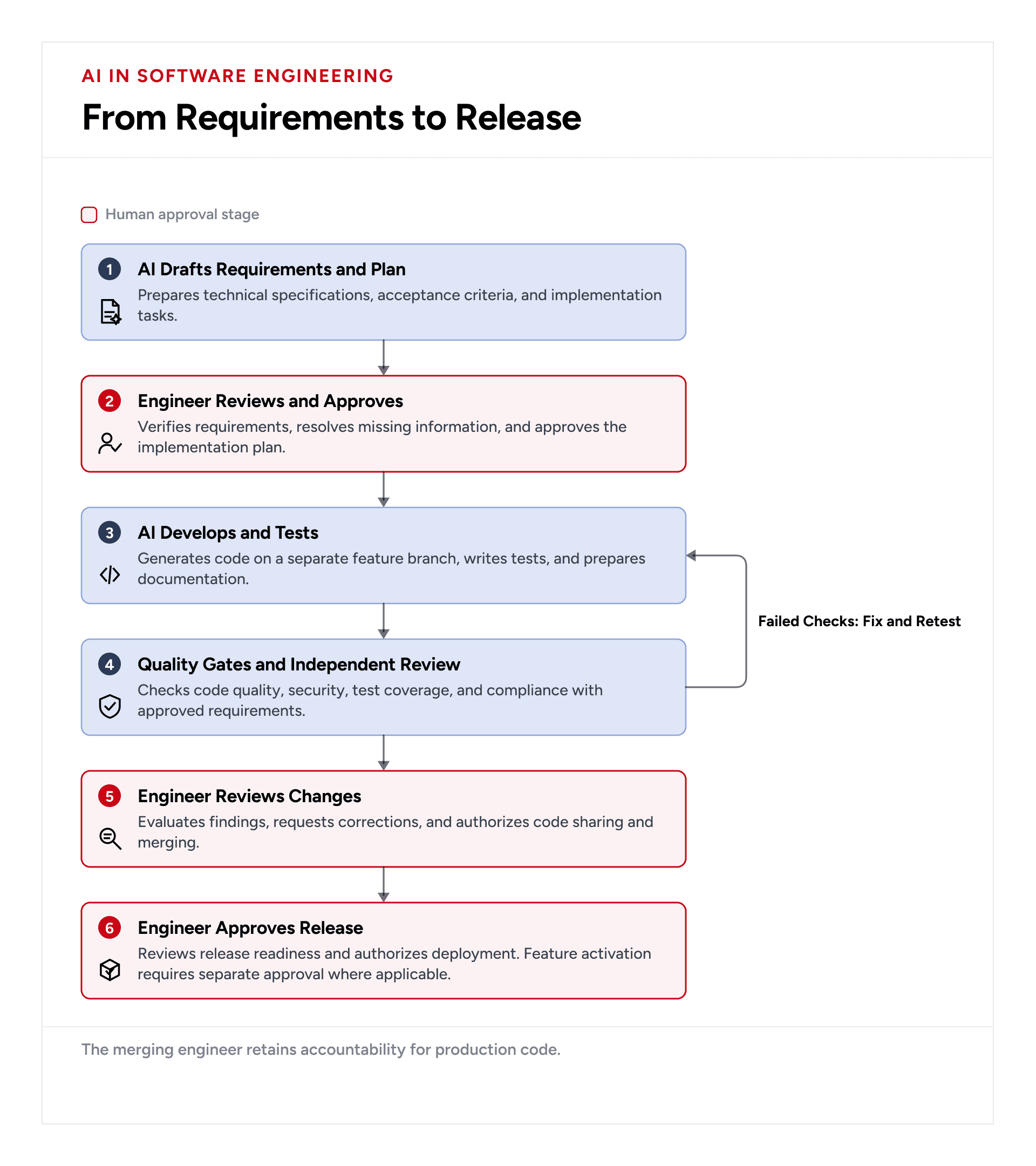
What Quality Gates Must AI-Generated Work Pass?
Quality gates are checks that a change must pass during development or release. The projects used different combinations of automated checks and human review. The table groups their checks by purpose without treating every project rule as a company-wide standard.
Quality gate | Evidence required |
|---|---|
Requirement coverage | Ticket identifiers, approved specifications, and tests linked to identified edge cases |
Code and architecture | Formatting checks, TypeScript checks for data-type errors, and rules against prohibited dependencies |
Security and data handling | OWASP Top 10 checks for common web security risks, scans for exposed secrets, and tests for restricted data in storage or logs |
Accessibility and performance | Accessibility checks at 375, 768, and 1280 pixel widths, plus website scores and service response targets |
Release readiness | Passing builds and tests, documented configuration, verified database changes, and application startup checks |
On the clinical education platform, billing integration tests connected to PostgreSQL and Redis, with a payment provider in test mode. The project used Lighthouse, a website assessment tool, with minimum scores of 80 for performance and 90 for accessibility, best practices, and search-engine optimization. Its service targets required 95% of requests to finish within 200 milliseconds, 99% within 500 milliseconds, and an error rate below 1%. The pre-deployment check returned BLOCKED on failure.
The family-records project recorded about 1,230 test runs, 475 code-rule checks, and 214 direct database checks. Live application testing uncovered defects the smaller tests missed. Google Drive uploads failed because the total request size was submitted as the file size. A PDF viewer counted requests for individual pages as separate document views. A background worker failed to start because of a faulty connection between software components.
The team inspected its safeguards as well as the application. One audit found a misspelled command in a check that ran before commits. The error prevented a scanner for exposed secrets from running. ga applied a different safeguard: each task began with a failing test and finished with a passing one, followed by a run of the complete test suite. Its reviewers checked security, missing tests, and silent failures, while working application builds confirmed that generated templates could start and serve requests.
Who Owns AI-Generated Changes in Production?
The engineer who approves and merges a change takes responsibility for that code in production. AI co-authorship records tool involvement; a person remains accountable. The clinical education project's records connected approved specifications, ticket identifiers, and named reviewers to the delivered changes. Its repository retained technical rules and decisions for the next engineer to inspect. A repository is the shared location for project code and its change history.
The family-records team's numbered decision log preserved the reasoning behind product choices. For ga, engineers reviewed the final report before accepting the work. During one test run, an agent's draft report counted six tasks with tests written ahead of code; its correction identified seven. The discrepancy illustrates the need to verify generated progress reports against project evidence.
What Does This Mean for Engineering Delivery?
AI coding agents can handle a substantial share of software development, from preparing requirements to checking completed features. The three GeekyAnts projects show the controls supporting that work: recorded product decisions, tests against running systems, restricted tool permissions, and engineer-approved releases. For clients, those records offer a way to examine what the team built, which risks received review, and who accepted the production change. Explore GeekyAnts' engineering delivery approach for its broader delivery practices.