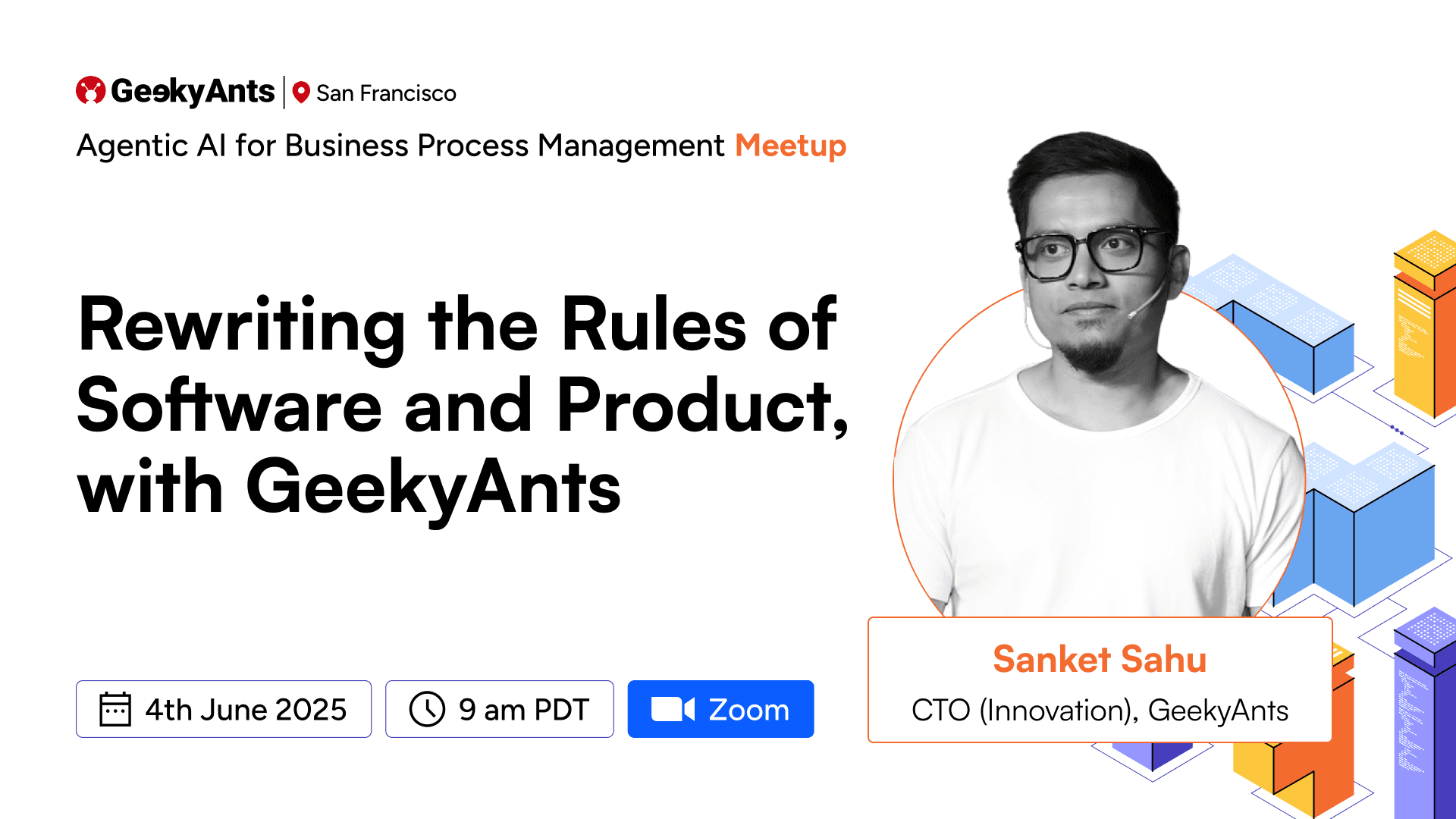

Editor’s Note- This blog is adapted from a talk by Sanket Sahu, CTO at GeekyAnts, delivered during the AI US Meetup. In this session, he explores the evolving relationship between design and code—how it began with visual tools like Visual Basic and Flash, fragmented over the decades, and is now coming full circle with the rise of AI.
Drawing on his experience building tools like NativeBase, BuilderX, and Shaper, Sanket shares how AI is reshaping the craft of software development. From vibe coding to agent-powered workflows, this is not just about speeding up delivery—it’s about removing friction, restoring creativity, and redefining what it means to be a builder in 2025.
Hi, I am Sanket Sahu, CTO (Innovation) at GeekyAnts. Kushal and I started with GeekyAnts in Bangalore. Today, we have a growing presence in the US and the UK. Our work spans open source and client services. We have built tools like NativeBase, glustack, and BuilderX, and we stay closely connected with developer communities across time zones
A Different Starting Point
Much of what I do comes from one persistent question: how do design and code come closer together?
This question did not start with AI. It started back in the late 1990s.
When I was a kid, I spent hours in Visual Basic. It felt like painting. You dragged elements onto a screen. You edited their properties. You connected them with logic. That was software. No friction, no handoff. It worked.
Later came Macromedia Flash. Same idea—Visual first. Logic second. Draw a circle, animate it, connect it to user input, and embed it into a website. I built a slideshow tool where users uploaded photos, and the app created transitions automatically. ActionScript made logic simple.
Then things shifted. Apple pulled Flash support from iOS. Mobile changed the stack. Visual programming faded. Dreamweaver tried to hold that line. It lets you toggle between UI and code. But even that faded. Over time, development tools and design tools began to drift apart.
What Changed
It is 2025. The gap still exists. Figma and VSCode live in different worlds. Most teams still copy-paste their way through product handoffs.
Then AI arrived.
The shift began with prompts. I saw games and apps being built in real time. Not from scratch, but from natural language. Tools like Graph3 turned a short sentence into a working 3D game. Nothing hard-coded. Physics included. The interaction was live.
Developers called it vibe coding. It was not limited to hobby projects. Levels.io built a multiplayer game where real users floated as balloons. Each balloon carried an ad. The whole thing was coded with prompts. It worked. It scaled. It made sense.
The Two Shifts
We are seeing two shifts.
One is augmentation. Tools like Cursor or Continue wrap around VSCode. Firefly and Figma now embed AI inside the workflow. These do not replace habits. They change the pace.
The second is replacement. Tools like Locofy, Builder, and others flatten the entire development process. Small teams now scale faster than large ones.
Companies like Lovable reached significant revenue with fewer than 20 people. AI makes that possible.
What We Are Building
At GeekyAnts, we are building tools to support that shift.
One is AntAgents. It maps AI agents to real business roles. Sales. Design. Testing. Development. Each agent works with a human in the loop. Nothing runs without validation. It is not about autonomy. It is about assistance, routed through trust.
The second is Shaper. It connects design and development at the source. Shaper opens a Next.js project as a design file. You can edit layouts, colors, and margins. Those changes reflect in live code. Developers then step in and add functionality without losing sync.
It removes the handoff.
Shaper merges the roles. The design is the code. The code is the interface.
Looking Ahead
The roles are shifting. Designer. Developer. PM. Founder. The boundaries are no longer fixed. We are seeing something new. We call them builders.