
AI has become the center of almost every fintech conversation. It dominates conference agendas, keynote presentations, product demonstrations, and investor discussions. Vendors position their platforms as AI-first, organizations announce intelligent decisioning capabilities, and almost every roadmap promises autonomous financial services. The industry appears to be moving rapidly toward AI-driven financial products.
The picture changes when the discussion moves from conferences to regulated financial institutions. Ask a Chief Compliance Officer how much of that AI is running in production, making decisions that affect customer money under regulatory oversight. The answer usually reveals a gap between industry enthusiasm and operational reality. Many organizations have built pilots, prototypes, and internal demonstrations, but far fewer have AI systems that process live financial decisions in production.
This gap does not exist because financial institutions lack interest in AI or because the technology is not capable enough. It exists because the journey from a successful AI demonstration to a production-ready financial system is much more demanding than most organizations expect. An AI model that performs well during testing still has to satisfy regulatory requirements, maintain complete audit records, support human review, and operate within strict governance controls before it can influence financial decisions. Those requirements change how AI systems must be designed, built, and deployed.
This article focuses on that journey.
Before discussing the challenges, it is important to separate two conversations that often get grouped together. Many organizations describe AI-assisted software development as AI in fintech. Development teams use tools such as GitHub Copilot to write code, generate test cases, or improve engineering productivity. These tools provide measurable value, but they support software development rather than financial decision-making.
AI in fintech begins when AI operates inside a financial product and influences outcomes that affect customers. These systems support activities such as credit approvals, fraud detection, identity verification, investment recommendations, and risk scoring. Unlike developer productivity tools, these models participate in decisions that influence customer finances. When they produce the wrong outcome, the consequences extend beyond software defects. A customer may lose access to savings, receive an incorrect credit decision, or become the subject of a fraud investigation without cause. These risks make AI engineering in financial services fundamentally different from AI engineering in most other industries.
Every AI Decision Carries Financial Consequences
Most software products can recover from incorrect decisions with limited consequences. If a streaming platform recommends the wrong movie, the user simply chooses another option. If a content moderation system removes the wrong post, the platform can usually restore it. These situations may frustrate users, but they rarely create lasting financial or legal consequences.
Financial systems operate under different conditions because every decision can affect a person's money, financial opportunities, or long-term security. A legitimate transaction blocked by an AI system may prevent a family from paying rent. A qualified borrower denied credit may lose the opportunity to start or expand a business. A fraud detection model that misses suspicious activity may expose a customer's savings to theft. A biased credit model may produce unfair lending decisions across an entire customer segment before the institution identifies the pattern and corrects it.
The consequences extend beyond individual customers. Financial institutions may face regulatory investigations, customer compensation programs, compliance reviews, legal challenges, and lasting damage to customer confidence. Unlike many software defects, these outcomes cannot always be corrected through a product update after deployment. Every incorrect decision creates operational, regulatory, and reputational consequences that require evidence, investigation, and accountability.
These risks change the standard for building AI systems. In many software products, teams release features, gather feedback, correct defects, and continue improving the product through regular updates. Financial institutions cannot rely on the same approach when AI participates in regulated decisions. Before an AI system enters production, the organization must understand how every decision will be explained, reviewed, recorded, and defended if regulators, auditors, or customers request evidence months or years later.
For that reason, production AI in fintech is not measured only by model accuracy or prediction quality. A high-performing model still falls short if the organization cannot explain why it produced a particular decision, identify the model version responsible for that decision, or demonstrate that the system operated within regulatory requirements throughout its lifecycle. Production AI succeeds only when technical performance, regulatory compliance, governance, and auditability work together as a single engineering system.
Engineering AI for Regulated Financial Systems
Financial institutions often describe AI systems as compliant, observable, or well governed. These terms appear in board presentations, vendor pitches, and product documentation, yet they rarely explain what those capabilities require in practice. In a regulated financial environment, they represent engineering decisions that shape the architecture of the system long before it reaches production.
Compliance begins with system design. Regulatory requirements influence the data a model can access, the decisions it is permitted to support, the conditions under which it operates, and the actions that follow every recommendation. These requirements become part of the architecture rather than an approval step before launch. A production system must demonstrate that it has operated within regulatory boundaries throughout its lifecycle, supported by evidence that regulators and auditors can verify whenever required.
An audit trail provides that evidence. Every AI-assisted decision must create a complete record that captures the input data, the model version, the output, the confidence score, and the human or automated action that followed. The record must be generated at the time of the decision, stored securely, and retained according to jurisdictional requirements. Reconstructing events from incomplete logs months later leaves organizations without the evidence needed during an audit or investigation.
Observability extends beyond monitoring system availability. Engineering teams need continuous visibility into how models behave in production. Changes in customer behavior, shifts in data quality, model drift, or unexpected variations across customer segments must be detected before they affect business outcomes. Continuous monitoring enables teams to identify emerging issues early, investigate their cause, and take corrective action before customers or regulators uncover them.
Model governance ensures that production models evolve under controlled processes. Every deployment requires version control, documented approvals, performance monitoring, and a defined process for retraining or rollback. Economic conditions, customer behavior, and market dynamics change over time, which means a model trained eighteen months ago may no longer produce reliable outcomes. Governance provides the framework for evaluating those changes and introducing updates without compromising regulatory obligations.
Fairness requires the same level of engineering discipline. Training data, feature selection, and historical business decisions can introduce unintended bias even when discrimination was never intended. Financial institutions therefore need structured testing that measures outcomes across customer groups, identifies disparities, and documents corrective actions before deployment. As regulators increase their focus on algorithmic fairness, these capabilities will become part of the expected engineering standard rather than an advanced feature.
Together, compliance, auditability, observability, governance, and fairness define the operational foundation of production AI. Organizations that treat them as independent workstreams often discover costly architectural limitations during compliance reviews. Organizations that design these capabilities into the platform from the beginning create systems that scale with greater confidence and satisfy regulatory expectations with less rework.
Architectural Decisions Determine Production Readiness
Engineering decisions made during the first stages of development determine whether an AI system can progress beyond a pilot. Choosing an explainable model, designing comprehensive logging, building structured human review workflows, planning governance processes, and implementing fairness testing are foundational activities. They establish the operating framework within which the model functions throughout its lifecycle.
These decisions become significantly harder to introduce after deployment. Logging cannot recreate information that was never captured. Human review workflows require interfaces, operational processes, and audit records that take time to design and validate. Governance and fairness monitoring depend on infrastructure that must already exist when the system begins making decisions. Each missing capability increases the cost and complexity of reaching production readiness.
Many proof-of-concept projects succeed because they operate in controlled environments where these constraints remain invisible. Production systems operate under very different conditions. Every customer interaction creates regulatory obligations, every decision requires supporting evidence, and every model update demands documented governance. Teams that recognize these requirements early build architectures that accommodate them from the start. Teams that postpone them often find themselves redesigning core components before deployment.
From Industry Momentum to Production Reality
AI has attracted unprecedented attention across the financial services industry over the past few years. Global investment continues to grow, financial institutions are funding pilot programs, and industry surveys consistently report high levels of AI exploration and experimentation. Viewed through those signals alone, the industry appears to be progressing rapidly toward widespread adoption.
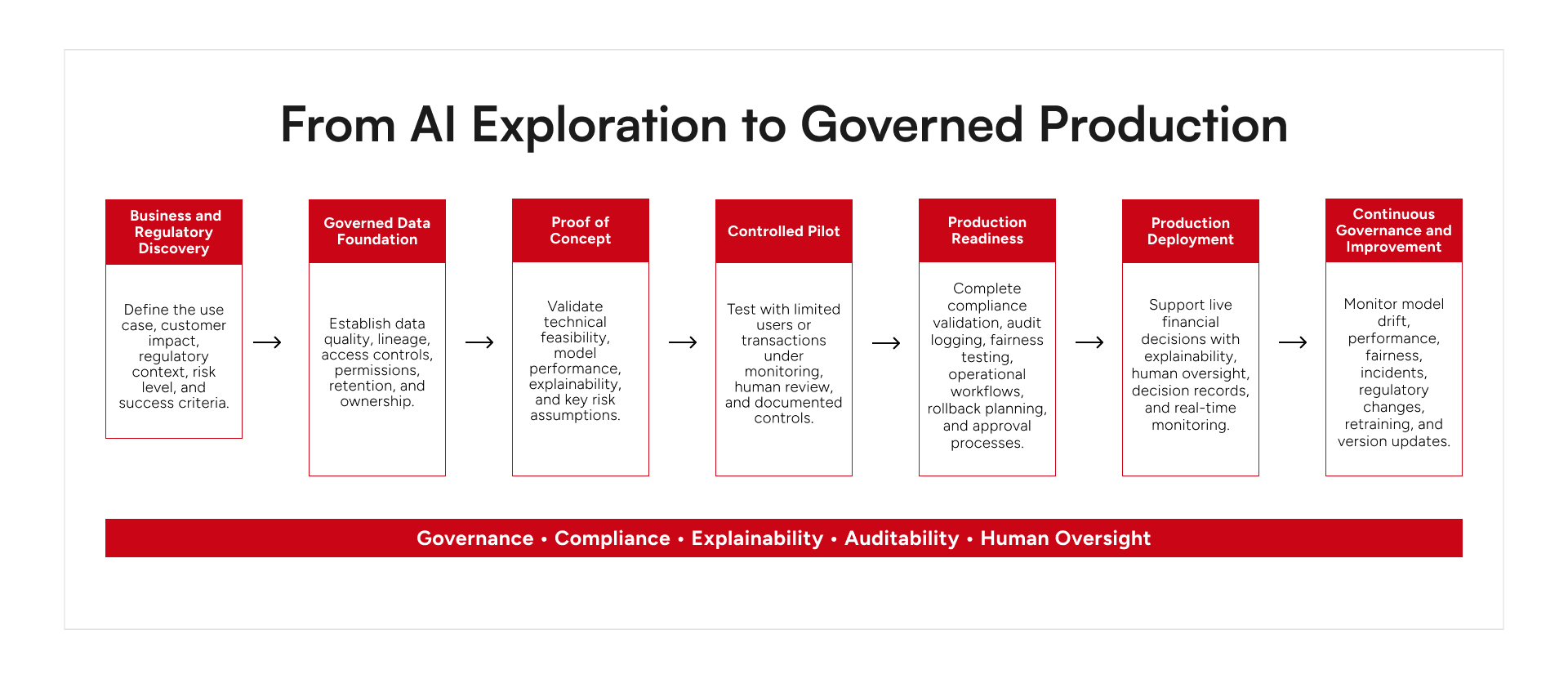
Those indicators describe interest and experimentation rather than production deployment. Pilots, internal tools, and roadmap announcements demonstrate that organizations recognize AI's potential, but they do not show how many AI systems operate under regulatory oversight or influence customer outcomes in live financial environments. Production deployment begins when an AI system participates in decisions that affect customers and continues to satisfy operational, compliance, and governance requirements throughout its lifecycle. That transition remains far less common than the industry's public narrative suggests.
The gap between ambition and execution is understandable. Leadership teams recognize AI as a strategic priority, investors expect measurable progress, and engineering teams are motivated to deliver new capabilities. Most organizations begin their AI journey with the expectation that technical development will present the greatest challenge. They discover a different reality as projects move toward production. Compliance reviews, governance requirements, operational controls, and auditability introduce engineering demands that rarely surface during early experimentation. By the time these requirements become visible, significant architectural decisions have already been made, making changes slower, more expensive, and more disruptive than anticipated.
The discussion therefore shifts from whether organizations want to deploy AI to why production deployments continue to stall. Technical capability explains only part of the picture. Production readiness depends on a broader set of engineering, governance, and regulatory decisions that determine whether an AI system can operate safely in a regulated financial environment. Those decisions form the primary barriers between a successful pilot and a production-ready platform.
The Three Barriers Between AI Pilots and Production
Most AI initiatives begin with confidence. Organizations invest in modern infrastructure, assemble experienced engineering teams, and build models that perform well in controlled environments. Early demonstrations often validate the technical approach and strengthen the belief that production deployment is only a matter of completing implementation. The challenges that follow rarely stem from the model itself. They emerge as organizations prepare to operate AI within a regulated financial environment.
At this stage, engineering teams shift their attention from model performance to production readiness. Every decision must withstand regulatory scrutiny, operate within established governance frameworks, and earn the confidence of business leaders, compliance teams, and customers. These requirements introduce challenges that extend beyond software engineering and become part of the organization's operational and risk management responsibilities.
Three barriers consistently shape this transition. Explainability determines whether stakeholders can understand and defend an AI-driven decision. Data governance establishes whether information is collected, processed, and retained in accordance with regulatory obligations. Organizational trust determines whether decision-makers are willing to rely on AI in processes where errors carry financial, legal, or reputational consequences. Together, these factors influence whether an AI system progresses from a successful pilot to a production-ready solution.
The distinction becomes clearer when comparing the concerns that dominate early AI projects with the requirements that define production deployment.
Early Project Focus | Production Requirement |
|---|---|
Model accuracy | Explainable and defensible decisions |
Data availability | Governed, compliant, and traceable data |
Feature delivery | Organizational and regulatory confidence |
Each of these barriers affects engineering decisions from the beginning of a project. Addressing them during deployment often requires architectural changes, additional governance processes, and significant operational effort. Organizations that account for these requirements during system design build a smoother path to production, while those that postpone them frequently encounter delays, redesigns, and extended compliance reviews.
1. Explainability Builds Confidence in AI Decisions
Financial institutions make decisions that affect people's savings, access to credit, investments, and financial security. Every AI-assisted recommendation therefore requires a clear explanation of how the outcome was produced. Compliance teams, auditors, customer support teams, and regulators all need sufficient information to understand the reasoning behind a decision and assess whether it aligns with internal policies and regulatory expectations.
Explainability also improves operational efficiency. Customer disputes, regulatory inquiries, and internal investigations become easier to resolve when decision pathways are documented and accessible. Engineering teams can identify unexpected behavior more quickly, business teams can communicate outcomes with greater confidence, and compliance teams can demonstrate that appropriate controls were followed throughout the decision-making process. Explainability therefore supports both regulatory accountability and day-to-day operations.
2. Data Governance Protects System Integrity
AI systems depend on data, but production environments require more than large datasets and accurate models. Financial institutions must understand where information originates, who has permission to access it, how it is processed, and how long it is retained. Every stage of the data lifecycle must align with regulatory obligations and internal governance standards.
Strong data governance also improves model reliability. Consistent data quality, documented lineage, controlled access, and clear ownership reduce operational risk while making it easier to investigate unexpected outcomes. These practices strengthen compliance and create a stable foundation for model training, monitoring, and continuous improvement.
3. Trust Determines Adoption
Technical success alone does not place AI into production. Organizations adopt AI when decision-makers have confidence in the systems that support critical business processes. Executives need assurance that operational risks remain under control. Compliance teams require evidence that regulatory obligations have been satisfied. Customer-facing teams need confidence that decisions can be explained clearly and consistently. Customers expect financial institutions to make decisions that are fair, reliable, and accountable.
Trust develops through disciplined engineering rather than promises about AI capability. Transparent decision-making, comprehensive governance, continuous monitoring, and well-defined human oversight create confidence across the organization. When these capabilities are built into the platform from the beginning, AI becomes a dependable component of financial operations instead of an experimental technology that remains confined to pilot programs.
Building AI That Meets Regulatory Expectations
Production AI succeeds because it is engineered to operate within regulatory and operational controls from the beginning. Compliance, governance, and auditability are architectural requirements that influence every stage of development, from data collection and model training to deployment and ongoing monitoring. When these capabilities become part of the platform architecture, organizations spend less time redesigning systems during compliance reviews and more time delivering reliable AI solutions.
A production-ready AI platform records every significant event throughout the decision lifecycle. Each recommendation should be linked to the input data, the model version, the confidence score, the supporting evidence, and the action that followed. These records create a reliable audit trail that allows engineering teams, compliance officers, auditors, and regulators to reconstruct every decision with confidence. The objective is not to generate more logs but to preserve the evidence required to explain and validate every outcome.
Human oversight forms another essential layer of the architecture. Financial institutions remain accountable for the decisions made within their systems, even when AI contributes to those decisions. Workflows should therefore define when AI can automate routine tasks, when it should request human review, and when a decision requires approval before execution. These controls improve operational consistency while ensuring that high-impact decisions receive the level of scrutiny they demand.
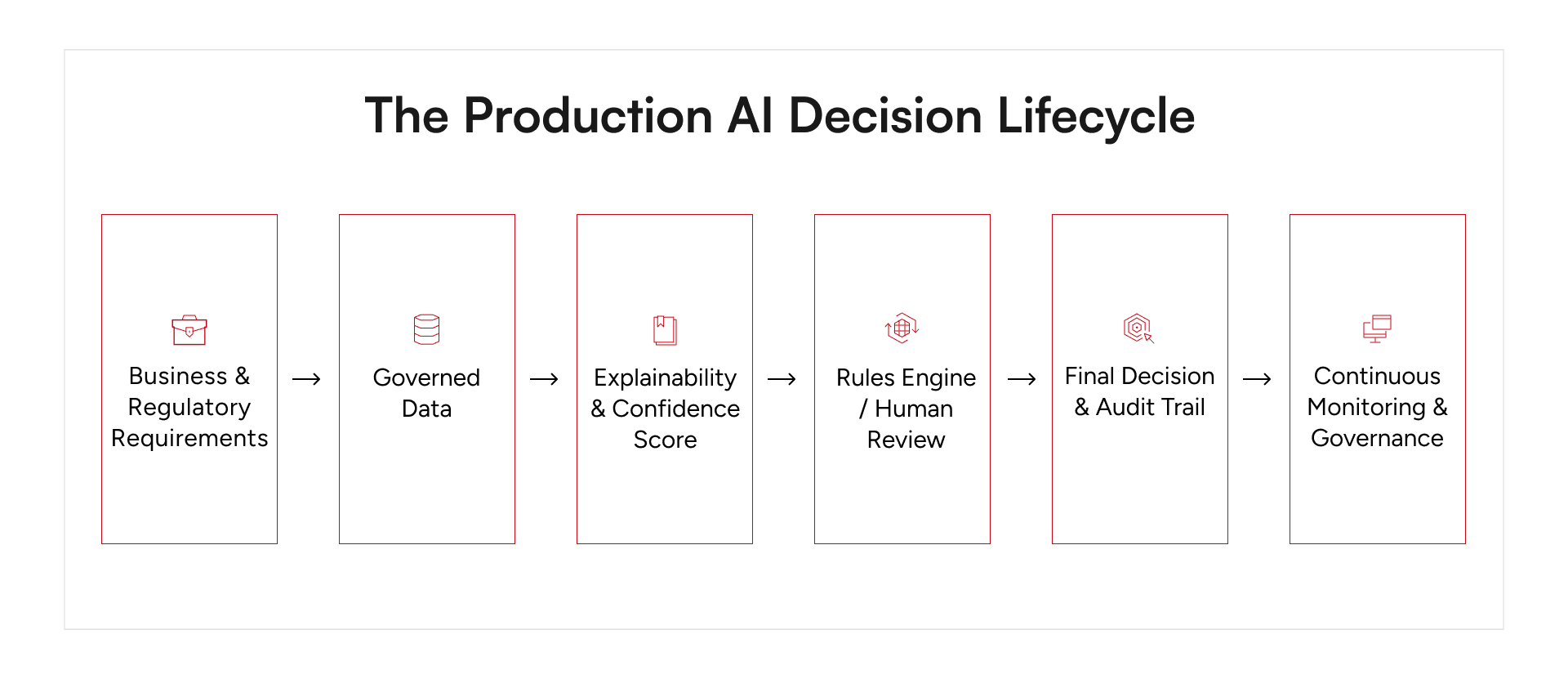
Continuous monitoring allows organizations to understand how models perform after deployment. Customer behavior, transaction patterns, fraud techniques, and market conditions evolve over time. Models must be evaluated against those changes to identify performance degradation, unexpected behavior, or emerging risks before they affect customers. Monitoring supports timely intervention and provides the operational visibility needed to maintain confidence in production systems.
Governance connects these capabilities into a structured operating model. Version management, approval workflows, retraining policies, deployment controls, and documented ownership establish clear accountability throughout the model lifecycle. Every update follows a defined process that balances innovation with regulatory obligations, allowing organizations to improve AI systems without compromising operational stability.
The architecture therefore extends beyond model development. It creates an environment where engineering, compliance, operations, and business teams work from the same set of controls and evidence. This shared foundation enables AI systems to operate consistently, respond to regulatory reviews efficiently, and adapt to changing business requirements without disrupting production.
Components of a Production AI Architecture
Capability | Purpose | Business Value |
|---|---|---|
Decision logging | Captures inputs, outputs, model versions, and decision history | Supports audits, investigations, and regulatory reporting |
Explainability | Provides reasons behind AI recommendations | Improves transparency and customer communication |
Human review workflows | Routes high-risk decisions for manual assessment | Reduces operational and regulatory risk |
Continuous monitoring | Tracks model performance, drift, and anomalies | Maintains reliability after deployment |
Governance framework | Manages approvals, version control, and retraining | Ensures accountability across the AI lifecycle |
Data governance | Controls data quality, access, lineage, and retention | Strengthens compliance and model reliability |
The value of these capabilities lies in how they work together. Logging without governance produces information with limited operational value. Explainability without monitoring cannot identify changing model behavior. Human oversight without structured workflows introduces inconsistency instead of control. A production-ready platform integrates these capabilities into a single operating framework that supports technical performance, regulatory compliance, and long-term operational resilience.
Production AI in Practice
Discussions about production AI often remain theoretical. Organizations describe future roadmaps, pilot programs, and proof-of-concept projects, but few explain how AI operates within live financial systems. Production deployments provide a more meaningful measure because they reveal how engineering decisions hold up under regulatory oversight, operational scale, and customer expectations.
Our work across regulated financial products follows a consistent engineering approach. AI contributes intelligence, recommendations, and pattern recognition, while governance, business rules, and human oversight determine how those outputs influence customer outcomes. Every deployment combines explainability, auditability, and operational controls with the underlying AI model so that the system remains accountable throughout its lifecycle.
The following examples demonstrate how this approach applies across different financial products.
Production AI Solutions
Solution | AI's Role | Governance Layer | Business Outcome |
|---|---|---|---|
RASP-based fraud detection | Detects behavioral fraud patterns during runtime | Rules engine validates signals and records every decision | 100% block rate for screen-share attacks with zero false positives |
KYC orchestration | Selects and coordinates identity verification providers | Compliance rules and human review govern final outcomes | Verification time reduced from days to minutes |
Investment recommendations for Elever | Generates personalized investment recommendations | Users review recommendations before acting, with every interaction logged | Transparent and compliant advisory workflow |
Credit decisioning for BNPL and digital lending | Produces credit risk scores and recommended limits | Decision engine applies regulatory credit rules | Faster and more informed lending decisions |
Savings intelligence for Jupiter | Identifies personalized savings opportunities | Customers retain complete control over every recommendation | 120,000+ active users supported through explainable recommendations |
Fraud Detection with Runtime Application Self-Protection
Screen-share fraud presents a significant challenge in digital investing because the transaction itself often appears legitimate. The customer uses a recognized device, an authenticated session, and valid credentials, leaving traditional fraud detection systems with limited evidence of suspicious activity. The distinguishing signals appear in user behavior rather than the transaction itself.
Our Runtime Application Self-Protection (RASP) system analyzes behavioral patterns throughout the customer session. It evaluates screen-sharing activity, the sequence and timing of user interactions, and inconsistencies between expected customer behavior and application activity. The AI identifies suspicious patterns and produces a fraud signal with supporting evidence instead of making the final decision.
The signal passes through a rules engine that determines the appropriate action based on predefined controls. Every event records the behavioral indicators, confidence score, model version, and resulting action, creating a complete audit trail for future review. This approach achieved a 100% block rate for screen-share attacks without disrupting legitimate customer sessions through false positives.
KYC Orchestration Across Multiple Identity Providers
Customer verification often depends on multiple identity providers operating across different jurisdictions, formats, and response times. Building a production-ready KYC platform therefore requires more than connecting external services. It requires intelligent orchestration that maintains visibility, consistency, and compliance throughout the verification process.
The AI evaluates each application and determines which identity providers should participate based on jurisdiction, document type, risk indicators, and real-time provider performance. When a provider fails or returns an inconclusive response, the system automatically routes the request to the next appropriate provider without interrupting the customer journey.
Every verification records the providers involved, the information they returned, and the reasoning behind the final risk score. Compliance rules and human review determine the final outcome where required. This architecture reduced verification times from days to minutes while preserving a complete audit trail for every application.
AI-Assisted Investment Recommendations for Elever
Investment advice operates within a regulated environment where every recommendation must be suitable for the customer's financial profile and risk appetite. AI therefore supports the advisory process by analyzing customer information and generating personalized recommendations while preserving customer control over the final decision.
The platform evaluates income, assets, investment objectives, risk tolerance, and time horizon to recommend suitable investment strategies. Each recommendation includes the factors that influenced the outcome, alternative considerations, and the associated risk profile. Customers review this information before deciding whether to act on the recommendation.
The platform records the recommendation, supporting rationale, customer response, and model version for every interaction. This structure provides transparency, supports regulatory requirements, and preserves the customer's role as the final decision-maker.
Credit Decision Support for BNPL and Digital Lending
Credit assessment combines regulatory rules with behavioral analysis to improve lending decisions. The AI analyzes transaction history, spending behavior, repayment patterns, and application context to generate a credit risk score together with a recommended credit limit.
The recommendation then enters a decision engine that evaluates affordability requirements, exposure limits, and other regulatory controls before reaching a final decision. The AI contributes predictive insights, while the decision engine applies the policies that govern lending outcomes.
Each assessment records the contributing factors, risk score, model version, and final decision. Adverse outcomes include sufficient information to support customer inquiries and regulatory review, ensuring that every lending decision remains transparent and defensible.
Savings Intelligence for Jupiter
Savings recommendations carry lower regulatory risk than lending or fraud detection, yet they provide an effective environment for building the operational capabilities required for production AI. The platform analyzes spending behavior and identifies realistic opportunities for customers to save based on their own financial patterns rather than generic budgeting advice.
Customers remain in complete control of every recommendation. The platform suggests appropriate actions, while users decide whether to accept or ignore them. Every recommendation and model version is recorded, creating the same level of observability and governance applied to higher-risk financial products.
With more than 120,000 active users, this platform demonstrates that production AI depends on disciplined engineering rather than the complexity of the use case. The underlying architecture remains consistent across savings, lending, fraud detection, and investment advice.
A Consistent Engineering Pattern
Although these products address different financial problems, they follow the same engineering principles. AI generates recommendations, scores, or behavioral signals rather than making autonomous financial decisions. Business rules, regulatory controls, or human reviewers determine the final outcome based on the context of each use case.
Every deployment records the reasoning behind the recommendation, associates each decision with the corresponding model version, and maintains the evidence required for future audits or investigations. Compliance requirements influence the architecture from the beginning of development, allowing production systems to satisfy regulatory expectations without extensive redesign after deployment.
Engineering AI for Production from Day One
Many AI initiatives encounter production challenges because compliance and governance are introduced after the model has already been developed. Engineering teams focus on improving accuracy, integrating data sources, and validating model performance, while regulatory requirements receive attention closer to deployment. By that stage, introducing audit trails, explainability, approval workflows, and governance controls often requires significant architectural changes.
A more sustainable approach treats these capabilities as core engineering requirements from the beginning of the project. Every design decision considers how the model will be monitored, how decisions will be explained, how evidence will be retained, and how human oversight will operate in practice. This approach reduces implementation risk while creating a platform that can evolve without repeated redesign.
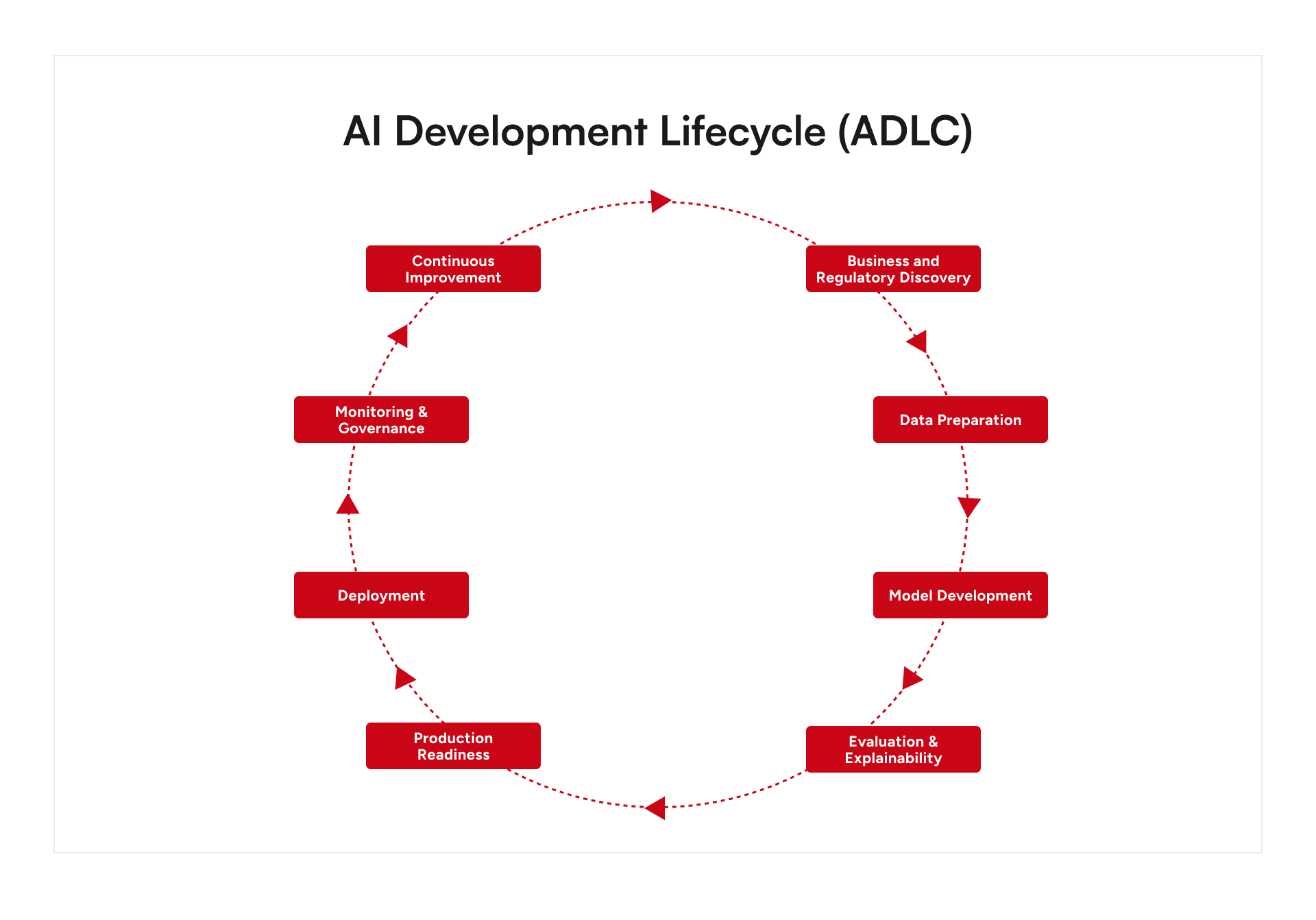
At GeekyAnts, this philosophy is reflected in our AI Development Lifecycle (ADLC). Rather than treating AI development as an extension of conventional software delivery, ADLC integrates engineering, governance, compliance, and operational readiness into a single delivery framework. The objective is to ensure that production readiness develops alongside model capability instead of becoming a separate phase at the end of the project.
The lifecycle begins by defining the business objective, regulatory context, and measurable success criteria. Data collection and preparation follow with clear governance over data quality, lineage, and access controls. Model development proceeds alongside explainability requirements, evaluation metrics, and documentation standards so that every iteration contributes to both technical performance and regulatory accountability.
Deployment introduces continuous monitoring rather than marking the end of development. Production models are evaluated for performance, model drift, operational reliability, and fairness as customer behavior and market conditions evolve. Governance processes manage approvals, version control, retraining, and rollback strategies to ensure that every change remains transparent and controlled throughout the model's lifecycle.
This structured approach allows engineering teams, compliance specialists, business stakeholders, and operations teams to work within a shared framework. Each group understands its responsibilities, has access to the same operational evidence, and contributes to maintaining production readiness as the platform evolves.
Production AI Reflects Engineering Discipline
Financial institutions have already demonstrated the value of AI across fraud detection, customer onboarding, lending, wealth management, payments, and operational workflows. The next stage of adoption depends on how reliably these systems operate within regulated, high-impact environments.
Production readiness requires a broader standard than model accuracy. Financial institutions must be able to explain significant decisions, trace outputs to the correct model and data version, monitor changes in performance, and demonstrate that appropriate controls operated throughout the decision lifecycle. These capabilities allow teams to investigate unexpected outcomes, respond to regulatory inquiries, and improve models without weakening operational stability.
The organizations making the strongest progress design these controls into the platform from the beginning. Explainability requirements shape model selection. Audit requirements influence event logging and data retention. Human review thresholds guide workflow design. Governance processes define how models are approved, deployed, retrained, and rolled back.
This foundation also prepares financial institutions for evolving regulatory expectations. As AI becomes more deeply embedded in financial products, organizations will need stronger evidence around data use, model behavior, fairness, decision transparency, and accountability. Platforms built around traceability and controlled change can respond to these expectations more efficiently than systems that add governance after deployment.
The same engineering foundation supports long-term innovation. A governed and observable AI platform allows teams to introduce new use cases, evaluate models, update decision policies, and expand across business functions with greater confidence. Each deployment contributes reusable monitoring, audit, data governance, and human oversight capabilities that strengthen future initiatives.
Competitive advantage will increasingly come from the ability to operate AI consistently at scale. Financial institutions that combine intelligent models with disciplined engineering can move from isolated pilots to dependable systems that support customers, compliance teams, business leaders, and regulators.
Conclusion
Production AI in financial services depends on the systems surrounding the model. Explainability, audit trails, data governance, continuous monitoring, human oversight, and controlled model updates turn AI outputs into accountable financial decisions.
Organizations that build these capabilities from the outset create a clearer path from experimentation to production. They can deploy new AI services with greater confidence, adapt to regulatory change, and maintain trust as models, markets, and customer expectations evolve.