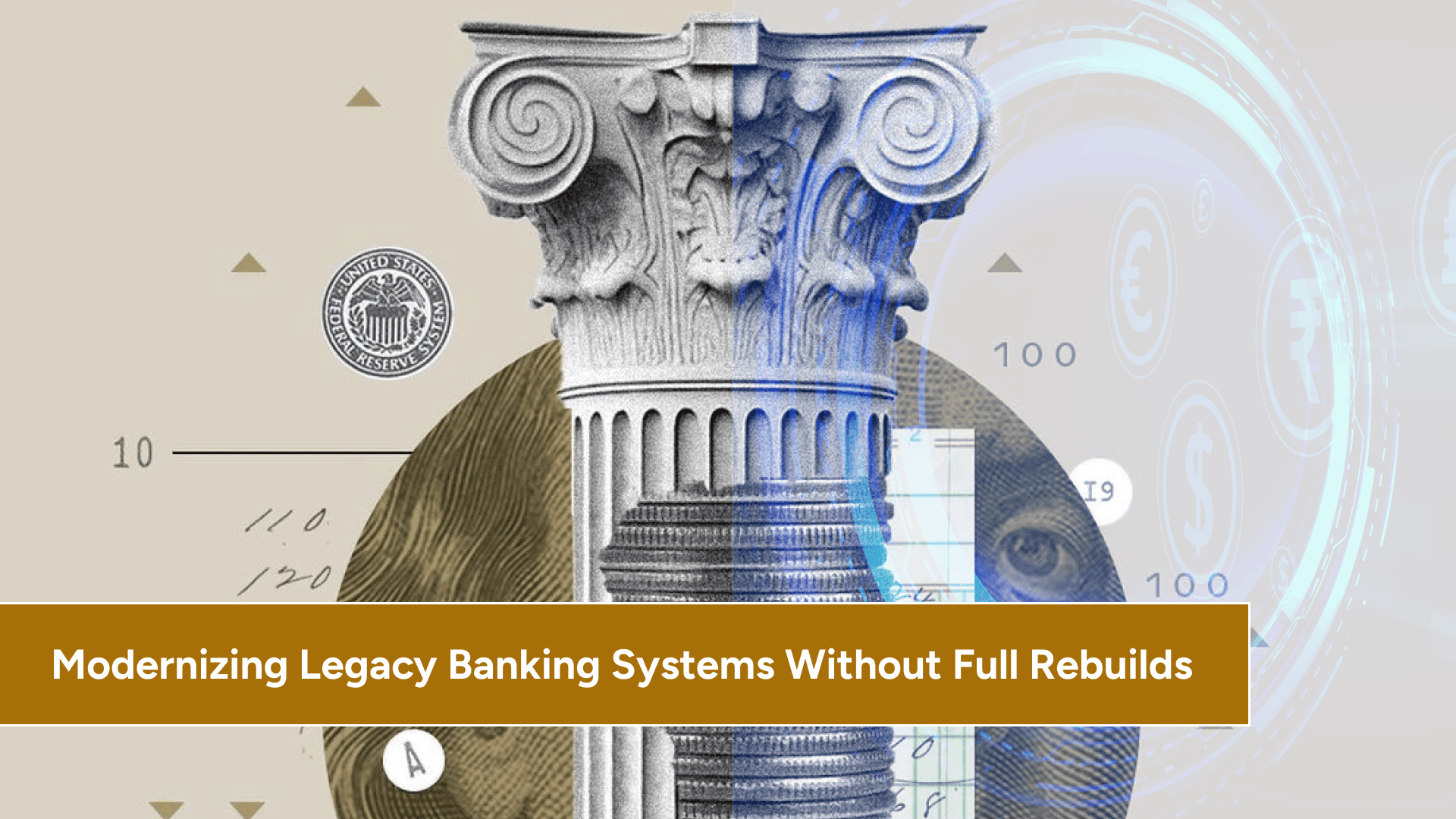

Most core banking systems in the United States were built between the 1960s and 1980s. They run on COBOL, a programming language that predates the internet, and were designed for batch processing, where transactions get queued and processed in groups rather than in real time. Today, 90% of US banking core software is classified as legacy. Banks spend 78% of their IT budgets keeping these systems operational, which leaves very little room to build anything new.
Full system replacements carry risks that most banks are not positioned to absorb. TSB Bank's 2018 core migration locked out 1.9 million customers for days and cost the bank over $416 million in total. For institutions processing millions of transactions daily, that level of disruption is not acceptable. Working around the core rather than replacing it has become the standard approach, and fintech companies have built the infrastructure to support it.
The Real Cost of Staying Still
Maintaining legacy systems costs US banks more than most technology budgets reflect. COBOL programmers charge between $200 and $250 per hour compared to $90 per hour for developers on modern stacks, according to CARITech's 2025 analysis, and that gap widens as the existing pool of COBOL engineers shrinks through retirement. Industry research indicates that engineering graduates today have little interest in working on decades-old systems, making the talent shortage around legacy platforms increasingly difficult to address over time.
The operational constraints are where the pressure becomes most visible. Legacy cores were built for overnight batch runs. As of 2025, only 49% of US banks offered real-time payments, while fintechs and neobanks had made it a baseline feature years earlier. Launching a new product that touches the core can take months of internal development. Boston Consulting Group projected that without modernization, the average bank's cost-to-income ratio could climb to 74% by 2030, up from 63% in 2023.
IBM's 2024 Cost of a Data Breach Report put the average financial sector breach at $6.08 million. Banks on outdated infrastructure face three times more attack attempts than those running on modern platforms.
How Banks Are Modernizing Without Pulling the Core Out
Banks making real progress share one thing: they did not attempt to replace their core all at once. Three patterns have gained traction, each suited to a different risk appetite and starting point.
API Wrapping
API wrapping introduces a modern interface layer in front of the legacy core. Mobile applications, third-party services, and fintech integrations communicate with this layer instead of connecting directly to the core system. The legacy platform continues processing transactions as usual, while the new layer exposes standardized APIs for external consumption. This approach enables faster integration and digital channel expansion without modifying the underlying codebase or disrupting operations. However, it does not reduce the complexity or maintenance burden of the legacy system itself.
The Strangler Fig Pattern
The strangler fig pattern takes modernization a step further by gradually replacing legacy components with new services. Named after a tree species that grows around its host until the original structure is replaced, this approach allows new services to run alongside the legacy platform. A proxy layer routes requests either to the new service or the legacy system, depending on which component has been modernized and validated. As confidence grows, more traffic shifts to the new architecture. Popularized by Martin Fowler, this method has become a common strategy for large financial institutions that cannot tolerate service disruptions during modernization.
The Sidecar Strategy
The sidecar strategy introduces a modern core platform alongside the existing system but limits its scope to a specific product line, customer segment, or business function. For example, a bank may run a new digital savings product on the modern platform while mortgages and business accounts continue operating on the legacy core. This approach contains risk, allows teams to gain operational experience with new infrastructure, and provides a controlled path for expanding modernization efforts over time.
The Role Fintech Companies Play
A generation of infrastructure-focused fintech companies has built platforms designed to fit into this kind of phased modernization.
Finxact, acquired by Fiserv in 2022, provides a cloud-native core that banks can deploy for specific products without touching their primary system. Thought Machine's Vault platform processes transactions in real time and has been adopted by Standard Chartered and Lloyds for parallel operations. Mambu offers a composable banking platform, meaning banks can configure it through APIs and add a single product line without a large internal build.
The dynamic is consistent across these partnerships. Traditional banks bring customer relationships, regulatory standing, and existing deposits. Fintech companies bring the modern architecture. McKinsey's review of 150 banking transformation projects found that banks using fintech-built platforms finished their migrations 40% faster and at 30% lower cost than those working with traditional IT vendors.
Choosing the right migration approach is only part of the challenge; executing it successfully is where many modernization programs struggle. Teams need engineers who understand both the constraints of the legacy system and the architecture being built around it. That combination is harder to find than many banks expect, and the resulting skill gaps often become apparent midway through migration efforts.
Legacy banking modernization succeeds through incremental progress rather than large-scale replacement efforts. Each completed component reduces maintenance overhead and opens up capabilities that were not possible before. The banks making the most progress are making a series of smaller changes, each one lowering risk for the next.
GeekyAnts works with financial services teams on this kind of incremental work, from API integration layers to full component migrations. If your team is planning the next phase of a core banking transformation, we can help you move without disrupting what is already running.