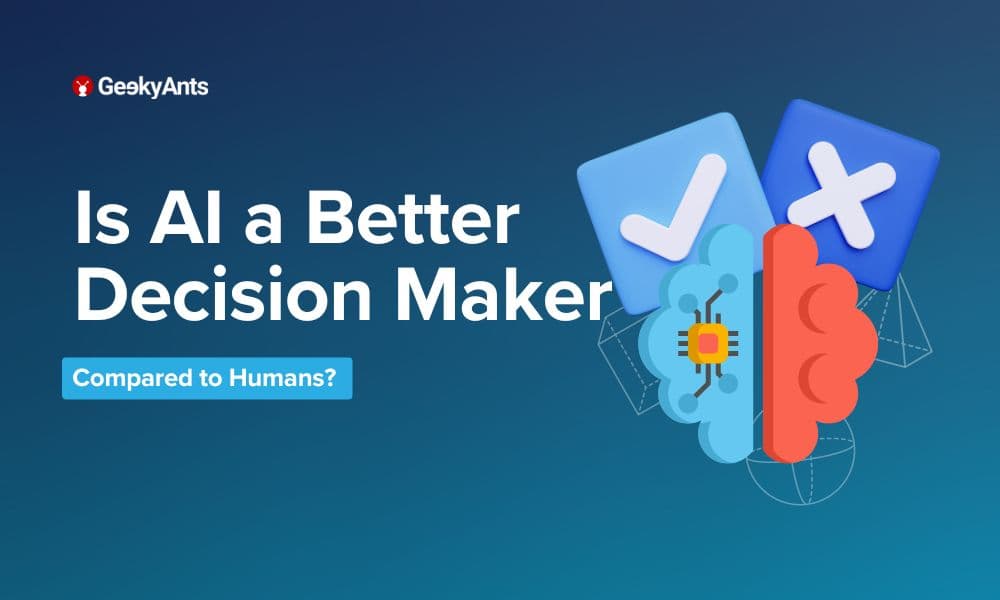

In the era of Artificial Intelligence, which continues to positively affect various aspects of our lives, the most critical question is: Can AI make decisions better than humans?
AI-based systems offer commendable speed and efficiency and can process vast amounts of data, but the ethical grounds for their decision-making capabilities need to be studied.
At GeekyAnts, we are committed to using AI responsibly and ethically, ensuring that technology serves our clients and their users in the best possible way.
The Ethical Considerations of AI Decision-Making
Fairness
We always have one big question with respect to AI - can it make decisions which are unbiased?
The answer depends totally on the data provided to the AI models, and the key is to provide unbiased data. AI models learn continuously from the data provided and if there is even a minor amount of unrepresentative or biased data, AI will mostly perpetuate these biases which will snowball into major concerns like discrimination against any group.
Transparency
AI-based decisions can at times lack transparency leaving those who are affected very confused. Providing the right explanations for the decisions made by AI is important by making the processes clear and understandable. Also, any potential flaws can be identified and trust can be built.
Privacy
Relying on AI based systems with large amounts of data also means relying the system with a lot of confidential and sensitive information. It is to be made sure that the data processed by the AI is utlized responsibly and any misuse should be prevented. Also, the AI models should be made to comply with all the data privacy rules and regulations.
Accountability
Individuals or organizations who develop, deploy and manage AI systems should take the accountability of the outcomes which may involve constantly improving the performance, biases (if any) or incorrect data. They should make sure that the AI systems learns and improves according to the new data sets. Accountability ensures that there is a human supervision overseeing AI actions, which is important for ethical decision-making.
How to Manage Ethical Concerns
To address these ethical challenges, several steps can be taken:
- Diversify Training Data: Use datasets that are representative of all segments of the population to minimize biases. This might involve collecting new data to fill gaps in existing datasets.
- Ethical Frameworks: Implement guidelines and standards for AI system development that prioritize ethical grounds. This should also include regular monitoring and auditing.
- Continuous learning and unlearning: AI systems should be built to evolve according to the data over time. Regular data updates and training can help to detect and correct biases and manipulation early.
Key Elements of Ethical AI
- Protection of Individual Rights: AI models should consider personal freedoms, including privacy rights and equal treatment of all users.
- Non-Discrimination: Developers must strive to eliminate biases in AI solutions against any culture, group, ethnicity etc.
- Continuous Improvement: Ethical AI isn't a one-time achievement but an ongoing process. Teams should remain vigilant, ready to address new ethical dilemmas as they arise, and commit to regular system updates.
GeekyAnts’s commitment to Ethical AI
We, at GeekyAnts, are early adoptors in this era of Generative AI and we understand the immense potential of AI to transform industries and improve lives. However, we also understand the responsibility that comes with leveraging such powerful technology:
- Responsible Development: We prioritize and commit fairness, transparency, and accountability in all our AI projects.
- Data Integrity: We ensure that the data used in our AI systems is collected ethically and used in compliance with all privacy regulations.
- Continuous Oversight: Our teams are dedicated to monitoring AI performance, ready to make adjustments to address any ethical concerns promptly.
Conclusion
AI can make better decisions than humans in many contexts, but this doesn't mean Ai is better than human intelligence. Making AI take ethically right decisions is of course difficult but if we focus on fairness, transparency, privacy, and accountability, we can guide AI development in a direction that leads to the digital transformation of the world. At GeekyAnts, we're proud to be part of this important journey towards responsible and ethical AI.