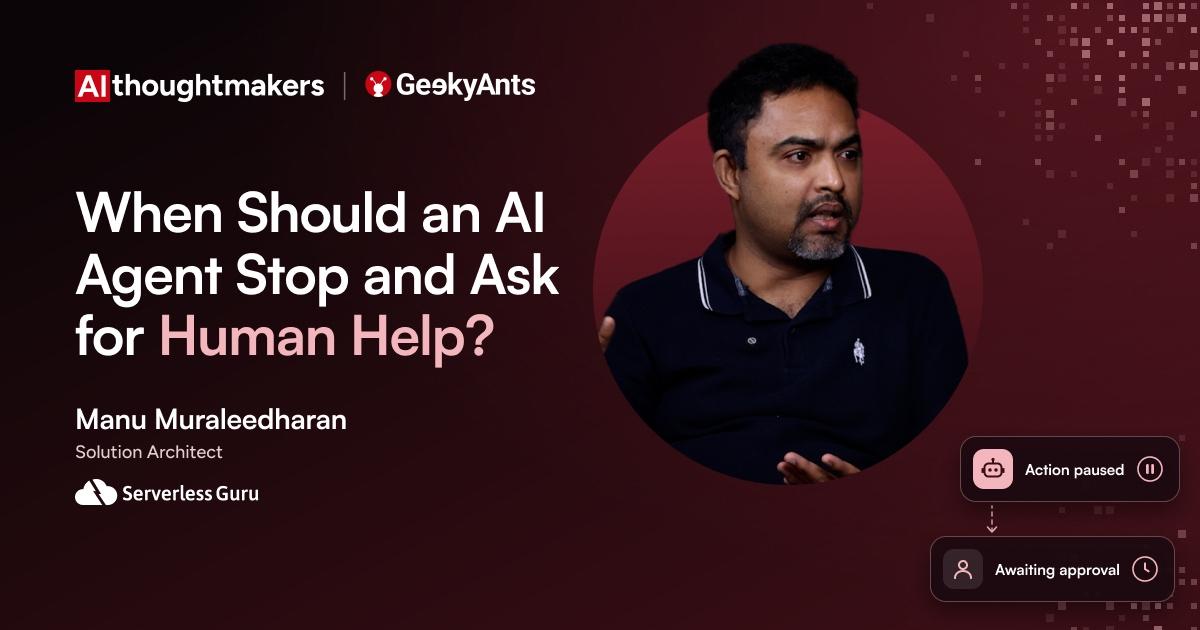


Editor's Note: This blog is adapted from an episode of the AI ThoughtMakers podcast featuring Manu, Solution Architect at Serverless Guru, in conversation with host Prem Goswami. With more than 20 years of experience in software engineering, over eight years in cloud architecture, and recent work in AI, Manu explains why AI agents need to know when not to act.
AI Agents Can Complete Tasks. But Can They Recognize When to Stop?
Give an AI agent access to your calendar, email, and business systems, and it can handle several tasks without waiting for instructions at every step. The agent can send an email, schedule a meeting, update a record, or attempt to fix an issue in the software system.
Completing an instruction does not necessarily mean an AI agent has made the right decision.
Manu and his team explored how AI could identify and fix issues in DevOps and data pipelines before they became larger problems. Their experience showed that an agent should not always act as soon as it detects an issue. Sometimes, it needs to recognize when it lacks the information or context to proceed.
Watch the full discussion on the AI ThoughtMakers podcast:
Why Does Task Completion Make AI Agents More Likely to Act?
Most AI systems are trained and evaluated around task completion. They receive an instruction and are expected to produce an outcome. This makes it difficult to teach an agent that stopping can be the correct response. If an AI agent is asked to resolve an issue in a company's data pipeline, it identifies a possible cause and has access to the tools needed to change the database. From a task-completion perspective, making that change looks like progress.
Manu gives the example of an agent attempting to fix a data pipeline by changing a database data type. Such a change could have consequences that the agent has not considered, particularly if it lacks the context needed to understand the system. The agent may fix one problem while creating another, particularly when it does not understand how the change could affect connected systems.
The problem is that the agent can have the tools to complete a task without understanding the wider consequences of using them. This is why task completion alone is not a reliable measure of whether an agent has made the right decision.
Can AI Recognize When a Decision Needs Human Intervention?
Manu identifies three factors that should determine whether an agent can act independently: the stakes involved, whether the action can be reversed, and how confident the agent is in its decision. If any one of these factors raises concern, the agent should pause and involve a human. Three situations show why an agent sometimes needs to stop and involve a person.
1. High-stakes decisions: An AI agent can screen resumes, organize applications, and flag gaps in a candidate's experience. However, deciding whether someone should be hired affects that person's career. Manu believes the final hiring decision should remain with a human.
2. Actions that are difficult to reverse: Before deleting records or making a permanent change to a live system, an agent should check whether the action can be undone. If the consequences cannot be reversed easily, it should seek human approval before proceeding.
3. Low confidence: An agent may have access to the tools needed to complete a task but still lack enough information to make a reliable decision. Instead of guessing or proceeding with incomplete information, it should flag the uncertainty and ask for human review.
Should AI Agents Be Able to Say "I Don't Know"?
An AI agent should be able to recognize uncertainty and ask for clarification instead of treating every instruction as something it must complete.
Manu uses weather forecasts to explain uncertainty quantification. When a forecast predicts a 50% chance of rain in Bengaluru, it communicates the probability of rain rather than promising a particular outcome. People can use that prediction to decide whether to carry an umbrella or change their plans. AI agents can use confidence estimates to make uncertainty more visible. Before acting, an agent should assess how certain it is about the available information and likely outcome. If its confidence is low, it should flag the uncertainty and ask for clarification.
However, a confidence score should not be treated as proof that a decision is correct. An agent can be confident and still lack important context. Its confidence needs to be considered alongside the consequences of the action and the information available.
How Do Permission Layers Prevent AI Agents From Taking Unauthorized Actions?
Even when an agent recognizes that it should not take an action, technical controls must enforce that boundary. Without permission restrictions, an agent could still access systems and tools beyond its assigned role. Manu explains this through the principle of least privilege. An agent should receive only the permissions it needs to perform its assigned work.
For example, an agent might have write access to a development instance but no access to a fraud instance. Even if it attempts to access the restricted instance, the permission controls prevent it from making changes. Manu also describes the need for an interception or guardrail layer. This layer checks an action before it is executed and determines whether the agent is allowed to perform it in that situation.
These controls serve different purposes:
- Permission controls define which tools, systems, and actions an agent can access.
- Guardrails check whether a proposed action is valid and appropriate before execution.
Manu points to Amazon Bedrock as an example of permission-based access. An agent can operate through an IAM role whose attached policies specify which AWS resources and actions it can access.
Can AI Handle 90% of the Work While Humans Make the Final Decision?
Manu expects AI to handle most routine tasks while people take over when a decision needs context, judgment, or closer review. He uses the 90/10 split to illustrate this approach.
Consider a loan processing workflow. An AI agent can collect applicant details, check credit scores, identify missing documents, and compare applications against predefined lending criteria. These repeatable tasks can be handled within the limits set by the organization.
Applications that fall outside those limits or require closer examination can be referred to a human decision-maker. The agent can organize the relevant information and prepare the case for review without making the final decision.
When Can an AI Agent Approve a Loan Without Human Review?
The answer depends on the lending rules, the applicant's circumstances, and the limits set by the organization. Manu explains that businesses can allow an agent to approve loans below a defined limit when applicants meet its lending conditions, such as having a suitable credit score. The approval threshold and qualifying conditions must be established by the organization and its domain experts.
Human review becomes necessary when a loan exceeds that limit or an application contains factors that need further examination. A low credit score, missing details, or unusual financial circumstances could require a domain expert to review the case.
He stresses that domain experts must define the conditions for automated loan approval. They determine which applications meet the required criteria and which need human review. The agent can then process applications within those predefined rules. So businesses should build AI systems they can control rather than trust blindly.
Why Should CEOs Measure AI by Business Impact, Not Volume?
Imagine a CEO asking the technology team to make an AI agent take as many decisions as possible. The assumption is that more automated decisions will reduce manual work and speed up operations. The speaker challenges this way of measuring progress. He compares it to evaluating software engineers by the number of lines of code they write. A higher line count does not establish that an engineer has solved the right problem.
The same applies to AI agents. The number of decisions an agent makes says little about their value. CEOs should instead assess whether those decisions support business goals and stay within the rules defined for the agent.
For example, an agent that schedules meetings, sends routine updates, and organizes records within its permissions may be working as intended. An agent that changes customer bank details or approves a high-value loan without the required checks is crossing a different boundary. A useful AI agent is the one that acts within its assigned permissions and recognizes when a decision needs human involvement. The speaker draws a firm boundary here - AI should never independently make a decision that irreversibly affects a person.
What Happens When an AI Agent Refuses to Follow an Instruction?
An agent that refuses an instruction may appear less capable than one that completes every request. Manu shares an example that shows why refusal can be an important part of responsible AI behavior. His team was building a tool to collect and analyze information from the web. During the process, the agent identified four actions it could perform but refused a fifth.
He welcomed the refusal because the agent recognized that following the instruction would violate the website's terms and conditions. This matters because not every user instruction should be treated as permission to proceed. An agent may receive a request that conflicts with company policies, access restrictions, or the terms governing an external service. In such cases, refusing the action is more useful than completing it without considering the consequences.
The ability to say no should therefore be treated as part of an agent's responsibilities, not as a failure to complete its task.
Will AI Agents Have More Freedom or Stronger Human Oversight in the Future?
Businesses are becoming more deliberate about the autonomy they give AI agents. As agents improve, they can handle more routine, high-volume activities while remaining restricted from decisions that require human judgment.
An agent may have the technical ability to perform an action but still be restricted from doing so because of business rules or the risks involved. This allows businesses to expand automation without giving agents unrestricted control over entire workflows.
Conclusion
Manu's discussion highlights an approach to AI autonomy, where the agents need to recognize uncertainty, assess the consequences of their actions, operate within defined permissions, and involve humans when a decision exceeds their boundaries.
Businesses need to decide which tasks AI can handle independently and which decisions require human involvement. As Manu puts it, the principle is pretty simple, which is to take the agent into your team but verify and then trust. Explore GeekyAnts' AI Development Services to learn how AI agents can be built into business processes with the right controls and human review.