

BFF services act as a middle layer between the frontend and backend systems, optimizing performance and enhancing user experience.
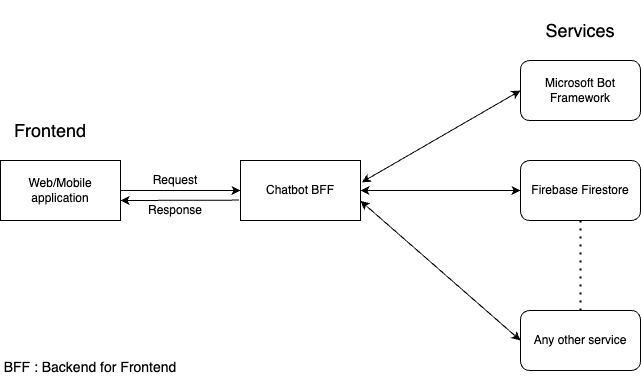
Imagine a scenario where you must build a chatbot application using a third-party service. You may have services like Microsoft Bot Framework, Firebase Firestore, etc. The services expose APIs/functions for the front-end.
Let's get started

However, the data returned to the frontend by the services may not be formatted or filtered according to the exact way the frontend needs to represent them.
In that case, the frontend needs to have some logic on its own to re-format these data. Having such logic in the frontend will use up more browser resources.
In a situation like this, we can use a BFF in order to shift some of this front-end logic to an intermediate layer. The intermediate layer is the BFF. When a frontend requests some data, it will call an API in the BFF.
The BFF will do the following.
- Call the relevant service APIs and obtain the needed data
- Format the data based on the frontend representation
- Send the formatted data to the frontend
As a result, there will be minimal logic on the frontend. Therefore, a BFF helps to streamline data representation and takes up the responsibility of providing a well-focused interface for the frontend.
Will this increase latency?
Now we know that a BFF is similar to a proxy server between the client and other external APIs, services, etc. If the request has to go through another component, it will definitely increase latency. However, the BFF latency is negligible compared to the browser’s high resource usage if it needs to work with multiple services not optimized for the frontend.
Building a BFF allows you to intelligently make batch calls to other backends/ services and return the data all at once or return a more convenient representation by transforming and formatting the data.
This can be very useful for mobile clients on 2G or 3G networks, where establishing the connection can take seconds (or more).
Relevance of BFF in Frontend Development
The concept of BFFs is highly relevant to front-end development for several reasons. Firstly, the BFF architecture simplifies the frontend codebase, as developers don't have to write complex logic to retrieve and manipulate data from multiple backend services. Secondly, BFFs allow for faster development cycles, as changes in the frontend can be mirrored in the BFF without affecting other parts of the system. Lastly, BFFs enable front-end developers to control data shaping, which can greatly enhance the performance of the front-end application.
When to use a BFF for your applications?
Like many other patterns, using the BFF in your application depends on the context and the architecture you plan to follow. For example, a BFF is unnecessary if your application is a simple monolithic app. It will add little to no value.
However, suppose your application depends on microservices and consumes many external APIs and other services. In that case, it is better to use a BFF to streamline the data flow and introduce a lot of efficiency to your application.
Further, if your application needs to develop an optimized backend for a specific frontend interface or your clients need to consume data that requires significant aggregation on the backend, BFF is a suitable option.
Choosing the exemplary BFF service for your project
When selecting a BFF service for your front-end development project, it's crucial to consider factors like scalability, flexibility, and compatibility with your existing tech stack. Look for features such as cache management, load balancing, and support for different data formats. Additionally, consider the level of customization and ease of integration offered by the BFF service. Stay informed for more insights on optimizing BFF services in your development projects.
Best practices for implementing BFF services
What we have seen so far has been amazing! However, are BFFs fault-proof?
The answer is NO! Like every other technology or pattern, even BFFs have pitfalls. To avoid these, we have to follow best practices.
- Avoid implementing a BFF with self-contained all-inclusive APIs — Your self-contained APIs should be in the backend layer. Most developers forget this and also start implementing service-level APIs in the BFF. Remember that the BFF is a translation layer between the client and the services. When data is returned from a service API, it transforms it into the data type specified by the client application.
- Avoid BFF logic duplication —A vital note is that a single BFF should cater to a specific user experience, not a device type. For example, most of the time, all mobile devices (iOS, Android, etc.) share the same user experience. In that case, one BFF for all these operating systems is sufficient. There is no need to have a separate BFF for iOS and another for Android.
- Avoid over-relying on BFFs—A BFF is merely a translation layer. Yes, it provides a certain level of security to the application. But you should not rely on it more than you should. Your API layer and frontend layer should take care of all the functionality and security aspects regardless of the presence of a BFF. The BFF is supposed to fill a gap, not add any functionality or service to the application.
Conclusion
In conclusion, BFFs are a vital cog in the machinery of front-end development. Their adoption helps streamline development processes, enhance frontend performance, and ultimately lead to a much-improved user experience. As we move towards more complex and user-centric applications, the role of BFFs in front-end development is set to become even more significant.