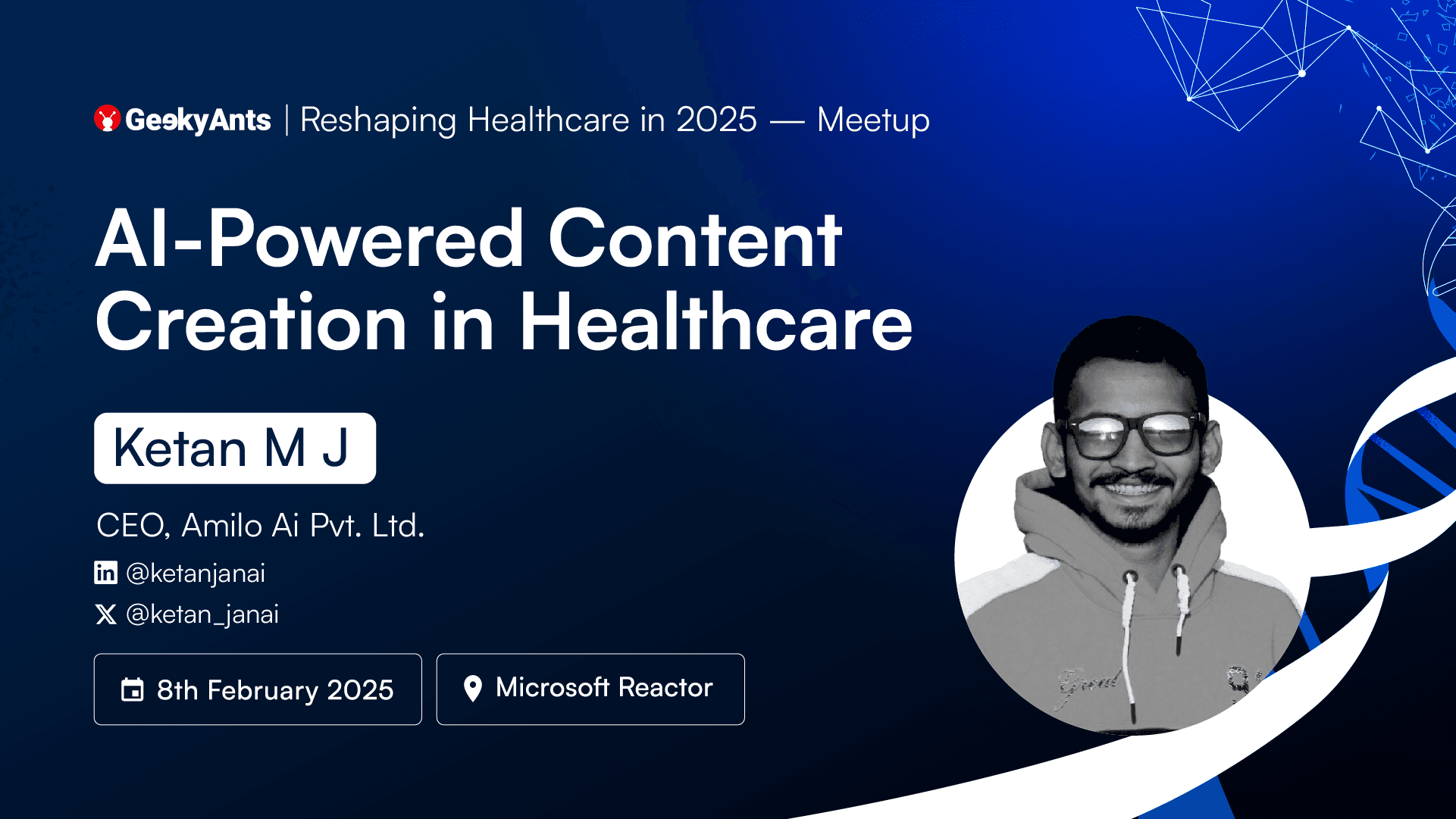

Editor’s Note: This blog is an adapted transcript of Ketan MJ's talk at the GeekyAnts Healthcare AI Meetup. Ketan, the CEO of Amilo AI Pvt. Ltd., explored the role of AI in automating content creation in the healthcare sector. While refined for clarity and brevity, this transcript captures the depth and essence of the session.
The Growing Need for AI in Content Creation
Good afternoon, everyone! It is been an inspiring lineup of talks today, and I am truly amazed to be invited here. In one of the previous discussions, social media was briefly mentioned, touching upon trends. That’s where our work comes in. At Amilo AI, we are both a social media and AI-driven company focused on automating content creation to make the process seamless for users. Content creation, particularly in the healthcare industry, is a daunting task. Doctors and medical practitioners have little to no time to manage digital content. Given these challenges, we are building AI-powered solutions to streamline this process and ensure accurate, timely, and engaging content without exhaustive manual effort.
Currently, content creation is largely a manual task. It involves scripting, shooting, editing, and refining—each step requiring significant time and effort. Even though we handle content for our clients, we struggle to create it for ourselves due to the overwhelming workload. This highlights the core problem we aim to solve: healthcare content creation is slow, tedious, and impractical for busy professionals. Traditional methods simply don’t align with the fast-paced nature of the healthcare sector. This is where AI steps in as a game-changer.
Leveraging AI to Overcome Content Bottlenecks
We are developing AI models that can generate content in mere seconds. Technologies like ChatGPT, Hugging Face’s AI models, and proprietary AI engines are being integrated into our platform. These tools will significantly reduce the time required for editing and publishing healthcare content. What currently takes hours or even days will be completed within 30 seconds. However, speed isn’t the only issue—we must also ensure that medical content is accurate and reliable.
Social media platforms are flooded with misinformation. Instagram, for example, is often full of low-quality content, and while AI has made great strides, it cannot still filter and rectify misleading information effectively. Our AI solutions add an extra layer of validation, ensuring that the content aligns with medical standards. The need for moderation is immense, especially in health-related fields where misinformation can have serious consequences. The recent ban on TikTok demonstrates how unregulated content can spiral out of control. This is why we emphasize AI-driven verification to ensure only credible, accurate information is disseminated.
AI-Driven Content Optimization
Creating social media content for healthcare professionals involves multiple formats, from videos and banners to carousels and interactive posts. Our AI automates the entire process, making content creation more accessible. Today, we are fortunate to have advanced AI capabilities that were simply not feasible decades ago. Although AI as a concept has existed since the late 1950s and 1960s, technological limitations held back its widespread application. Now, with the rapid evolution of machine learning, we can leverage AI to its fullest potential.
We are working with artificial neural networks (ANNs) to optimize content strategies. These networks help predict emerging trends and personalize content based on audience demographics. For instance, AI can tailor content differently for men and women, or even for individuals with specific disabilities. This level of personalization ensures that content is more relevant and engaging. Currently, we are collaborating with several doctors who have social media followings of 50K to 100K. Despite their influence, creating 25 high-quality videos per month remains a significant challenge, requiring a dedicated team of at least five professionals. This underscores the need for AI automation—not just for healthcare professionals but for anyone struggling to create digital content.
Harnessing AI for Scalable Content Solutions
To illustrate our AI-driven approach, consider a case study of a doctor leveraging AI-generated content. Using models like Hugging Face’s AI, we can generate personalized health tips, automate social media campaigns, and optimize engagement strategies. Campaigns no longer need to be manually adjusted every time; instead, AI continuously refines them based on performance metrics. We use artificial neural networks (ANNs) to analyze user interactions, identify successful content patterns, and enhance future campaigns accordingly. By automating these otherwise mundane tasks, we free up valuable time for healthcare professionals, allowing them to focus on patient care rather than content management.
The Power of Neural Networks in Content Optimization
Neural networks are the backbone of our AI-driven content creation. They function similarly to the human brain, processing inputs, identifying patterns, and making decisions based on past data. Artificial neural networks have been around for decades, but their practical applications have only recently gained traction. Through deep learning and backpropagation, our AI continually refines its accuracy. The AI isn’t just generating content—it’s learning and improving with every iteration.
For instance, in a simple neural network, an input image might go through multiple hidden layers where the system adjusts weights and biases to improve accuracy. This process repeats until the AI correctly classifies the content. If an AI model misclassifies a circular image as a square, backpropagation helps correct the error, enhancing precision over time. This approach ensures that AI-generated healthcare content is not just fast but also accurate and reliable.
The Future of AI in Healthcare Content Creation
As we look ahead, AI will play a pivotal role in real-time healthcare communication. From providing instant health assistance to generating timely updates during public health crises, AI-driven solutions will revolutionize content dissemination. Social media platforms can be leveraged to spread critical health messages, but the challenge lies in preventing the spread of misinformation. AI validation mechanisms will ensure that only accurate, fact-checked information reaches the public.
To put AI’s impact into perspective, let’s take a quick challenge. Consider two images—one real, one AI-generated. Can you tell the difference? The reality is that AI-generated visuals are becoming so refined that even experts struggle to differentiate them from real photographs. This accuracy, while impressive, raises important ethical concerns. The scientific community is still grappling with the complexities of AI’s decision-making processes. Some believe quantum computing may hold the key to solving these challenges, but for now, AI remains an evolving field that requires careful oversight.
Final Thoughts
AI is not here to replace humans—it is here to assist and enhance our capabilities. Whether for doctors, content creators, or businesses, AI can act as a powerful companion that simplifies complex tasks. It provides personal assistance, reduces workloads, and enhances efficiency. As we continue to develop AI-driven solutions, our goal is to ensure that technology serves everyone, not just a select few. At Amilo AI, we are committed to open-source development, making our innovations accessible to the wider community.
For those interested in working on AI-driven healthcare content solutions, we are actively looking for interns and collaborators. If this field excites you, feel free to connect with me on LinkedIn. Thank you for your time, and I hope this talk has provided valuable insights into the future of AI-powered content creation in healthcare.